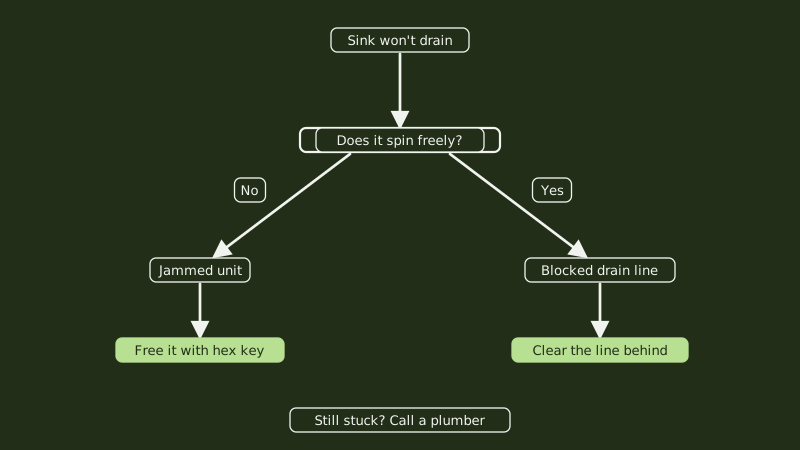
Cut the power, then work out what kind of trouble you have. If the disposal hums and the blades do not turn, something is wedged in the grinder: free it with a hex key from underneath. If the blades whirl without trouble yet the basin stays full, the blockage lies downstream, in the trap or the pipe past it. This page belongs with our wider coverage of drain cleaning and clogs.
Kitchen drains clog differently from bathroom ones. Grease, starch and stringy scraps combine into a paste that sticks, so the fix often means opening a trap, with a pail and a wrench within reach.
Is the disposal jammed, or is the line behind it blocked?
Listen first. A hum with no spinning, or silence with the switch on, means a jam or a tripped overload. A normal whirring noise with slow or standing water means the drain beyond the disposal is blocked. Gurgling or water rising in the second sink bowl also points to a line clog.
Compare what you see against this list:
| What you notice | Likely cause | First move |
|---|---|---|
| Hum, no spin | Object jammed in the grinder | Power off, turn the blades by hand |
| Nothing at all | Tripped reset button or breaker | Press the red reset on the bottom |
| Spins, sink fills | Clog in the trap or line | Clear the trap, then plunge |
| Water comes up in the other bowl | Shared drain clogged | Clear the trap arm, then the wall stub |
| Water leaks from the unit | Seal or fitting failed | Replacement, not a clog |
The overload reset is a small button on the underside. Many units trip when they jam, then refuse to start until it is pressed. Give the motor a few minutes to cool before you press it.
How do you free a jammed garbage disposal safely?
Flick the wall switch off, then unplug the disposal or trip its breaker, so nothing can start it while you work. Slot a hex key into the center socket on the underside and rock it back and forth until the blades move easily. Pull out the culprit with tongs, then press the reset.
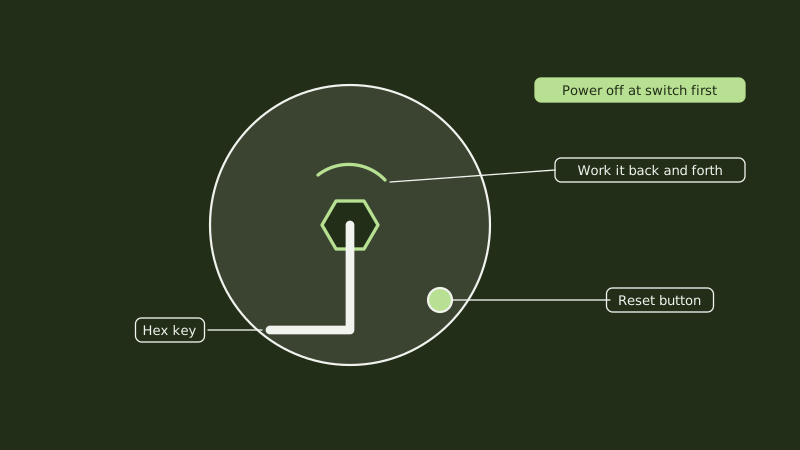
Never put fingers into the opening, even when the power is off, and never trust a wall switch alone. The grinder on most units is a turntable with impeller lugs, not sharp knives, but a motor that suddenly starts can still crush a hand.
Steps that work:
- Switch off, then remove power at the panel or the plug.
- Aim a flashlight down the opening and hunt for a spoon, bottle cap, fruit pit or bone.
- Seat the hex key from below and rock it until the turntable spins. With no socket on your unit, press a broom handle against a blade from above.
- Lift out the object with pliers or tongs.
- Restore power, press reset, run cold water and test.
Wikipedia's description of the appliance mentions this: a stuck unit can usually be freed by turning the turntable from above or the motor from below.
How do you clear the clog beyond the disposal?
Set a pail below the trap, undo its slip nuts, and pour the contents out. Check the arm leading into the wall and wipe out the grease. Rinse the parts in the yard or a utility sink, reassemble with the washers seated, and run water to test. Most kitchen clogs live in the trap, and emptying it takes roughly ten minutes.
With a clean trap and water still standing, thread a hand auger into the wall stub. Kitchen clogs are usually grease, starch and coffee grounds that harden. Go slowly, because pipe in many Santa Ana houses from before the 1960s is old steel or cast iron, and a hard push can crack a joint.
Reassemble with care. A slip nut that is cross-threaded leaks quietly and swells cabinet floors over weeks. Dry-fit the pieces first, and check for drips after ten minutes of running water.
For a broader walk-through that is not specific to disposals, see unclogging a kitchen sink.
Can you plunge a disposal, and what about the dishwasher?
Yes, but plug the second sink bowl first, or the pressure escapes there. Add a few fingers of water, seat a cup plunger flat over the disposal opening, and pump hard. The dishwasher hose also ties into the disposal, so a blockage can push murky water back toward the dishwasher.
A dishwasher left holding gray water after a cycle points at the disposal side first. A small cause hides there: a fresh disposal ships with a plastic knockout plug at the dishwasher inlet, and someone must punch it out. Leave it in and the dishwasher has no way to drain.
A high loop in the dishwasher hose, or an air gap on the counter, exists to keep sink water out. A hose that droops below the sink drain invites backflow.
Why do disposal drains clog, and what should stay out?
Grease cools and lines the pipe, starch swells into paste, and stringy scraps like celery or corn husks wind into ropes. Coffee grounds settle in the trap. Over months, that buildup shrinks the pipe. Keep grease, pasta, rice, potato peels and bones out, and let a good flow of cold water run during use.
Scrape fats into a jar and bin it rather than rinsing them down. Hot water melts grease long enough to carry it downstream, where it cools and sticks again, often in the main kitchen line under the slab. Santa Ana's hard water leaves mineral scale on top of that film, so old kitchen drains narrow faster than people expect.
Leave the cold tap on for another ten or fifteen seconds after the grinding stops. That flushes pieces past the trap while they are still moving.
Do chemical cleaners, ice and citrus peels help?
Chemical cleaners are a poor choice. Poison Control warns they can cause severe burns, and the New Jersey Department of Health notes that combining products can give off toxic fumes. They also sit in a trap you may need to open. Ice and citrus peels freshen a disposal but do not clear a real clog.
Ice cubes knock loose some residue on the grinder, and citrus leaves a pleasant smell. Neither removes a grease plug. Already poured one in? Say so to anyone who opens the trap, and wear splash goggles and gloves yourself.
Enzyme products work slowly and gently. They suit monthly upkeep and spare the seals. For stubborn buildup, see which home remedies for clogged drains help.
When does a kitchen drain need a plumber?
Call when the clog returns in days, when the sink and the dishwasher both back up, when water emerges from a floor drain or cleanout outside, or when the disposal leaks. A heavy grease coat in the main kitchen line may need a machine, or hydro jetting, which blasts the pipe wall clean with pressurized water.
A plumber's camera shows whether grease or a cracked pipe is behind it, and a leaking housing means a new disposal. Pricing is covered under unclogging a sink, and the swap itself under garbage disposal installation.
To set up a visit, give the symptoms and the start date on the price request form. Browse the full list of trades on the Santa Ana Plumbing Co home page.
Common questions
Why does my disposal hum and not spin?
A hum means the motor is powered but the blades cannot turn, which usually means a jam. Switch it off, cut the power, and turn the blades by hand with a hex key from underneath. If nothing was wedged, the motor may be worn. A unit that hums again right after a clear jam, or smells burnt, is due for replacement.
Should a cable be pushed through the disposal itself?
Better to take off the trap and snake the wall pipe than to feed a cable through the unit, where it can scratch the housing or snag the impellers. Cut the power first. Should you go through the unit anyway, move slowly and stop when the cable binds, since forcing it can damage the grinder.
How can I keep the disposal from clogging again?
Let cold water run hard during grinding and a quarter-minute beyond it. Scrape grease into the trash. Feed scraps in small amounts instead of a bowl at a time. Skip fibrous and starchy items. Clean the trap once or twice a year if the sink drains slowly, which prevents the paste from building.
Will a clog in the disposal damage the dishwasher?
It can. Backed-up water can flow into the dishwasher through the drain hose and leave dirty water standing after a cycle. The cure is clearing the clog, checking the knockout plug on a new unit, and making sure the hose has a high loop or air gap. A dishwasher that smells after a clog should be run empty with hot water.
Sources
- Wikipedia, Garbage disposal unit
- Wikipedia, Drain cleaner
- Poison Control, guidance on chemical drain cleaners (read November 2026)
- New Jersey Department of Health, hazard alert on mixing cleaners
- Published 2026 drain cleaning price guides (national figures, read November 2026)
Last updated