Yes, it can. A softener that is working normally uses extra water every time it cleans its resin, a process called regeneration, and that shows up as a small bump on the bill. A softener that is stuck, mis-set or oversized can use far more. A bill that has leapt, in a home with a softener, is a reason to test the softener first. The wider topic of fitting and sizing one is on our page about plumbing for a water softener installation.
How much extra water does a working softener use?
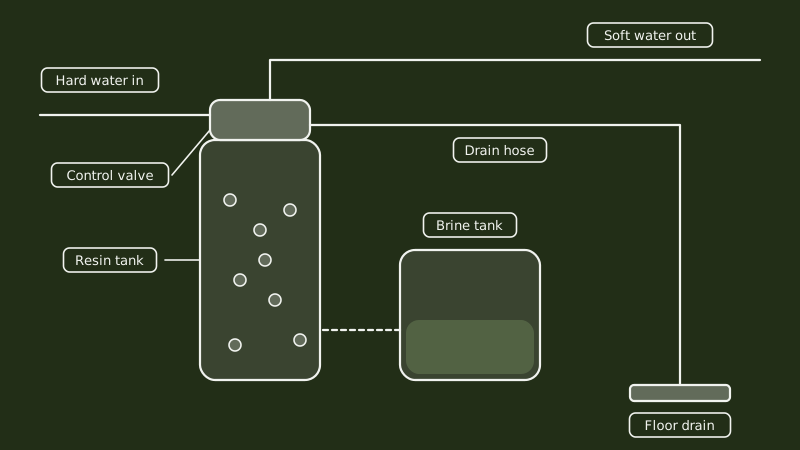
A normal salt-based softener flushes brine through its resin tank to recharge it, and that water goes down the drain. The EPA's WaterSense program says regeneration can use 25 gallons a day or more, and up to 10,000 gallons a year. Its selection guide puts a typical cycle at 20 to 70 gallons, depending on the unit and how often it runs.
Spread across a year, that is a modest slice of household use, so a healthy softener is rarely the reason for a sudden spike. The amount depends on the softener's capacity, how hard your water is and how much you use. An oversized or time-clock unit that regenerates on a fixed schedule whether or not it needs to burns more water than one that regenerates on demand. The EPA recommends demand-initiated models that regenerate based on actual use.
Because the brine goes to the sewer, some utilities bill that water at both the water and sewer rate. Ask your utility how it bills if you want a firm figure.
How hard is Santa Ana water, and does that change how often the softener runs?
Santa Ana's water is hard. The city's water quality FAQ puts hardness at about 250 parts per million, roughly 15 grains per gallon, and says most of the supply is local groundwater and the remainder is imported. Harder water exhausts the resin faster, so a softener in Santa Ana cycles more often than one in a soft-water area.
That makes setting the hardness correctly important. Most softeners ask for a hardness number during setup, and an input that is too high triggers extra cycles. If your unit was installed years ago, or moved from another home, the setting may be off. A softener also reacts to a change in water source, and the city's supply mix can shift. A plumber or the maker's manual can walk through the settings.
The same hardness leaves scale in pipes, fixtures and water heaters, which is why people buy softeners. What scale does, and how to deal with it, is in the guide to removing hard water scale.
What faults make a softener drive up the bill?
A few failures cause a big jump. A valve that sticks mid-cycle can run water through the drain for hours or days. A broken timer or control board can start regeneration every day. A failing seal can let water drain continuously. A leaking brine line or a cracked resin tank adds waste. Any of these can add thousands of gallons in a billing period.
Signs include a drain line that never stops running, a softener that hums or hisses all day, salt use that is far higher than usual, and a water meter creeping round while every tap is shut. A stuck cycle is not a minor fault. Water and sewer charges added together make it costly. If the bill has doubled or worse, a stuck valve is high on the list. Our page on causes of high water bills lists the other usual suspects.
How can you check whether the softener is the cause?
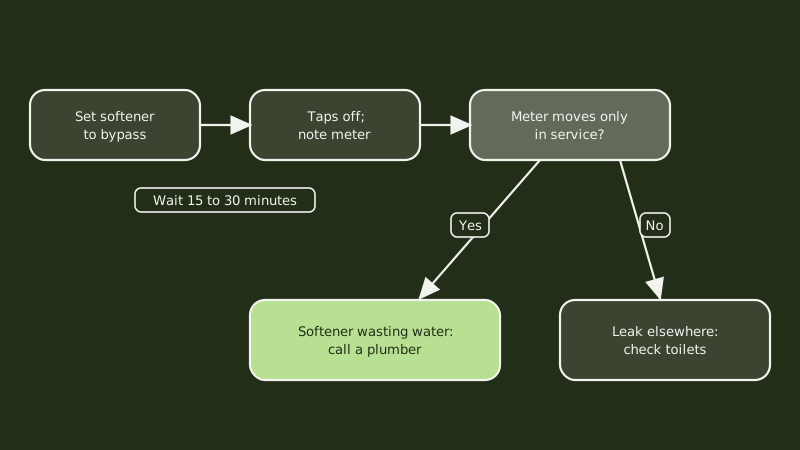
Put the softener into bypass, so water skips it, then watch the meter. Shut every tap, appliance and irrigation zone, jot down the meter reading, give it 15 to 30 minutes, then compare. If the meter stays still moving with the softener bypassed but moves with it in service, the softener is wasting water.
Next, look at the drain line. Find the small hose or pipe that carries brine to a floor drain or standpipe, and listen for water flowing when no one is using the house. A softener in regeneration at night is normal. Water running through that line in the afternoon is not. The control head shows the cycle, and many have a manual regeneration button that you can press to see how a cycle sounds.
If the meter moves even with the softener bypassed, the leak is elsewhere. Check toilets, irrigation and outdoor taps first. The most frequent culprit has its own page: a running toilet.
Can you reduce the water a softener uses?
Yes. Match the unit to the household, and do not oversize it. Choose a demand-initiated unit that regenerates by measured use. Check the hardness setting against the city's figure. Fix leaks in the salt tank and brine line. Replace worn seals when a rebuild is due. The EPA also notes that efficient models use only a few gallons per 1,000 grains of hardness removed.
Where a softener is old and failing repeatedly, replacing it with an efficient model can pay off. Some owners choose a cartridge-based or salt-free conditioner, which uses no regeneration water but does not remove hardness the same way. Whether that suits you depends on what you want the water to do. Costs for fitting a new unit are on the page about water softener system installation cost.
State law is a footnote: California has no statewide ban on salt-based softeners, though local agencies may restrict them under Water Code section 13148 after a formal process. We found no restriction for Santa Ana, but your city or sanitation district can confirm.
When does this become a plumber's job?
Bring in a plumber if the softener runs water nonstop, the valve will not stay shut, the meter moves with the softener bypassed, or there is a leak at the unit. A plumber can bypass or shut off the softener, fix or replace the valve, and check the water meter and plumbing. Softener rebuilds may also be done by a water treatment technician.
A softener connects to the main water line and the drain, so plumbing work is part of fitting or removing one. If you are not sure whether the softener or a pipe is leaking, a plumber can find out in a visit. The quote page is where a visit gets set up.
Common questions
How much water does a softener waste per year?
The EPA says regeneration can use 25 gallons a day or more and up to 10,000 gallons annually. Actual use depends on your unit, your hardness and how much water you use. A demand-initiated softener sized to the household uses less. A stuck or faulty unit can use far more than any of these figures.
What does a softener stuck in regeneration look like?
Listen at the drain line and watch the control head. If water flows from the drain line for much longer than a normal cycle, which normally takes an hour or two, or it flows daily at odd hours, the valve may be stuck. Bypass the softener and check the meter. A plumber or a water treatment technician can service the valve.
Does a softener increase my sewer bill?
It can. The water used in regeneration goes to the sewer. If your utility charges sewer fees on metered water use, that water may be billed twice. Some utilities base sewer charges on winter use. Ask your utility how it calculates your sewer charge before deciding whether a softener's extra water matters.
Is a salt-free system a way to avoid the water use?
A salt-free conditioner does not use regeneration water, so it avoids that extra volume. It changes how scale forms rather than removing hardness. For some households that is enough, and for others it is not. Weigh scale protection against how much you value truly soft water, and ask a plumber which suits your fixtures.
For everything else we cover, start from the Santa Ana Plumbing Co home page.
Sources
- U.S. EPA WaterSense, Cation exchange water softeners (regeneration can use 25 gallons a day or more, up to 10,000 gallons a year)
- U.S. EPA WaterSense, Soften water without wasting it: guide to selecting and maintaining a softener
- City of Santa Ana, water quality FAQ (hardness about 250 ppm, groundwater and imported supply)
- California Water Code section 13148 (local agency authority over salt discharges from softeners)
Last updated