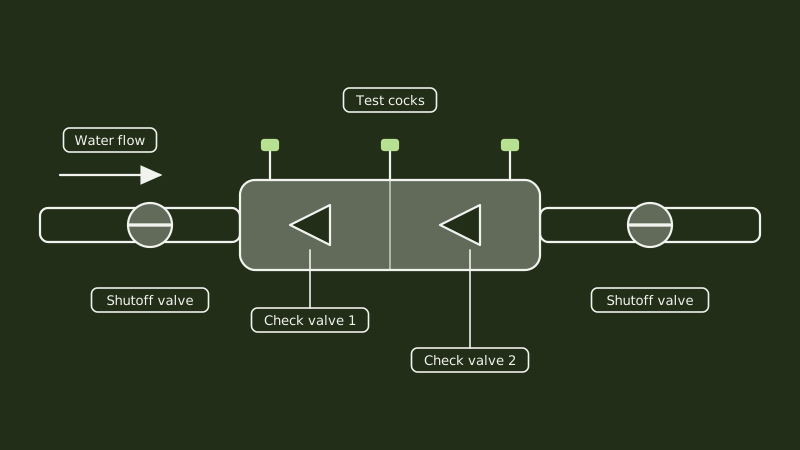
A backflow test confirms that a protective valve set still stops used or dirty water from running backward into the public supply. The State Water Board's cross-connection handbook says these assemblies get a yearly check, performed by someone trained for the task. Gas pipework is a different trade with its own rules. This page covers both, as they come up together when a property owner asks who is allowed to touch what. If you want the full range of services we arrange, start at the Santa Ana Plumbing Co home page.
What is backflow testing, and what does the tester actually do?
Backflow testing is a short pressure check on a backflow prevention assembly, the valve set that keeps irrigation water, boiler water or other non-drinking water from creeping back into the public supply. A gauge goes onto the small test cocks on the assembly, a fixed sequence of steps follows, and the readings show if each check valve and the relief valve seal. Most tests take about half an hour.
A passing assembly gets a report sent, usually to the water provider. A failing one needs work and a second test. Typical repairs are new rubber parts or a rebuilt check valve; a worn-out body is replaced.
The device itself usually sits above ground near the meter or beside the irrigation line, often under a green or silver cover that looks like a small pipe manifold. If your lawn sprinklers run off a dedicated line with a brass assembly in the planter, that is likely one. Backflow prevention assembly testing shows what the hardware looks like.
Who is required to test, and how often?
Annual testing applies to any property whose water provider has flagged a cross-connection hazard. That list typically includes commercial buildings, fire sprinkler feeds, irrigation systems, pools and some larger residential properties. The water provider sends a notice with a due date, and you are responsible for getting the test done and the result filed.
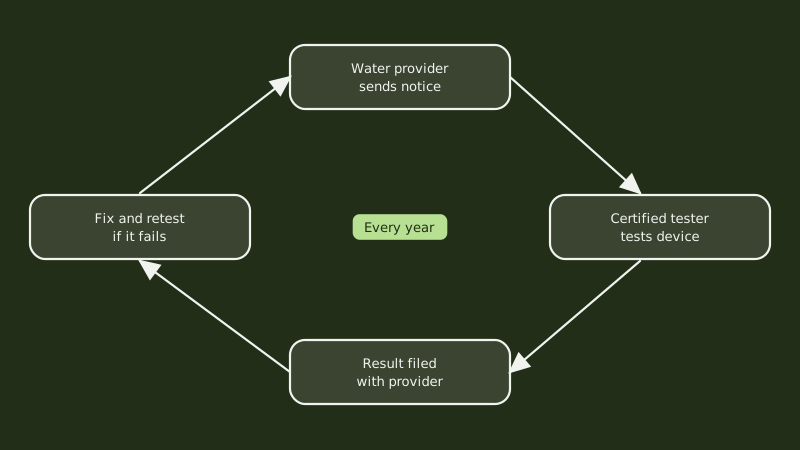
Frequency is at least once a year under the state handbook, and again after installation, relocation or repair. Local water agencies add their own forms and deadlines.
Santa Ana homes are served by the city's own water system in most of the city, so the notice normally comes from the City of Santa Ana. I could not read the city's cross-connection page, so ring the city's water division or check your notice for the exact process and approved testers. Nearby Mesa Water, for instance, says tests must be done by a tester holding Orange County Health Care Agency certification and sent to both the district and the agency, and Santa Ana's rules may be similar. Confirm before you book.
A plain single-family home with a standard hose bib vacuum breaker typically has nothing to test. The notice, not a guess, tells you whether you do.
Which testers can sign off a backflow report here?
Just a person holding the tester qualification your local water agency recognizes. In practice that means a tester who completed a state-approved backflow assembly tester course of about 40 hours, with credentials such as AWWA or ABPA tester status, and who is listed with the Orange County Health Care Agency where the district requires it. A handyman cannot sign off the paperwork.
Credentials vary between agencies. Ask any tester for a certificate number, then compare it with the approved list the water provider keeps. Company names that sound official, including "American" or "AAA" style names, say nothing about who is on that list. We do not rate testers by name; compare quotes and credentials instead.
You might also see results for testers in Texas or other states, such as Killeen. Their rules and agencies do not apply here. What matters is the provider that supplies your address.
How much does residential backflow testing cost?
Published prices from California water districts and testers cluster around $75 to $200 per assembly for the annual test, as a guide checked in November 2026. Several assemblies at one site often cost less each. A failed device adds repair or replacement, and replacing an assembly can run well beyond the test fee.
| Item | Typical range (guide only) |
|---|---|
| Annual test, one small assembly | $75 to $200 |
| Several assemblies in one visit | Often a lower price each |
| Repair parts and retest | Extra, depends on the device |
| Replacement of a failed assembly | Often $1,000 and up |
Size, access, assembly type and whether the tester files the report for you all move the figure. For more on pricing see backflow testing rates and residential backflow testing cost. Shopping for a tester? The page on how to choose a backflow testing company lists what to ask.
Who may legally work on a gas line in Santa Ana?
A contractor, for anything that adds, moves or swaps gas piping. California law brings in the contractor license requirement once labor and materials reach $1,000, and also whenever a building permit is involved, however small the price. New gas runs almost always need both permit and inspection, so do-it-yourself ends at the appliance shutoff.
Smell gas? Get out before doing anything else. Once outdoors, ring the SoCalGas line, 1-800-427-2200, staffed day and night. Dial 911 too if someone is at risk or nobody answers. Leave switches, lighters and indoor phones alone.
The rules for pipe materials and sizing are in the plumbing code, and our write-up on residential gas piping codes covers the common ones. Before gas work begins, look up the contractor's number through the state license board.
How does a plumbing permit work in Orange County?
There is no single Orange County permit. Each city runs its own building department, so a job in Santa Ana goes through the City of Santa Ana's building and safety staff, while a job in Irvine or Costa Mesa goes through that city. Permits are for work that changes plumbing, gas or venting, such as a water heater, a repipe or a new gas line.
The contractor normally applies and schedules the inspection. What you get is proof that a city inspector looked at the finished job. Details for pulling one are in how to pull a plumbing permit.
A plumber may also suggest a camera inspection, a small camera fed along the sewer line, ahead of buying an older house. It is a separate service from permit inspections, and it shows root intrusion, cracks and sags. For a house with a shared sewer lateral or a mobile home, see mobile home plumbing inspection.
Common questions
Why would I need backflow certification testing?
Because your water provider said so. If the provider flagged your property, a result from a recognized tester is what closes the notice. Skipping it can bring follow-up letters and, eventually, service action. The purpose is public health: it keeps pool, irrigation or process water from reaching the drinking supply.
Are the testing gauge and test kit something I can buy and use?
You can buy a gauge, but the water provider will not accept a result from someone without the tester credential. The gauge must also be calibrated on a schedule. For compliance, hire a recognized tester. For curiosity, a homeowner can learn what the device does from a tester during the visit.
What happens if my assembly fails?
The tester tells you what failed. Most failures are worn seals, a fouled check valve or a relief valve that leaks. They repair and retest, often on the same visit. If the body is corroded or too old to repair, replacement is needed, and replacements usually carry their own permit. Report the retest result to the water provider promptly.
Do I need to be there for the test?
Someone should let the tester in, point out the assembly and approve any repair price. The test may briefly shut off the irrigation or the water to a building, so tell the occupants. Many assemblies sit outside in a planter, which means no one needs to enter the house at all.
Is a gas plumber different from a regular plumber?
In California, gas piping falls under the plumbing contractor license class, so a plumber with that license can do gas work, though not every plumber does it. Ask whether they handle gas line installation and repair, and whether they will pull the permit. Appliance hookups on a new line also need testing before the gas is turned on.
In this section
- Backflow testing
Backflow prevention assembly testing in Santa Ana: who has to test, how often, what a test costs and what happens when a device fails.
- Permits, codes and inspections
Backflow test rates, sewer camera inspection prices and plumbing permit basics for Santa Ana homes: typical dollar ranges, what changes…
- Backflow testing services
How backflow testing works in Santa Ana and Orange County: who must test, who may do it, what a test involves, permits for repairs and…
- Mobile home plumbing inspection
What a plumbing inspection of a mobile or manufactured home covers in Santa Ana: supply lines, drains, water heater, gas, camera checks,…
- Residential backflow testing cost
Residential backflow testing cost: published prices per device, what a failed test adds, who needs a test at home, and how annual testing…
- Gas piping codes
Residential gas piping codes in Santa Ana: when a permit is required, what inspectors check, the pressure test, flexible connectors and…
- Plumbing permits
How a plumbing permit works in Santa Ana: who applies, the online steps, plans, inspections, and where backflow testing fits into the…
Sources
- State Water Resources Control Board, Cross-Connection Control Policy Handbook
- Mesa Water District, backflow program
- California Contractors State License Board
- SoCalGas, natural gas leak safety
- Published backflow test prices from California water districts and testers, checked November 2026
Last updated