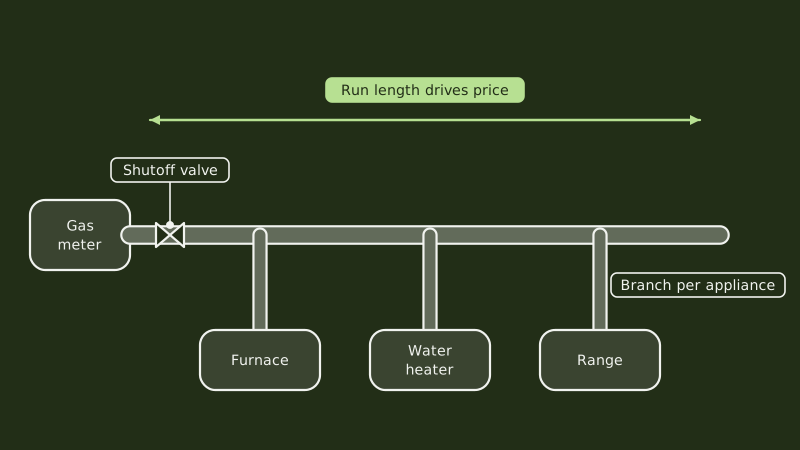
Gas piping is priced by the foot plus the extras. National 2026 guides show about $12 to $30 per linear foot, with a typical homeowner paying roughly $270 to $940 and an average near $600. A brief run to a range lands cheap. A trenched line out to a fire pit does not. Detail on the pipe itself, and who may install it, is on the gas line installation and repair page.
Smelling gas as you read? Close this page. Walk out of the building and, from the yard or street, phone SoCalGas on 1-800-427-2200. Emergency services (911) come first if anyone is hurt or threatened.
What should a new gas line run you?
Think $12 to $30 per foot installed. HomeAdvisor's published figures translate that into $270 to $940 for most homes and an average near $600. Trenching adds $5 to $12 per foot. Permit and inspection fees and a pressure test come on top, so a quote should list them as separate lines.
Several 2026 guides agree within a narrow band, though the outliers sit higher. One price list quotes $800 for a 25-foot furnace line, and complicated runs with digging or many turns can top $35 to $50 per foot. National numbers blur local factors, so use them to flag a quote that looks oddly low or oddly high.
What a plumber is pricing, in practice, is the distance from the nearest existing gas pipe to the new appliance, what is in the way, and how much wall, ceiling or yard must be cut open and sealed afterward.
Typical plumber prices in Santa Ana
By appliance, guides list $200 to $700 for a range or stove, between $150 and $500 for a dryer, and up to $1,000 for a barbecue or fireplace, from $300. A stub-out already behind the dryer drops the hookup to roughly $75 to $150. None of this is a quote; the route inside your house sets the number.
| Job | Guide range | Why it varies |
|---|---|---|
| Range or stove line | $200-$700 | Distance, finished walls |
| Dryer line | $150 to $500 | An existing stub-out cuts it to $75 to $150 |
| Outdoor barbecue or fireplace | $300 to $1,000 | Trenching, patio crossings, vent work |
| Permit and inspection | $50-$500 | Fees set by the city |
| Pressure test | $75 to $200 | Often included in the line price |
| Earthquake shut-off valve | about $250 to $800 | Valve type, meter position, permit |
Santa Ana homes built from the 1920s through the postwar tract era often have steel gas pipe that was sized for fewer appliances. When a new tankless water heater, a range or a fire feature goes in, the old pipe sometimes has to be upsized, and that is a different price from a simple stub for a stove.
What do earthquake shut-off valves cost?
Published California figures for an installed seismic valve run roughly $250 to $800, with a combined seismic and excess-flow valve at the upper end, and a few contractors quoting more. It mounts downstream of the meter, on pipe the homeowner owns, so a plumber fits it, not the gas company.
SoCalGas explains the difference between earthquake and excess flow valves on its safety page, and our own page on earthquake gas shut-off valves in Santa Ana covers the types and the permit. Price depends on the valve model, where the meter sits and what the city charges for the permit.
A valve sized to the meter, with a clear spot to mount it, goes in fast. A cramped meter location, or a valve that needs a new bracket or a longer fitting, takes longer and costs more.
What does a gas plumber charge per hour?
Across the United States plumbers commonly bill about $75 to $180 an hour, more after hours. "Gas Safe" is a UK register and does not apply here. Gas piping in this state goes to a contractor whose license classification covers it; the board's website lets you look up any number.
Plenty of gas jobs get a flat price after the plumber walks the route, since access sets the time. If one plumber quotes hourly and another quotes a fixed price, compare totals including permit and pressure test, not the rate alone. Rates get more space in plumber cost per hour, and the minimum charge is explained under service call fees.
What pushes a gas line quote up or down?
Length, access, the pipe size needed, the number of appliances on the line, trenching and the permit are the main drivers. A line through an open attic is cheaper than one through finished walls. A yard run costs more for digging. Needing a bigger main pipe to carry a new appliance can double a quote.
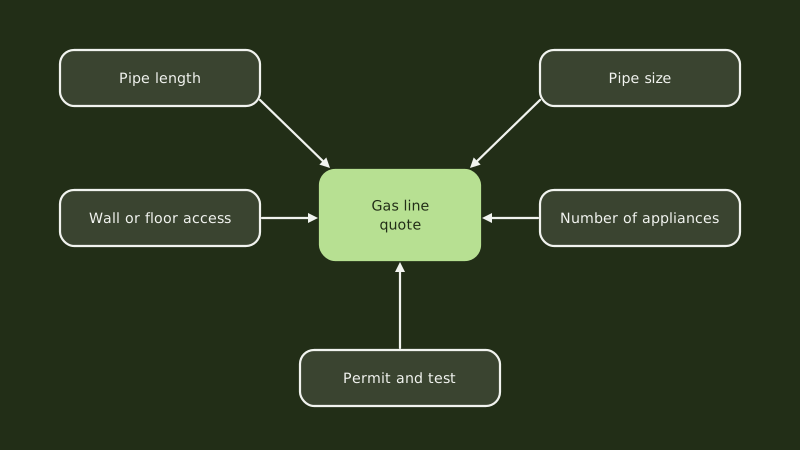
A few specifics:
- Pipe type. Steel pipe and flexible corrugated tubing are priced differently, and the plumber picks what the code allows for the location. For the materials, read which pipe carries natural gas.
- Appliance connectors. The short flexible hose between pipe and appliance looks minor but carries real safety weight. Fit a new one whenever a stove or dryer moves, and never recycle an old one.
- Code. Gas piping follows rules on sizing, support and testing. What the inspector checks is laid out in residential gas piping codes.
- Repairs. A corroded section or leaking joint usually costs a visit charge plus parts, and a pinhole in old steel may mean swapping the whole stretch instead of patching.
Because gas work is regulated, keep the job on the permit. The City of Santa Ana's permits counter can tell you what a gas line permit requires at your address.
For a figure on your own house, tell us the appliance and its distance from the nearest gas pipe on the price request form. Other trades are listed on the Santa Ana Plumbing Co home page.
Common questions
What is the time on site?
A simple stub for a range or dryer in an easy spot may be done within a couple of hours, then a pressure test. A barbecue or fireplace line with trenching, or a new run through finished walls, takes most of a day or longer. Permit inspection scheduling can add days, since gas work normally needs a final inspection.
Which questions belong in a gas quote conversation?
Collect the contractor's license number, then run it through the state board's lookup. Confirm that the price covers the permit, the pressure test and wall patching. Learn which pipe and connectors will be used, and when the inspection happens. A written quote that names each of these is a good sign.
Does someone have to stay at the house?
Usually yes. Someone lets the plumber in, points out where the appliance goes and stays reachable, because gas is shut off for a time and appliances with pilot lights have to be relit afterward. The plumber tests every connection before leaving. Plan to be nearby for most of the day.
Can I fix a gas pipe myself to save money?
No. Gas piping is work for a contractor under California rules, and a mistake can leak gas or cause a fire. Savings come from describing the job clearly, clearing access to the wall or attic, and comparing written quotes. Should gas ever be in the air, step outside first and let SoCalGas know on 1-800-427-2200.
Sources
- Published 2026 gas line installation cost guides, including HomeAdvisor and several contractor price lists (national figures, read November 2026)
- Published 2026 earthquake gas shut-off valve price guides, including Angi and Southern California contractors (read November 2026)
- SoCalGas, earthquake and excess flow valves
- California Contractors State License Board, finding the right contractor
- City of Santa Ana, Permits Counter
Last updated