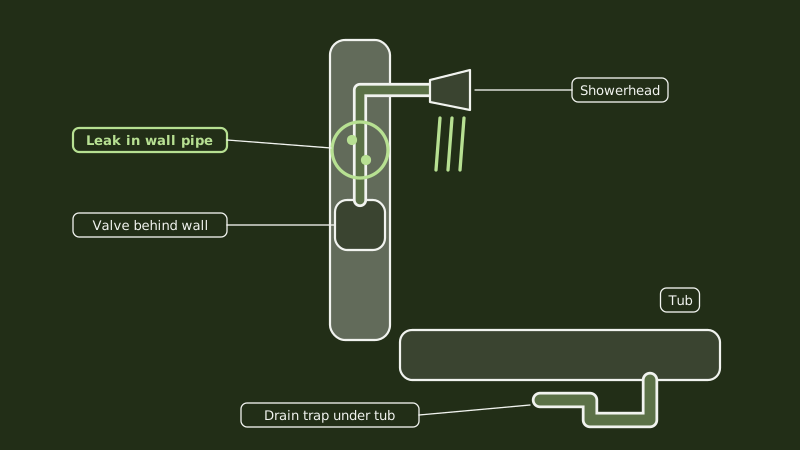
When a shower leaks, work out where the water appears: at the shower head or arm, around the handle, on the floor outside the stall, or as a stain on a wall or ceiling next to it. Every location implicates a different part, and the last two usually bring in a plumber with moisture tools. A burst pipe pouring water means the main valve closes first, then you call. The form lower on this page starts a request, and a local plumber is arranged from there. Related fixture work, such as garbage disposal installation, is covered further down, and the wider list of our Santa Ana work is on the home page.
Where does a leaking shower leak from, and when is a plumber needed?
Water escapes from four possible spots: the head and arm, the valve and its trim, the tub spout, or a hidden pipe or pan beneath the finish. The first three often yield to cheap washers, cartridges or tape. Water behind the wall, under the floor or through the ceiling below needs a plumber.
A fast way to sort the cases:
- Drip from the shower head or arm. Worn threads or a failed washer. Plumber's tape and a new washer often cure it.
- Water from the spout while the shower runs. The diverter inside the spout has given out, and a new spout is a simple swap.
- Water around or behind the handle. A worn cartridge or seal in the valve. This one opens the wall trim and may need a plumber.
- Water outside the stall, or damp floor. A cracked shower pan, a failed liner or a bad drain connection. It leaks only when the shower is used.
- A stain on a wall or ceiling next to the shower. A pipe or fitting in the wall, or a leaking pan.
A dripping faucet or shower valve that runs constantly wastes water. EPA lists dripping faucets, worn toilet flappers and leaking valves among the common household leaks. Further help is in fixing a leaky shower faucet and, for the tub side, a leaky tub faucet.
How should I react when a shower pipe lets go?
Shut the main water valve at once, empty the lines through a low faucet, and cut power wherever water is close to outlets, lights or the ceiling below. Take photos, then ring a plumber. A split pipe flows until the supply is closed, so the main valve beats any bucket.
Signs a shower line has split: water pouring from the wall or ceiling, a stain that spreads fast, a rushing sound when no fixture is on, or a meter dial that races. The repair opens the wall to reach the pipe, so access panels or tile cuts are normal. Drying and rebuilding follow. The ceiling-below case is handled in dealing with a ceiling water leak.
If the home is a rental, tell the landlord in writing at once. The plumber's visit is arranged through us once you describe the damage, and the price is agreed in writing before work starts.
Why is only the tub weak while other fixtures run strong?
A weak tub or shower with strong taps elsewhere has a local cause: a clogged head, a stuck diverter, a worn cartridge or a partly closed stop. Scale from hard water is a frequent reason. If everything is weak, suspect the supply side, a regulator or the main valve.
Checks in order of effort:
- Soak the shower head in white vinegar and rinse to clear mineral deposits. A small brush helps.
- Try other taps. If only the tub spout is weak while the shower head works, the diverter is suspect.
- Check hot versus cold. Weak on one side only means a clogged cartridge or a stuck stop on that side.
- Look at the shutoff behind the access panel, if there is one.
- Think about the whole house. Weak flow at the kitchen sink as well is a bigger problem. See low water pressure from the shower.
The city puts Santa Ana tap water near 250 parts per million hardness, which is very hard, so crusted shower heads and valves are a realistic cause locally.
How does a garbage disposal go in, and does the brand matter?
Installation has five stages: take out the old unit or flange, set the new flange in plumber's putty, build the mounting assembly, wire or plug in the unit, then hang it and connect the drain. Mounting details differ between American Standard, Glacier Bay, Moen and InSinkErator, so follow the manual packed with your own model.
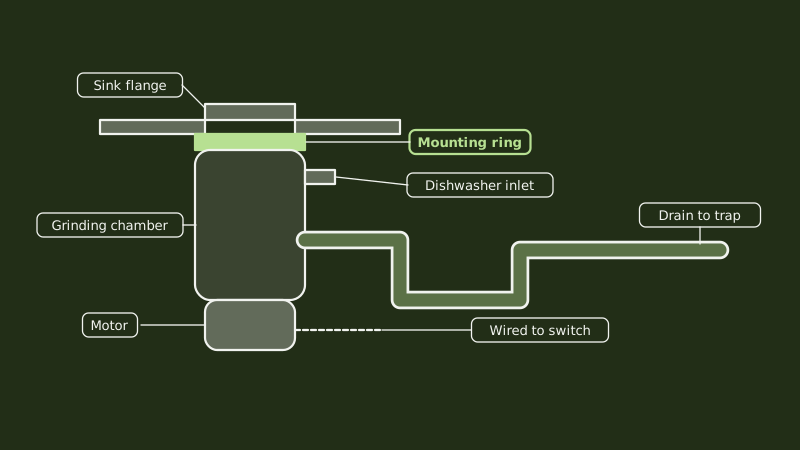
The InSinkErator Badger 500, one of the most common, works like this according to its installation manual:
- Switch the breaker off, then disconnect the trap and any dishwasher hose.
- Press plumber's putty around the sink flange and seat it in the drain opening.
- From below, add the fiber gasket, backup flange and mounting ring, hold them, and fit the snap ring. Tighten the three mounting screws evenly.
- If a dishwasher will connect, knock out the drain plug inside the disposal's side inlet. The plug cannot be put back, and connecting a dishwasher without removing it can cause the dishwasher to overflow.
- Connect wiring: white to white, black to black, ground to the green screw, using wire nuts. A unit without a factory cord needs a cord with a grounding plug, and the maker recommends its own accessory.
- Lift the unit and hang it by lining up the three tabs on the mounting ring, then turn it to lock. All three tabs must be engaged, or it can leak.
- Connect the discharge tube, run water to test for leaks, and restore power.
Other brands follow the same outline, though the mount type, dishwasher inlet and power connection vary. An outline is not a substitute for your own model's manual.
Can an owner fit a disposal, and what does it cost?
Many owners do it, if they are comfortable with basic plumbing and wiring. Electricity is the risky part: tying wires into a household circuit or adding an outlet under the sink. Permit rules and who may do the electrical part differ from city to city, so ask your building department first.
A plumber handles the mounting, drain and alignment, and the electrical part may be a separate trade. Costs depend on the unit's horsepower, whether power already exists, and the drain layout. For price ranges, see garbage disposal installation cost, and for the service itself, garbage disposal installation services. For a jam once it is installed, see clearing a garbage disposal drain.
A disposal swap normally falls under the $1,000 mark where California's contractor license rule begins, but a license number is still worth checking.
How is sink plumbing handled in a mobile home?
A manufactured home follows the same logic as a house: supply line, trap and drain. The pipes are often lighter and run beneath the floor, and the drain ties into a park or lot line. Check park rules and the state housing department's requirements before cutting into lines.
What to know:
- Materials. Supply lines are commonly flexible or plastic. Drains are often thin-walled plastic. Over-tightening or heavy tools can crack them.
- Access. Many mobile homes have the drains and supply lines under the floor, reachable through a belly panel.
- Ownership. The park or the owner may be responsible for the lateral or service connection. Ask park management.
- Permits. Manufactured housing in California has its own regulatory path through the state housing department, which may differ from city permits. Confirm with the park or the department before major work.
For a general check of an older mobile home, see mobile home plumbing inspection. A leak under a sink is covered in repairing a leaking pipe under a sink.
Common questions
How much water pressure should a shower have?
Street pressure varies, and state plumbing code asks for a regulator once static pressure tops 80 psi. A weak shower beside strong taps points at the head or valve, not the supply. A plumber can read your static pressure with a gauge.
Is a shower leak an emergency?
A spraying or pouring leak is, so close the main valve, then phone. A slow drip at the head is not, though it wastes water and, if hidden, can damage the wall. A leak that stains a ceiling or wall should be inspected soon, since moisture left for days can lead to mold.
Is a leaking shower head a plumber job?
Often not. A fresh washer and tape on the threads cures many drips, and swapping the head takes minutes. A leak at the valve, behind the wall or from the pan is plumber work, because the wall must be opened.
Will the new disposal fit my sink?
Most standard sink drain openings are 3.5 inches and accept the common mounts, though some models need a different flange. Check the manual and measure the opening. The discharge position and any dishwasher connection can require trap changes, so look at the drain layout before buying.
Is it smart to replace the faucet and the disposal together?
It can save a visit, since the cabinet is already emptied and the shutoffs are within reach. Replace tired supply hoses at the same time. Check that the faucet and the disposal do not crowd each other, and that a switched outlet is ready.
Sources
Last updated