To fix a leaky tub faucet, close the supply to the bathroom, remove the handle, and replace the part that seals the flow. On most modern faucets that part is a cartridge. On older two-handle ones it is a rubber washer and a worn brass seat. You need a screwdriver, pliers and a matching part, and the job usually takes under an hour. Water that seems to come from behind the wall is a plumber's job, and the quote page is how to start.
Bathroom and kitchen fixtures share most of their parts and tricks. This guide sits beside our pages on garbage disposal installation and other sink work, and it also deals with a Moen faucet and a leaking pipe under the kitchen sink.
How can I tell what type of tub faucet this is?
Start with the handle. Two separate handles for hot and cold usually mean compression valves, with a rubber washer and seat. One handle that moves up and down and side to side suggests a cartridge or ball. A single handle that you turn to set both temperature and flow often hides a cartridge. The type decides the repair.
Four common types:
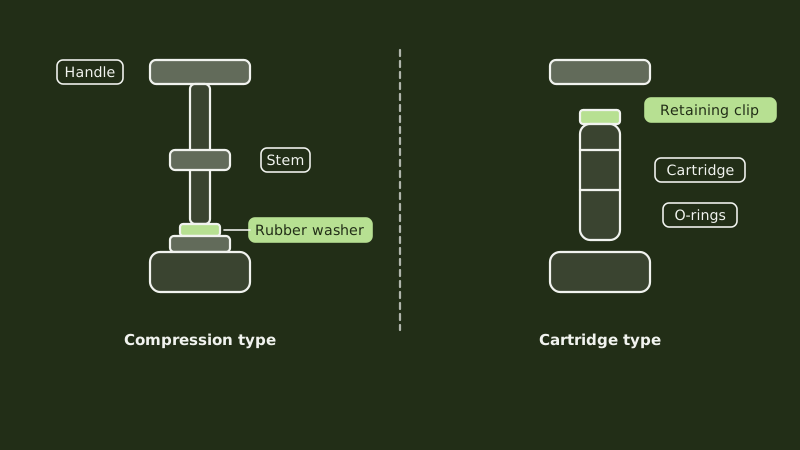
- Compression: two handles, you screw them tight to stop the flow. A worn washer or seat causes the drip.
- Cartridge: one or two handles that move smoothly. A cartridge, often held by a clip or nut, seals both flows.
- Ball: a single handle over a rounded cap. Rubber seats and springs wear out.
- Ceramic disc: a single handle on a cylinder. Seals inside the cylinder fail, and the repair is a replacement cylinder.
Unsure? Take the handle off (the next section shows how) and see what sits inside. Bring the worn part to a hardware store, or photograph it along with the make and model if you can find them. Moen, Delta, Kohler, American Standard and other makers sell parts matched to their models.
What is the process for swapping a cartridge or washer?
Shut the water, open the faucet to bleed it, then lever off the handle cap, take out the screw and lift the handle away. Unscrew the trim sleeve, remove the retaining clip or nut and pull out the cartridge, or unscrew the stem on a compression valve and replace the washer. Fit the new part in the same orientation and reassemble.
A step list:
- Water off. Use the bathroom's shutoff if it has one, or the main valve, then open the tub tap to relieve pressure.
- Plug the drain with a rag so small screws do not go down it.
- Handle. Prise up the decorative cap, undo the screw behind it and lift the handle off. Photograph as you go.
- Trim and escutcheon. Unscrew the trim plate to reach the valve body.
- Cartridge or stem. Pull the retaining clip, then wiggle the cartridge straight out. A cartridge puller helps if it is stuck. On a compression valve, back the stem out with a wrench and change the washer, plus the brass seat if it is scored.
- New part. Match it exactly. Lubricate the O-rings with plumber's grease and push the cartridge in facing the same way.
- Rebuild and test. Bring the water back slowly and look for drips at the spout and behind the trim.
Cartridges seat in a specific orientation, usually with a hot and cold indicator, so photograph before you pull. A wrongly oriented cartridge gives reversed temperature, not a leak.
Why is it still dripping after I replaced the part?
A persistent drip usually traces to a damaged valve seat, a cartridge that has not seated fully, or a failed diverter. Dribbling from the shower head after the tub tap is closed points to the cartridge. Water falling from the spout while the shower runs points to a worn diverter.
Hard water accelerates all of this. The City of Santa Ana reports hardness near 250 parts per million, and the USGS puts 181 mg/L and above in its very hard class. Scale scores seats and clogs cartridges, which is why faucets here can start dripping sooner than the label suggests. Clean mineral build-up in vinegar, and consider treating the water if scale keeps returning.
EPA WaterSense notes that a dripping fixture wastes water at a steady rate, so repair it soon. For shower leaks, see fixing a leaky shower faucet, and for a sink tap see fixing a leaky sink faucet. The general leaky faucet guide covers the basics.
What is different about a leaky Moen bathroom faucet?
Moen's single-handle faucets rely on a replaceable cartridge, so the sequence matches the one above: water off, handle and trim off, retaining clip out, old cartridge out, matching new cartridge in. Moen makes several, so match yours to the model and follow the instructions packed with the replacement.
Two Moen-specific points. First, the handle is often held with a set screw behind a decorative cap, and a hex key removes it. Second, the cartridge can stick to the brass body, and a puller made for it saves a lot of wrestling. Model unknown? Look for a number on the box, the receipt or the back of the handle, or let a hardware store counter match it from the old cartridge.
Should a fresh cartridge fail to stop the drip, the valve body may be corroded, and replacing it means opening the wall, which is plumber's work.
What stops water dripping beneath the kitchen sink?
Wipe it all dry, run the tap and spot the exact wet joint. Usual suspects are loose slip nuts on the drain trap, a worn washer in a compression fitting or a cracked supply line. Snug slip nuts by hand, renew worn washers, and replace a cracked or corroded supply line or trap rather than patching it.
Identify what is leaking:
- Drain trap and tailpiece: slip nuts sit at each joint. Hand-tighten, then a quarter turn with pliers. Replace cracked plastic or rusty metal parts. The rubber washer inside matters, so replace it if it is flattened.
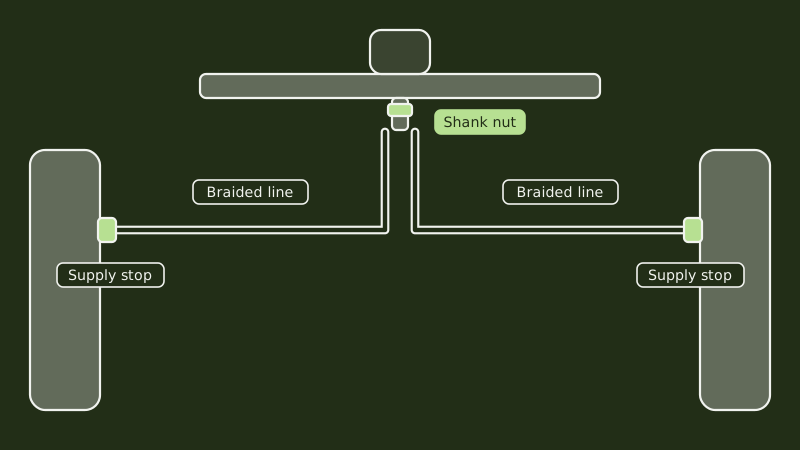
- Supply lines: the flexible hoses from the shutoff valves to the faucet. A weeping hose or loose compression nut is a quick swap.
- Shutoff valves: a valve weeping at the stem may respond to a slight turn of the packing nut. If the drip continues, fit a new valve.
- Disposal connection: a garbage disposal leaks at its flange, drain or dishwasher inlet. If you have one, see garbage disposal installation and how to unclog a disposal drain.
A fuller walk-through lives in mending leaks in the pipework below a sink. Keep a bowl under the leak while you work and look again after a day.
At what point should a plumber take the job?
Hand it over when the valve is sealed inside a wall without an access panel, the valve body is corroded, a new cartridge does not stop the drip, shutoffs will not close, or water shows in the ceiling below. A plumber can swap the valve body or the fixture and look for hidden leaks.
California's contractor license rule starts at $1,000 for labor plus materials, or at any permitted work, so a cartridge or trap repair is within a homeowner's reach, while opening walls to rework valves is contractor territory. A small fixture repair is typically a trip charge plus an hour or so of labor and parts, and plumber cost in Santa Ana lists the bands.
A faucet that drips for weeks can also be a clue to higher pressure or an old valve. The page on high water bill causes shows how to check.
Common questions
How much water does a dripping tub faucet waste?
A steady drip can waste a surprising amount over a month, and the loss shows on the water bill. EPA WaterSense treats leaks as one of the easiest savings to fix. Time a drip into a cup for a minute to gauge it, then repair it rather than living with it.
Why does my tub faucet drip only when it is hot?
Because the hot side is the failing valve. Heat speeds wear on rubber washers and seals, and hot water carries more dissolved minerals that leave scale. Replace the hot cartridge or washer. If both sides share one cartridge, the single part covers both.
Do I have to close the main to work on a tub faucet?
Not if the bathroom has its own shutoff, perhaps behind an access panel. Otherwise close the main valve. Never work on a faucet with water pressure behind it, because a cartridge can be forced out of the valve body and the water will gush.
How do I know which cartridge to buy?
Pull the old one and take it to a hardware store, or note the faucet brand and model number from the box, receipt or handle. Compare length, splines and shape. A cartridge that looks close but is not exact will not seal, so match it carefully.
Can a dripping faucet harm the tub or wall?
Slow drips stain the tub and, if water runs inside the wall, can soak the framing and drywall behind the tile. When the wall or the ceiling below is wet, shut the supply and phone a plumber. A drip at the spout alone is a nuisance and a bill.
More plumbing work we arrange is shown on the home page.
Sources
Last updated