Water seeping from copper buried in the floor can be patched where it fails, bypassed overhead, lined from inside or replaced along with the rest of the supply pipes. Leak history, pipe age and the way the house was built decide which route is sensible. Water pouring out right now? The burst pipe page has the first steps.
Ahead: four routes with rough prices, how to spot trouble, and the points to settle before a floor gets cut.
What are the repair routes for a leak under the floor?
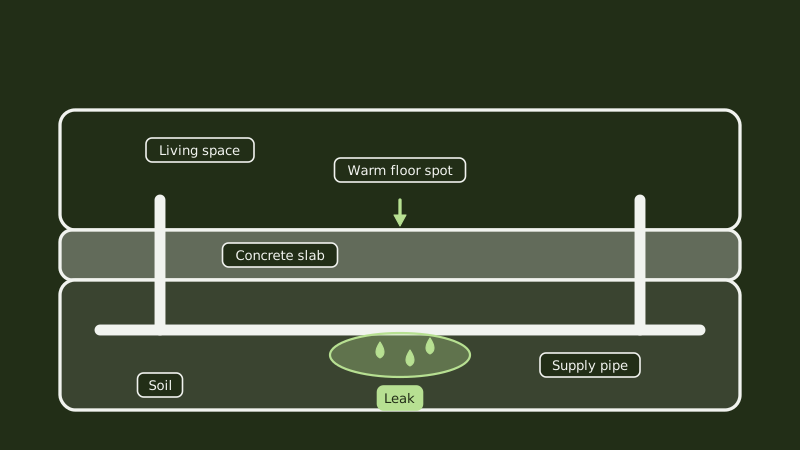
A slab leak means a supply line buried in or under the concrete has failed. Listening equipment locates it, and then the work goes one of four ways: dig down to it, bypass the section overhead, line the pipe from inside, or replace every supply line.
Ranges below come from published cost guides and are a rough guide only:
| Option | What happens | Rough range |
|---|---|---|
| Spot repair | Cut the floor open over the leak and patch the pipe | $500 to $4,000 plus floor repair |
| Reroute | Leave the failed run unused and install new pipe overhead or in the walls | $1,500 to $6,000 |
| Epoxy lining | Coat the inside of the existing pipe with a resin | $1,000 to $8,000 and up |
| Full repipe | Replace the home's supply lines, usually with PEX or copper | $4,000 to $15,000 and up |
Most price lists bill leak detection on its own line, often $150 to $400, and after-hours calls add a surcharge.
How can I tell water is escaping under my floor?
Watch for a floor that feels warm underfoot, a hiss or trickle while every fixture is off, a water bill that climbs for no reason, and damp carpet or buckled flooring with no visible source. A meter check backs up the suspicion, and acoustic detection pins down the spot.
To run the meter check, close every tap and appliance, including the ice maker, then check the small triangle or dial on the meter. If it spins, that means water is escaping downstream. It does not prove the slab is the culprit, since a silent toilet leak or a hose bib line behaves the same way, so rule those out first.
Warm spots deserve attention because hot lines tend to corrode faster, so a floor that feels toasty near a bathroom or the water heater is worth a closer look.
Which houses in Santa Ana are most likely to get one?
Houses on a slab foundation, with copper supply pipe cast in or under the floor, are the usual candidates. Many postwar tract houses in Santa Ana were built that way, while a lot of the 1920s and 1930s bungalows sit on raised floors with a crawl space, which keeps the plumbing within reach.
That is a general pattern, not a rule for your address, so check which kind of foundation you have. Santa Ana's very hard water, around 15 grains per gallon in the city's own report, does not help older copper, and corrosion from the outside, where copper touches rebar or a gap in the concrete, is another common cause.
Floral Park and other older neighborhoods are mostly raised foundation homes, so a leak there is more often a crawl space repair. See the notes for Floral Park if that is your area.
Should I do a spot repair or a repipe?
Choose a spot repair when the pipe is fairly young and this is the first failure. Choose a reroute or repipe when the pipe is old, when a second leak shows up, or when corrosion runs along the line. A spot repair on dying pipe often means paying to open the floor twice.
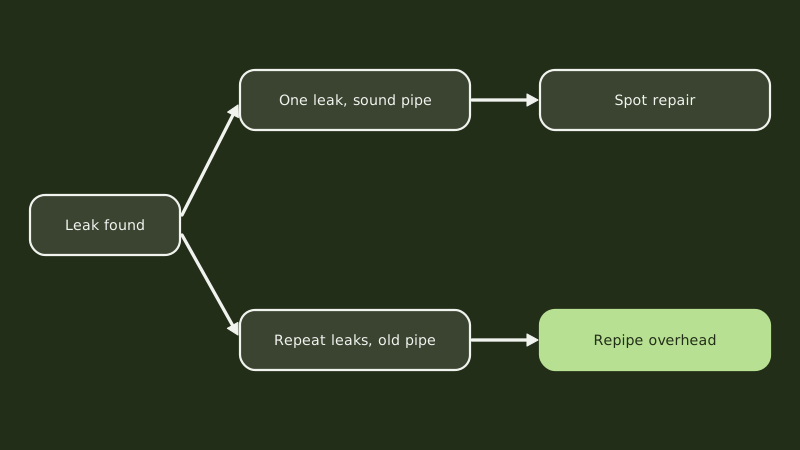
Think about cost across five years, not one invoice. A $2,500 spot repair that is followed by another break in two years has cost more, plus a second round of dust and drywall, than a single $6,000 reroute. A full repipe gives the longest runway, since it replaces the old pipe in the whole house. See the price to repipe a house and how repiping works.
What does repiping a slab-foundation home look like?
Typically the old lines stay in the concrete, capped off, and new PEX or copper travels through the attic or wall cavities to each fixture. No jackhammer is needed. Drywall is opened and patched at a few access points, and the buried pipe is abandoned where it lies.
PEX is popular for this work because it snakes around framing and costs less than copper, though some owners still prefer copper. Ask for both priced. Repiping is permit work in most cities, so ask who pulls it. In Santa Ana the Building Safety Division issues plumbing permits, and other Orange County cities run their own offices.
On the quote, look for pipe type, fixture count, drywall patching, paint and the permit line.
Can pipe lining replace a repipe?
Lining paints the pipe interior with resin so a leak seals without opening the floor. It can suit a system with several pinholes and otherwise sound pipe. Badly corroded pipe and fittings are poor candidates, and outcomes vary by contractor and system, so ask what written warranty comes with it and who stands behind it.
Put lining and a reroute side by side on one quote sheet. Lining sometimes costs about the same as rerouting but means less drywall work. A plumber has to inspect first, since pipe thinned by corrosion may not qualify.
Does a slab leak repair work the same outside Santa Ana?
The methods are the same everywhere. We arrange visits only in Santa Ana and central Orange County, including Irvine, Tustin, Costa Mesa and Garden Grove. If your search brought you here from another city, look for a local plumber there. Permit rules, soil and housing styles differ from town to town.
Will insurance cover a slab leak?
Often only in part. Homeowner policies commonly pay for sudden water damage that follows a leak, yet frequently exclude the pipe itself and sometimes the slab access. Wording varies, so read your own policy or phone your agent before work starts, and save photos, the detection report and invoices.
Insurers usually ask for a written detection report and an itemized quote. A related read: coverage for burst pipe damage.
Common questions
How many days is the floor torn up?
Spot repairs and reroutes often wrap up in one to three days including the patch, though drying and new flooring can stretch it. Repiping the entire house tends to take several days, with the taps dry for part of each one. Get a schedule in the quote, including the hours without water.
What questions belong on the quote?
How is the leak located, and by whom? Does the price include floor and drywall repair? Which pipe goes in? Who pulls the permit? What warranty is written down? Verify the contractor license on the CSLB site too, and remember the state's deposit ceiling on remodeling work.
Should I stay home while this is done?
Be on site at the start, when the leak is found and the options are laid out, then stay reachable by phone. An adult usually has to give access, and the floor area needs clearing of furniture beforehand. Ask the plumber how much of the job needs you on site.
Is a slab leak a do-it-yourself job?
Realistically no. Locating a leak under concrete takes detection gear, breaking the slab risks cutting other lines, and a repipe or reroute is permit work. Your part is closing the main, limiting the wet area and calling a plumber. Dry soaked flooring fast, because mold can begin in about 24 to 48 hours.
More services are listed on the plumber guide for Santa Ana.
Sources
- Published slab leak repair prices from national cost guides and plumbing price pages, checked November 2026
- City of Santa Ana, Permits Counter
- Contractors State License Board, Learn About Home Improvement Contracts
Last updated