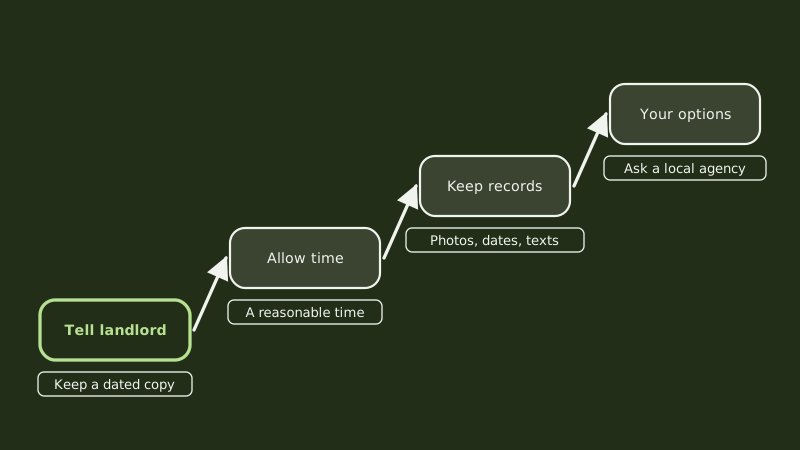
If you rent in California and the apartment has no hot water, the landlord is expected to fix it. State habitability law puts hot and cold running water on the list of what a rental must provide. That does not mean the heater gets repaired by midnight, and the law leaves several steps to you: tell the landlord, give reasonable time, keep records. This page covers those steps in order. If you own the building, or manage one, the same facts show what a prompt repair looks like. If a replacement is on the table, tankless water heater installation is where to read next, and everything else we arrange in Santa Ana is on the home page.
Does California law require a landlord to provide hot water?
Section 1941.1 of the California Civil Code sets out what a rental needs to be livable, and its list includes hot and cold running water hooked up to an approved sewage system. When the landlord supplies the water heater, keeping it working falls to the landlord. A unit with no hot water can fail that standard.
The same section covers working plumbing, heating, safe wiring and weatherproofing. Tenant organizations treat a prolonged loss of hot water as a livability issue, yet the statute names no number of hours for the fix. Some tenant guides call it urgent and mention an expectation of anywhere from the same day to three days. That window comes from secondary sources, not the statute, so read it as a rule of thumb, not a deadline.
Two cases worth separating:
- The landlord provides the heater, whether a single tank for your unit or a central boiler for the building. Fixing it is the landlord's duty.
- A tenant-installed or tenant-owned appliance. If the lease says you maintain it, the answer can differ. Read the lease and ask a tenant-rights group about your situation.
Whether a particular building is covered by extra local tenant rules is a question for the City of Santa Ana or a legal aid office, and we have not verified it here.
What are the first steps when the heater quits?
Make sure the whole unit is affected, then notify the property owner or manager in writing. Look at the obvious: does a neighbor have hot water, is a breaker off, did a pilot go out. Do not open the heater. Send a dated message saying what is wrong and asking for a repair.
A sensible order:
- Try a quick, safe check. Resetting a breaker or glancing at an unlit pilot is reasonable. Should you smell gas, leave the apartment and call SoCalGas from outside.
- Put it in writing. Email or text works, and a dated letter is stronger. Give the date the hot water stopped and request a repair.
- Keep proof. Save messages, take photos of the heater and any leak, and note each call, with the date and who you spoke to.
- Follow up after a day or two if nothing happens, again in writing.
- Ask whether the heater is shared. In some older buildings one central water heater serves several units, and all of them lose hot water at once.
Common causes appear in why a house has no hot water, which helps you describe the problem accurately. With a tank, the likely outcomes are a part repair or a replacement.
Can I deduct repair costs from the rent?
In some cases. Civil Code section 1942 allows a tenant, after notice and a reasonable wait, to fix a habitability problem and subtract the cost from rent. The limits are tight: no more than one month's rent, and no more than two uses in any 12 months. Thirty days is presumed to be a reasonable wait.
The conditions summarized by tenant legal groups:
- The landlord was told about the problem, preferably in writing.
- A reasonable time has passed without a fix. Thirty days is presumed reasonable, and a shorter time can be reasonable for something as basic as hot water.
- You did not cause the defect.
- The bill is at most one month's rent, and you have not used the remedy more than twice within 12 months.
- You keep the invoice and send a copy with a letter explaining the deduction.
This option has risks. A wrong deduction can lead to a notice about unpaid rent, so tenants often talk to a legal aid office or a tenant-rights group first. Hot water work that involves gas piping or a permit is contractor work, and a heater replacement usually clears the $1,000 point where a California contractor license applies. Hiring someone without that license invites a dispute over the deduction.
What other options do tenants have?
Beyond repair and deduct, tenants can report the problem to the city's code enforcement, ask for a rent reduction, withhold rent in some circumstances, or take the matter to court. These carry real consequences, so get advice from a tenant-rights group or legal aid office before using them. Civil Code section 1942.5 separately prohibits retaliation for asserting repair rights.
Practical points:
- Code enforcement. A city inspector can document a problem. Ask the City of Santa Ana how to file a complaint about habitability.
- Rent withholding and damages. Civil Code section 1942.4 deals with landlords who ignore serious defects, with conditions attached. Never stop paying rent before getting advice.
- Retaliation. If a landlord raises rent or tries to end a tenancy soon after you complain, record the dates and seek advice.
- Temporary arrangements. Ask whether the landlord can provide a hotplate, a shower arrangement or a rent credit while the repair is pending. Put any agreement in writing.
We are a plumbing service and not a law office, so use this as a map and not as advice. Legal aid and tenant organizations can say how the law applies to your lease.
How does a plumber fit in, and who pays?
When a landlord or manager arranges a repair, a plumber looks at the heater, finds the failed part, and either repairs it or recommends replacement. The landlord, as the owner of the equipment, normally pays for a fix to a landlord-supplied heater. Permits apply, since the City of Santa Ana lists water heater replacement among permit jobs.
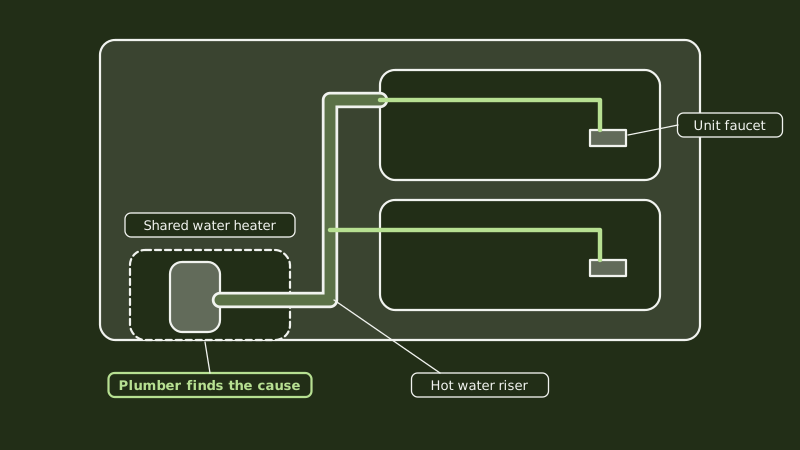
What a plumber typically checks in an apartment building:
- Power or gas supply to each heater, and the venting on gas models.
- Thermostats, elements or igniters on tanks, and error codes on tankless units.
- Sediment and scale. Santa Ana's tap water is very hard, around 250 parts per million by the city's figure, so scale is a frequent cause of lukewarm water in older tanks.
- Strapping and safe discharge. A replacement tank in California should be strapped, and its relief valve piped safely.
- Central systems. A shared boiler or recirculating line is a larger repair and may need a specialist.
For property owners and managers, we arrange visits across the area: the water heater replacement price guide gives ranges, and tank and tankless pros and cons are in tank versus tankless. The written price is settled before anything begins.
Common questions
What is the deadline for a landlord to restore hot water?
No number of days for hot water appears in the statute. Tenant guides call it urgent and often cite anything from the same day to three days, though the law does not say so. For repair and deduct, thirty days is presumed reasonable, while a shorter wait may be reasonable for hot water. Document everything.
Can I call a plumber myself and bill my landlord?
You can, but it is risky. Repair and deduct caps the cost at a month's rent and allows two uses a year. Tell the landlord first, keep the invoice, and get advice before deducting. Jobs priced at $1,000 and up need a contractor with a state license.
What if the building has one shared water heater?
The landlord or building manager is responsible, and several units are usually affected. Reporting it in writing alongside neighbors gives the manager a clear picture. A central boiler is a bigger repair than one tank and often needs a specialist and a permit.
Is a cold shower a habitability violation?
A rental without hot water can fail the habitability standard in Civil Code section 1941.1. Whether a given short outage counts depends on the cause and how quickly it is fixed. A repair that drags on, with no hot water for days, is more clearly a problem. Keep dated records.
Where can I get legal advice about this?
A legal aid office or a tenant-rights organization can review your lease and your facts, often free for people who qualify. The City of Santa Ana can say what local rules or inspections apply to your building. We are a plumbing service, so we cannot give legal advice.
Sources
Last updated