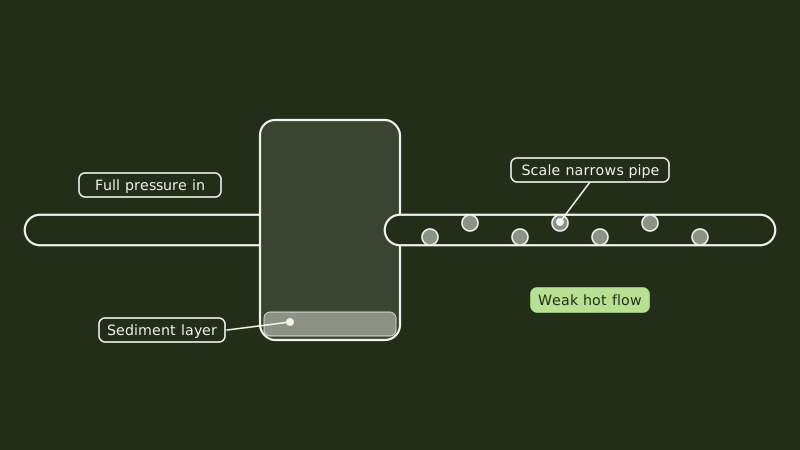
If cold water comes out strong and hot water dribbles, the problem is almost never your street supply. It sits in the hot branch: the shutoff valves around the heater, mineral scale inside the heater or its outlet pipe, a clogged fixture screen, or old pipe that has narrowed. Fix the cheap suspects first. The water heaters page covers the equipment itself, including tankless models.
Weak flow on both sides points to a whole-house cause, and that hunt lives in our piece on pressure trouble throughout a house.
How do I tell a house-wide hot water problem from a single bad faucet?
Open the hot tap at the kitchen sink, the bathroom sink and the shower in turn. One weak outlet means a local fault, typically a blocked aerator or cartridge. Weak hot at every outlet with normal cold means the trouble sits at the heater or in the hot lines. Run cold at each tap too, as a control.
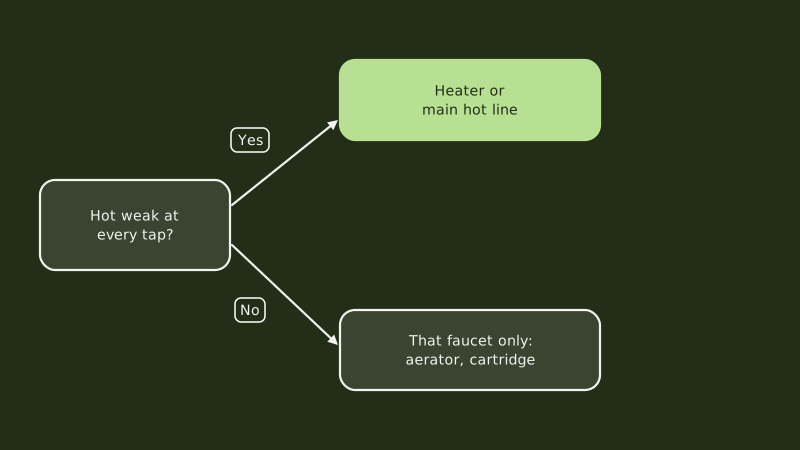
A small table keeps the results straight:
| Symptom | Probable cause |
|---|---|
| One hot tap weak, cold normal | Clogged aerator, shower head or cartridge, or a part-closed stop valve under the sink |
| All hot taps weak, cold normal | Heater shutoff partly closed, scale at the heater, or narrowed hot pipe |
| Hot and cold both weak | Main valve, regulator or the supply from the street |
| Hot weak only at distance from the heater | Long or undersized hot line, corroded pipe |
For a rough flow test, time a one-gallon bucket under hot, then under cold. A wide gap between the two confirms the pattern.
What blocks hot water at a single faucet or shower?
Mineral grit and flakes loosen inside a heater and travel into fixtures. They lodge in the screen of an aerator, the holes of a shower head, or the cartridge of a mixing valve. Unscrew the aerator, rinse out the grit and give it a vinegar bath. If the shower only misbehaves on hot, a failing cartridge is the next suspect.
Santa Ana's supply is very hard, around 15 grains per gallon by the City's own figures, and the USGS notes that scale narrows pipes and builds in water heaters. Hot water carries the most scale because heat drops it out of the water. That is why a fixture can have good cold flow and poor hot flow at the same time. What slows it is covered in preventing hard water scale.
After you clean a fixture, flush the line by running hot into a sink for a minute with the aerator off, so loose debris leaves before it is refitted.
Could the water heater be the cause?
Yes. A heater with a half-closed outlet valve, a scaled-up tank, or a clogged outlet fitting restricts hot flow to the house. Check that the valves on the pipes at the top of the tank are fully open, then listen for rumbling, which is sediment cooking on the tank floor. A tankless unit can restrict flow when scale builds inside its heat exchanger.
Sediment settles on the tank floor and the hot pipe leaves through the top, so light sediment seldom restricts flow on its own. Loose scale can still travel, though, and corroded fittings can shed flakes into the hot line. If a flush brings out gritty water, the tank is shedding material, and the heater may be near its end.
For a tank heater, a plumber can flush it and inspect the fittings. For a tankless unit, descaling with the maker's procedure is the usual cure for flow loss, and brand pages like our tankless repair notes explain symptoms. The question of whether repair is worth it, or whether water heater replacement makes more sense, depends on age and condition.
Can old pipes cause low hot water pressure in a Santa Ana house?
They can. A lot of Santa Ana housing was built between the 1920s and the 1950s, and wherever the original galvanized steel hot lines survive, corrosion builds inside them and shrinks the opening. Hot lines suffer first because heat speeds both corrosion and scale. If the weak flow worsens slowly over years and the water sometimes runs rusty, suspect the pipe itself.
There is no safe patch for a narrowed pipe. The options are replacing the hot water run or repiping the house with copper or PEX, and the plumber can point out where the pipe changes material. For scope and price, see repiping a house and pricing a whole-house pipe replacement in an old home.
Not every weak flow means pipe replacement. A stuck pressure regulator can cut flow to the whole house, so confirm cold pressure first. See water pressure regulator replacement.
What can I fix on my own, and where does a plumber come in?
You can clean aerators and shower heads, open the valves around the heater fully, and flush a tank by connecting a hose to its drain valve. Hand over anything involving gas, the relief valve, galvanized or leaking pipe, or an aged heater that rumbles. Permit work and heater replacement are for a contractor.
Local plumbing businesses reach Santa Ana homes through our service, so a visit can be arranged through the quote page. California also expects residential water heaters to be strapped against earthquake movement, something the plumber looks at during any heater job.
A few safety points. Do not remove or plug the relief valve. Do not turn the heater above its normal setting to compensate for weak flow, because higher temperatures raise scalding risk and speed scale. Gas odor near a heater means going outdoors and calling SoCalGas, whose number is 1-800-427-2200.
Common questions
Cold flows well and hot barely trickles. Why?
Because the fault is in the hot branch. Likely culprits are a partly closed valve near the heater, scale or debris inside the heater or its fittings, a clogged fixture screen, or narrowed hot water pipe. Cold water takes a different path, so a blockage in the hot line leaves it untouched.
Does heater sediment restrict hot flow?
It can, though usually in combination with other problems. Sediment gathers at the bottom, but loose scale can travel up through the outlet into the hot line and clog fixtures. A flush sometimes helps. If the tank is old and sheds grit again soon after, replacement may be the better choice.
Does weak hot flow create a safety risk?
By itself, no, but treat the cause. A failing heater can leak, and a blocked relief valve is a safety hazard, so leave it alone. If you see water around the tank, rusty water, or smell gas, act on that first and call a plumber.
The shower alone runs weak on hot. What should I do?
Unscrew the shower head, leave it in vinegar for an hour, then rinse it. Flow still poor on hot? Then the cartridge or mixing valve is next in line, because scale gathers there. A plumber can replace the cartridge and check the lines behind the wall for corrosion.
This guide is one of many on Santa Ana Plumbing Co.
Sources
Last updated