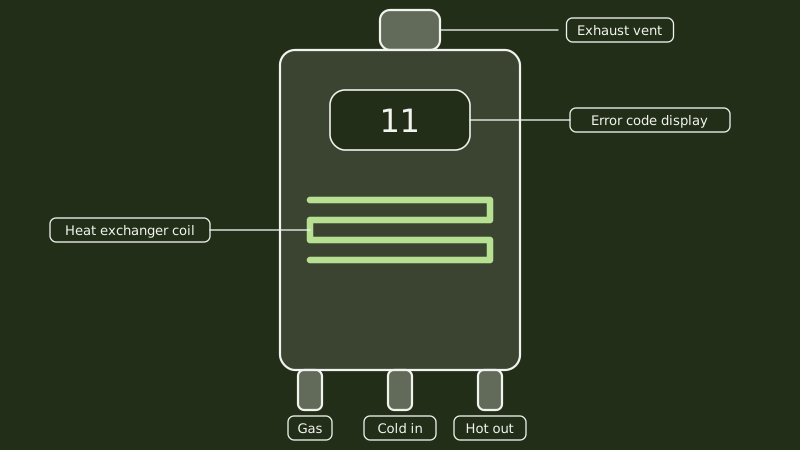
Read the code on the remote or the front display, then match it. Code 11 means the heater tried to light and never confirmed a flame, code 12 means a flame lit and then dropped out, code 10 means air or exhaust is restricted, and code 79 means the leak sensor found water inside the cabinet. Each has an owner check and a point where it becomes a plumber's repair. For the bigger picture on these units, see our overview of tankless water heater service and installation.
Gas is involved in every one of these. A whiff of gas at any stage sends everyone outdoors, and SoCalGas (1-800-427-2200) is phoned from there.
What do the common Rinnai error codes mean?
Codes are shorthand for which part of the cycle failed. Rinnai's own diagnostic guide and later summaries tie code 10 to air supply or exhaust, 11 to no ignition, 12 to loss of flame, and 79 to a water leak. Your manual lists the rest, and models differ, so use the table only as an orientation.
| Code | What it usually means | Owner check |
|---|---|---|
| 10 | Air supply or exhaust restricted | Look at the vent termination outside for a nest, leaves or damage; check the air filter if the model has one |
| 11 | No ignition: flame never proved | Confirm the gas valve is open; try a second hot tap in case of air in a new or recently worked line |
| 12 | Flame lit, then lost | Open a tap fully to see whether it repeats; note whether it fails right as water starts |
| 79 | Leak sensor tripped | Shut off water, gas and power, then look for the source |
| LC | Reported as a scale or maintenance flag on some models; not confirmed for every unit | Look it up in your manual; plan a flush |
Never defeat a safety by bypassing a sensor. Those sensors exist to protect you from gas, fire and water damage.
Why does a Rinnai give code 11 or 12, and what can you check?
Code 11 or 12 comes down to gas, spark and flame. Most often the cause is a closed gas valve, air in a line after gas work, a dirty or loose flame rod, a clogged burner, or low gas pressure. Check the valves and the hot tap first, and leave the burner and gas pressure to a plumber.
Here is what you can try safely:
- Confirm the gas shut-off on the supply line is parallel with the pipe, which means open.
- Make sure other gas appliances in the house work. If none do, the supply may be off.
- Open one hot tap fully. A low flow can keep the unit from firing.
- Reset by turning power off at the switch or unit, waiting a minute, and turning it on again.
- Write down the exact code and when it appears.
If the code returns, that is a service call. Cleaning a flame rod or checking inlet pressure means opening the unit and working with gas, and the maker's instructions point you to a qualified technician for it.
A code 12 that shows up the instant water begins to flow can indicate an electrical problem, which is another reason not to dig in.
What does code 10 mean, and is it a venting problem?
It is usually a restricted air path. The unit pulls in combustion air and pushes exhaust out through the vent, and anything that chokes either side trips code 10. Outside, a bird nest, leaves, a crushed pipe or a vent termination too close to a wall or plant can do it. Inside, heavy dust or a blocked condensate trap on condensing models can too.
Look at where the vent exits the house. Clear loose debris if you can reach it from the ground. Do not climb onto a roof for this. If the vent is physically damaged, or you see staining or smell exhaust, switch the unit off and have a plumber look, because exhaust leaking into the living space carries carbon monoxide.
Scale can also contribute. Buildup between heat exchanger fins restricts air flow, one more reason to keep up with flushing.
How does hard water shorten the life of a tankless heater?
Scale. Heating hard water precipitates calcium carbonate onto the hot surfaces of the heat exchanger, narrowing passages and cutting efficiency, and in bad cases triggering overheating shutdowns. Santa Ana's water is hard, around 250 parts per million by the city's figure, which is why units here usually need regular descaling.
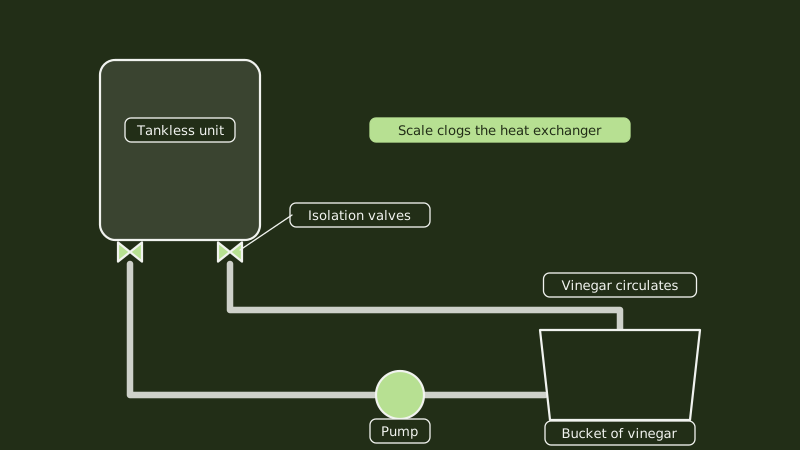
Makers typically call for periodic flushing, commonly yearly and sooner in hard water, and your manual states what Rinnai requires for your model and warranty. Many units come with isolation valves and service ports for this. Without them, a plumber can add the valves, which turns future flushes into a one-hour job.
The flush itself circulates a descaling solution, often white vinegar or a made-for-the-purpose product, through the heat exchanger with a small pump, then rinses with fresh water. It is a doable job for a careful owner, but a mistake with valves or hoses can leave you without hot water, so use the manual's steps.
Cleaning the cold water inlet filter is a separate five-minute job that helps flow. Two broader pages, water heater on but no hot water and the cold shower guide, list causes that are not specific to Rinnai.
Why is the water lukewarm, or swinging between hot and cold?
Possible causes: scale, a draw too light to keep the burner on, a mixing valve or recirculation loop upsetting the balance, or demand beyond what the unit can heat. A tankless heater only heats water that is flowing, and at very low flow rates it can shut off. A clogged inlet filter or a failing flow sensor are common culprits.
If you added a recirculation pump, a second shower or a high-flow fixture, the unit might be undersized for the new load. Models are rated by gallons per minute at a temperature rise, so a cold winter morning asks more of them than a warm afternoon.
Unit age matters too. Tankless heaters often serve for 15 to 20 years when maintained, and repair makes sense while parts are available and the heat exchanger is healthy. When repair stacks up, compare it to a replacement cost, and see how a new one is installed in tankless install pricing.
Which Rinnai problems need a plumber on site?
When a code returns after the owner checks, when the leak sensor trips, when you smell gas or exhaust, or when the heat exchanger or burner needs to be cleaned or replaced. These involve gas, the sealed combustion path and electrical parts. Whoever services it should carry a California contractor license number you have checked, and permit rules apply if any part of the system changes.
Before the visit, jot down the model number from the label, the code, how long the problem has lasted and what you tried. Say whether there was recent gas or plumbing work in the house.
Pass those details along via the price request form, and we line up a visit. Thinking of a different style of heater? Tank versus tankless compares the two. Other trades sit on the Santa Ana Plumbing Co home page.
Common questions
Why does my Rinnai show code 11 after a gas appliance was added?
New gas work can leave air in the line, and a bigger load can drop pressure. The heater tries to light, finds no flame and stops with code 11. Purging the line or correcting the pipe size is a job for the plumber who did the gas work or a replacement visit, and the unit's inlet pressure may need checking.
How often should a Rinnai be flushed in Santa Ana?
Yearly is a common starting point, and the city's hard water argues against skipping one. Your manual and warranty set the exact rule. Units with a softener upstream may need less. If hot water output slows, codes appear, or the unit is noisy, flush sooner and clean the inlet filter.
Is it worth repairing an older tankless heater?
Often, yes. Many tankless units reach 15 to 20 years when looked after, so a fix at year eight or ten usually makes sense. The balance tips toward replacement when the heat exchanger is badly scaled or corroded, when repairs repeat, or when parts are hard to find. Get a repair figure and a replacement figure on paper, then compare them.
Can I reset a Rinnai myself?
You can power-cycle it by switching off power for a minute and restoring it, and many codes clear. A code that returns means a real fault. Never bypass sensors, and leave the gas side closed. If there is a gas smell or water inside the cabinet, shut off supplies and call a plumber.
Sources
Last updated