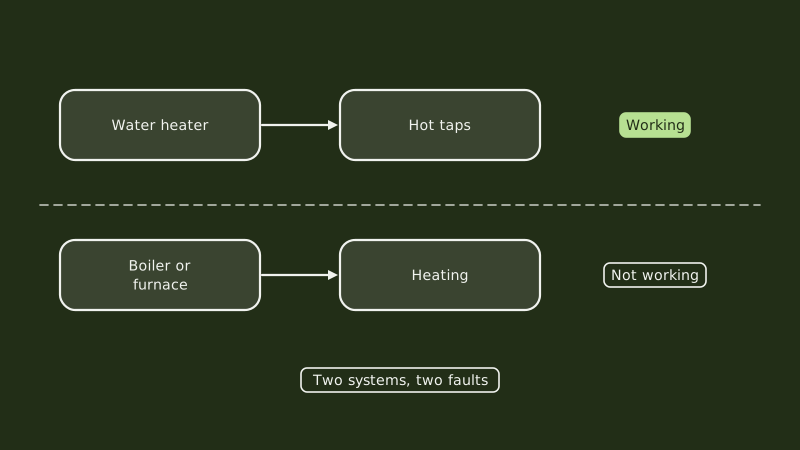
Hot water without heat almost always means two machines, not one. The water heater is fine. The furnace or wall heaters, which are heating equipment and often the job of an HVAC contractor, are what stopped. A home with a single boiler or combination unit doing both jobs is the exception in Orange County. If your question is really about replacing a water heater with a tankless model, the main page on tankless and water heater work is the starting point, and the second half of this one covers installation.
First a quick sort of which system is down and who to call, then what a gas tankless installation requires in a Santa Ana house.
Why would hot water work when the heating does not?
Because most homes here heat air and water separately. A gas or electric furnace, or wall heaters, warm the rooms, while a tank or tankless heater makes hot water. A tripped breaker, a dead thermostat battery, a clogged filter or a furnace that failed to ignite can stop the heat and leave the taps untouched.
Quick checks you can do without tools:
- Thermostat: fresh batteries, set to heat, a few degrees above room temperature.
- Breaker and wall switch: furnaces often have a service switch that looks like a light switch.
- Filter: a clogged one makes some furnaces shut down on high temperature.
- Pilot or igniter: if the furnace has a pilot, relight it only by the label's steps, and never with gas in the air.
If none of that restores heat, that is a furnace repair, and an HVAC contractor is the right call. We arrange plumbers, and a plumber can only help where water or gas piping is involved.
Should gas ever be in the air, everyone walks out of the house, and the call to SoCalGas, 1-800-427-2200, happens from the yard. Dial 911 for any immediate danger.
What if there is heat but no hot water?
Then the problem sits on the water side. On a gas tank heater, suspects include a pilot that blew out, a worn thermocouple or a tripped thermostat. On an electric tank, a heating element or breaker. On a tankless unit, an error code, a blocked vent or a gas supply that was shut. Each has its own page.
For an outage with no obvious cause, start with water heater on but no hot water, or the broader no hot water checklist. To judge how fast to move, read whether no hot water counts as an emergency.
When a pilot refuses to stay lit, look at the thermocouple, a small sensor that keeps the gas valve open only while a flame burns. If it fails, the gas shuts off by design. Replacing it is a short repair.
What goes into hanging a tankless unit?
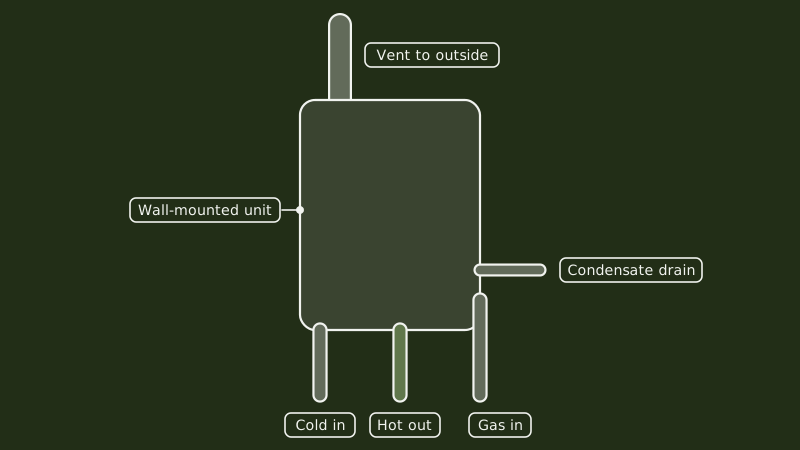
Installation means mounting the unit on a wall, running gas piping sized for its burn rate, venting exhaust outdoors, providing power for the electronics, adding isolation valves for flushing, and usually a condensate drain. A permit and an inspection close it out.
Each of those can change the price:
- Gas line. A tankless heater can draw up to about 199,000 BTU an hour, far more than a tank that burns around 40,000. A 3/4 inch gas pipe is the common minimum, and a longer run may need larger pipe. A half-inch branch that fed a tank is often too small.
- Venting. Units use stainless steel or plastic vent pipe, depending on the model. The manufacturer's manual sets the material, the number of elbows and the maximum length.
- Power. Even gas models draw electricity for ignition and controls, which leaves you without hot water in a blackout unless a battery backup is fitted.
- Water. Isolation valves with service ports let you flush scale. Santa Ana's water runs hard, near 250 parts per million, and scale clogs the narrow passages inside a tankless unit.
- Condensate. A condensing model captures extra heat from its exhaust and produces acidic water that must drain to a proper spot at a slight downhill slope or be pumped.
What do the code requirements say about installing a water heater?
California rules touch strapping, permits, safety valves, combustion air and gas piping. Tank heaters must be braced under state law. A tankless unit must be mounted per the manufacturer. Gas units cannot go in a sleeping room unless they are direct vent. Permit paperwork often includes gas pipe sizing and the maker's venting instructions.
Which code applies? The California Plumbing Code governs piping, venting and the relief valve discharge. The state's energy standards add rules on insulation and, for new construction, readiness for certain equipment. Local building departments adopt and enforce them, which is why the City of Santa Ana's permits counter is the place to confirm what your address needs. More detail sits in the page on water heater permits.
Two more points matter in Orange County. The regional air district, South Coast AQMD, sets nitrogen oxide limits for gas water heaters, so the unit must be a model that qualifies. And SoCalGas owns the meter, so a big new load such as a tankless heater plus a furnace and range can bump into what the existing meter and house piping can carry. A plumber will check before quoting.
What is different about a condensing, natural gas tankless heater?
A condensing unit squeezes more heat out of its exhaust, so its exhaust runs cooler and the maker may allow plastic vent materials like PVC, CPVC or polypropylene. The tradeoff is a condensate drain and a higher purchase price. A non-condensing natural gas unit uses stainless vent and has no drain, but wastes more heat.
Condensing models suit homes where a drain is close by, say a garage floor drain or the laundry standpipe. Where the unit sits on a far wall, running a drain can eat up the savings. The plumber should say which type fits your layout before you commit.
Propane versions exist but need different orifice and pressure settings, which are not interchangeable with natural gas without the maker's conversion kit.
Why hire a professional for a tankless installation?
Gas, venting and permits put this squarely in a plumber's hands, one holding a California contractor license. An installer who skips the gas sizing may starve the unit, giving fault codes and cold water on a busy morning. A vent put together wrongly can leak exhaust into the home. The inspection exists to catch both.
Before you sign, ask for the quote to show the gas line size and length, the vent material and route, the condensate plan, the permit fee, and the manufacturer's warranty terms. Ask about flushing too: units in hard water need cleaning about once a year, or twice if the water is very hard.
For costs, see what a tankless install costs and the wider water heater replacement cost page. Weighing the two types is easier with tank versus tankless. To have a plumber examine your setup, begin with the price request form. Everything else we arrange is on the Santa Ana Plumbing Co home page.
Common questions
Can a tankless water heater also heat my house?
Some can. Combination units and hydronic systems serve both hot water and radiators or air handlers, and they are common in colder climates. Most Santa Ana homes use a furnace for heat, so a standard tankless heater serves only the taps. Check the manual for the model before assuming it can do both.
How many hours does the job take?
Swapping like for like in an easy spot may fill most of a day. New venting, bigger gas pipe, a condensate drain or electrical work stretches that, and inspections add waiting. Ask the quote to list inclusions, and ask when the gas will be off.
Which details belong in the written quote?
Look for the contractor's license number, verified on the state board's site. Expect the quote to name who pulls the permit, the gas pipe size, the vent plan and the warranty terms. Flushing valves deserve a line too, because they make the yearly cleaning far easier.
Should I stay home while it is installed?
Have someone present when it starts, to point out the gas meter, the shutoff and the work area, and when it ends, to watch the unit run. Hot water, and sometimes gas, will be off for stretches. The plumber needs clear access to the utility space.
Sources
- Wikipedia, Tankless water heater
- Wikipedia, Water heating
- California Energy Commission, Residential Compliance Manual, water heating chapter
- South Coast Air Quality Management District, Rule 1146.2
- City of Santa Ana, Permits Counter
- SoCalGas, safety and prevention
- City of Santa Ana, water quality FAQs
Last updated