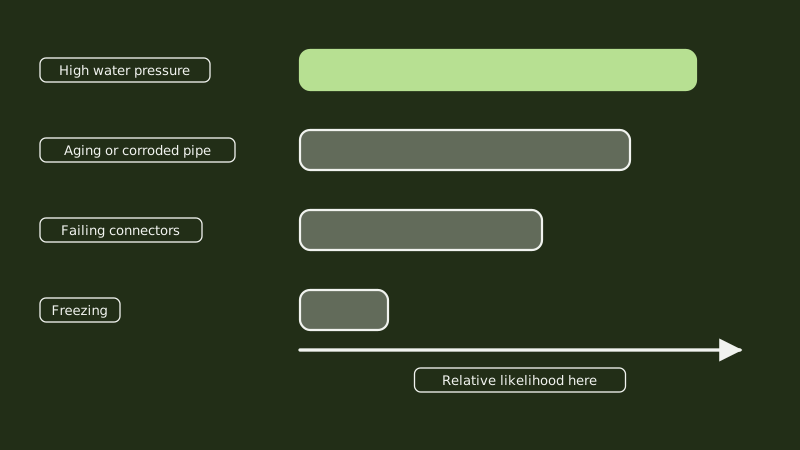
Three habits stop most bursts: keep water pressure in check, retire pipe that has worn out, and learn the main valve's location while nothing is wrong. Frost counts for less here than back east. When a pipe does give way, our burst pipe guide and the notes on a same-day burst pipe call explain the next move.
The list below runs from biggest risk reduction down. An afternoon covers the first half yourself. The second half needs a plumber, and the quote page takes your request for a price.
What actually makes pipes burst in Santa Ana?
Three things, in this order: high water pressure, aging or corroded pipe, and failing connectors. Freezing is a distant fourth in this climate. A burst is the end of a slow process, such as years of corrosion thinning the wall or hammering pressure loosening a fitting, so prevention means catching the slow part.
Pressure is the cause people never measure. When supply pressure exceeds what the pipework was built for, each joint, valve and appliance hose lives under constant strain. Industry summaries of section 608.2 of the California Plumbing Code say a regulator is required once static pressure passes 80 psi, and a regulator that has quietly failed lets street pressure straight through.
Age is next. A lot of Santa Ana housing was built between the 1920s and the 1950s, when galvanized steel was standard for water lines. Galvanized rusts from the inside, narrows and eventually splits. Copper from later decades can develop pinholes. Plastic fittings and rubber hoses simply get brittle.
Then connectors. The braided hose under a sink, a washing machine hose, a toilet supply line and a water heater flex connector are cheap parts that fail suddenly and put out a lot of water.
How can I measure the pressure in my house?
Thread a cheap pressure gauge onto an outside hose bib or the laundry faucet, open that tap fully and read the dial while nothing else runs. A healthy home sits comfortably below 80 psi. A needle above that suggests the regulator is failing or absent, and that deserves a plumber.
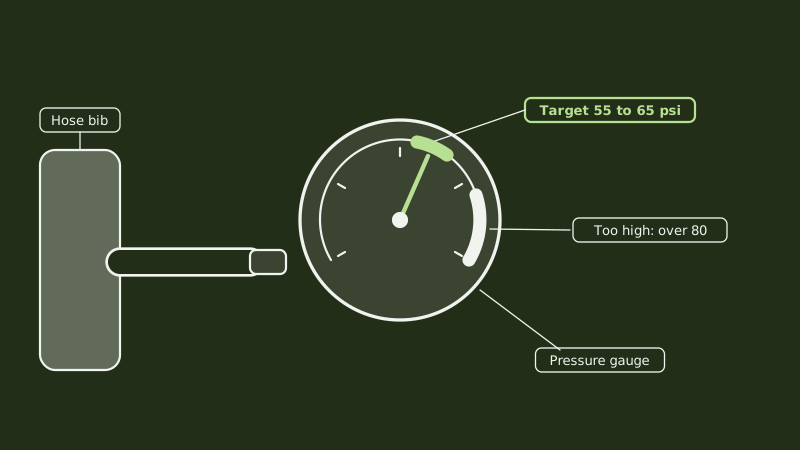
Gauges cost little at hardware stores. Take readings at night and in the morning, because supply pressure moves through the day. A regulator looks like a brass bell, usually sitting just past the main shutoff, with an adjusting screw on top. If your reading is high, or the house bangs when a tap closes, read our pages on replacing a water pressure regulator and the banging sound of water hammer.
Do not turn the adjustment screw to chase a number unless you know the setting. A wrong setting can leave the shower weak and the pressure unevenly high elsewhere. And if you have a regulator, the water heater generally needs an expansion tank, since the regulator closes the system. The Department of Energy lists a correctly sized expansion tank as protection against early tank failure from thermal expansion.
Could a hidden leak already be developing?
Read the water meter, wait two hours with every tap, appliance and sprinkler off, then take a second reading. If the reading shifts, water is escaping somewhere. EPA WaterSense pairs that check with a toilet dye test: a little food coloring in the tank, ten minutes of waiting without flushing, then a look at whether the bowl water has changed color.
Slow seepage within a wall or under concrete can go for months before it surfaces as a stain, a floor that feels warm or a higher bill. A sudden rise in the bill is the most common clue. Our page on high water bill causes takes you through it, and slab leak repair explains what happens when the leak is under concrete. Plumbers carry leak detection equipment, acoustic or thermal, to pinpoint a drip behind drywall without opening the whole surface.
If you find one, close the shutoff and call. Do not wait for it to turn into a burst.
Which old pipes should I replace first?
Start with pipe that is both likely to fail and hard to reach: galvanized steel, polybutylene, and copper that has already leaked twice. All three turn up in Santa Ana's older and mid-century housing. Repiping costs more than patching, yet a house with two leaks behind it often has more to come.
A rough order of concern:
- Polybutylene (flexible plastic pipe fitted in many North American houses between roughly 1978 and 1997): linked to leaks and splits from chlorinated water. See our guide on polybutylene pipe replacement.
- Galvanized steel: brown stains, low flow and rust at joints are the signs.
- Copper with pinholes or green crust at fittings.
- Cast iron or clay drains, which fail by cracking and roots rather than bursting.
A visit with a pressure test and a close look at the fittings usually lets a plumber judge condition. The price depends heavily on house size and access, so look at repipe pricing before you decide. A repipe needs a city permit, which the plumber normally handles.
What cheap parts are worth swapping for burst prevention?
Trade rubber washer hoses for braided stainless, renew aged supply lines under sinks and toilets, and make sure the water heater connectors have a working shutoff. Each costs little beside what one failed hose can ruin, and each takes under an hour.
Check the age. If you cannot tell when a hose went in, treat it as old, since rubber fails with no warning. Look for bulges, rust at the crimp collars and water stains below. On the water heater, Department of Energy material puts storage tank life near 10 to 15 years, and a tank that has started to leak is replaced rather than mended. Knowing the age of the heater lets you replace it on your own schedule instead of at midnight.
Leak sensors are worth considering. These are small battery units that sit on the floor by the water heater, dishwasher and under sinks and sound an alarm, or send a phone alert, when they get wet. Some automatic shutoff systems close the main when a sensor trips. They go on the main line, so a plumber should fit one.
Do I need to protect pipes from cold in Santa Ana?
Rarely, but a cold snap can catch you out. Water freezes at 32 degrees F, and hose bibs, sprinkler lines and bare pipe in attics and garages go first. Insulate exposed pipe and cover outdoor spigots before a forecast freeze. Illinois Extension advises keeping the heat at 55 degrees or above and opening cabinet doors under sinks.
Because hard freezes are unusual, many local houses have bare supply pipe up in the attic or down below the floor. A couple of dollars of foam sleeves on exposed runs is cheap insurance, and a foam cover on each outdoor spigot takes minutes. If a freeze is forecast, let a tap drip overnight on the coldest wall. For more on cold-weather bursts, see why pipes burst in winter.
A torch or open flame has no place near a frozen pipe. Warm it with a hair dryer on low, tap open, and phone a plumber if you see a crack.
What should I do before a trip or a long absence?
Shut the main valve and open one tap briefly to relieve the lines. If that feels like too much, at least close the washing machine shutoffs and any appliance with a supply hose. Check that the heater is set to a vacation or lower setting. A burst while you are away runs unnoticed for days, which is why a closed main is the cheapest protection.
Ready.gov's advice applies in every house: find the main shutoff, tag it, and be sure everyone knows where it is. Test it once a year. A valve that sticks halfway or will not close needs replacing, and that is a quick job.
Ask a neighbor to look in while you are away, and give them the shutoff location. Photograph the meter reading before you leave so you can tell on return whether water ran.
Common questions
Will my homeowner policy pay for a burst pipe?
Policies differ, though sudden damage tends to be covered and slow leaks tend not to be. Read yours and put the question to the insurer before a loss, not after. Insurance and burst pipes lays out the usual dividing line. Photograph damage before cleaning.
How often should old pipes be inspected?
Look at exposed pipe, hoses and the water heater once or twice a year, and read the meter if the bill jumps. For hidden pipe in a mid-century house, a plumber's visit can assess the condition. There is no fixed schedule; condition and age drive it.
Will a pressure regulator stop pipes from bursting?
It lowers the odds a lot, because most bursts involve high or spiking pressure on weak pipe. It does not stop corrosion. Pair it with a water heater expansion tank, since a regulator closes the system, and keep the gauge handy to confirm the reading stays in range.
Do leak detectors really help?
Yes, as an early warning. A sensor on the floor under the water heater or dishwasher tells you the moment water appears, hours or days earlier than a stain would. It will not find a leak inside a wall. A plumber's detection gear or a meter test covers that.
What if the pipe has already let go?
Turn the main valve off, drain the lines, photograph the mess and call a plumber and the insurer. If you smell gas, leave the house and ring SoCalGas from the yard on 1-800-427-2200. Spotting a pipe burst behind the wall lists the signs.
Other repairs mentioned above are among the services listed on the Santa Ana Plumbing Co home page.
Sources
- EPA WaterSense, Home Maintenance and Fix a Leak Week (meter check, toilet dye test)
- Illinois Extension, Water Pipes (cold weather precautions)
- Ready.gov, Safety Skills (main shutoff valve)
- California Plumbing Code, section 608.2 pressure limit, as summarized by industry references
- U.S. Department of Energy, Energy Saver Guide (water heater life, anode rod, expansion tank)
Last updated