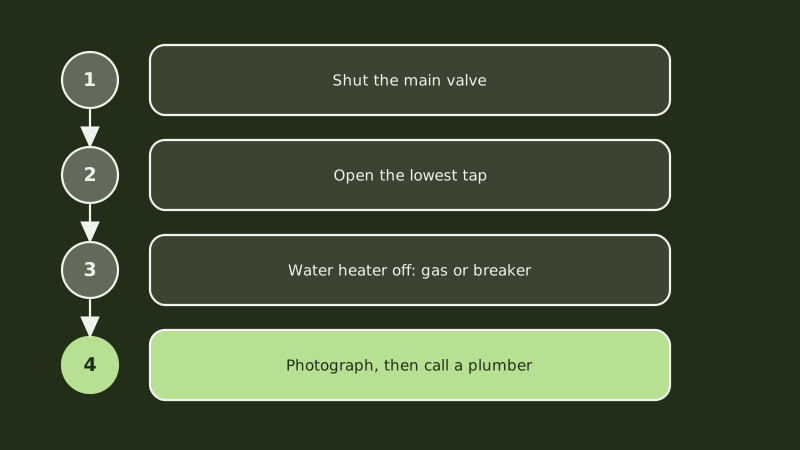
When a pipe bursts, the order never changes: main valve shut, lowest faucet open, water heater switched off, electricity cut near wet areas where that is safe, photos taken, plumber phoned. Repair and drying follow. The service side of this is on our burst pipe page, and this guide is the homeowner's timeline.
Santa Ana homes rarely see a hard freeze, so bursts here usually trace back to other causes. We cover them below.
Which steps come first when a pipe lets go?
Turn the main water valve off. Open the lowest faucet or hose bib so the pipes bleed down. Shut the water heater off, and keep clear of any outlet that water has reached. Lift rugs and valuables out of the wet zone, photograph the scene before moving anything, and then ring a plumber.
Two details deserve a word. The water heater first: with the cold supply shut, the tank can still push hot water through the break, and an electric element left running dry can burn out, so kill the gas or the breaker. Then the electrics: moisture around a panel, an outlet or a ceiling fixture is a shock hazard. Trip the breaker only from a dry floor. Failing that, get out and call the electric utility or 911.
A main that will not budge sends you to the meter box, usually a concrete or plastic lid near the curb, where a meter key or pliers turn the stem. A pipe wrench on a seized valve only cracks it.
Where is the main water shutoff in a Santa Ana house?
It is usually on the front exterior wall, by the hose bib, or in the garage where the supply enters. Some houses have it in a ground box beside the meter. Find it before an emergency and tag it. A round gate valve turns clockwise until it stops, and a lever handle ball valve turns a quarter turn.
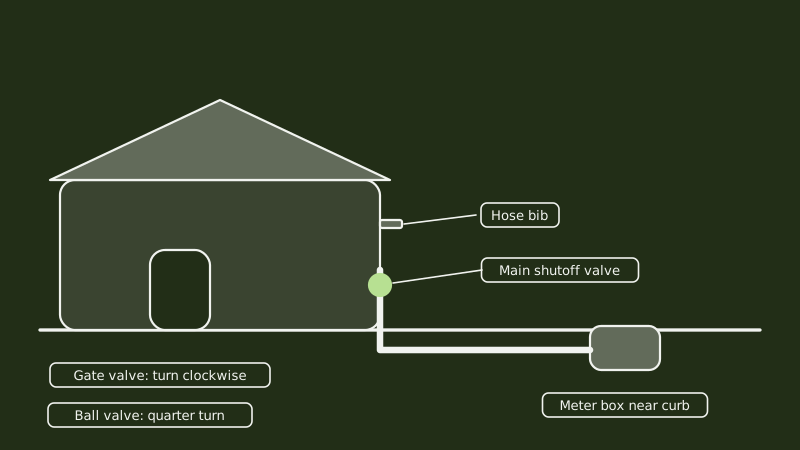
Many older Santa Ana houses, 1920s through 1950s construction, still have the original gate valve. These seize when they sit untouched. Work yours shut and open each autumn so it never locks up. If it leaks around the stem or will not turn, that is a quick replacement job for a plumber, and worth doing before the day you need it.
Why do pipes burst in a place that never freezes?
Mild climate does not protect pipes. The usual causes here are old corroded galvanized or copper lines giving way, water pressure above the 80 psi ceiling that the state plumbing code sets for homes with a regulator, water hammer from fast-closing valves, failed fittings and the push of tree roots or shifting soil. Earthquakes can also break connections.
Hard water speeds some of this. The City reports hardness around 15 grains per gallon, and scale narrows pipes, raising velocity and stress. Galvanized steel rots from the inside, so a pipe can look fine and fail at a threaded joint. If bursts keep happening, check the pressure. A cheap gauge on a hose bib reads it, and a pressure regulator that has failed lets street pressure into the house. See where the pressure regulator is located and burst pipe prevention.
Some bursts are not bursts. A pinhole or loose joint behind a wall can do the same damage over weeks. The clues are listed in spotting a burst pipe: a bill that spikes, a faint rushing sound, damp patches on walls.
Does a burst pipe need a plumber right now?
Ring the same day when water still runs after the main is off, when the break sits inside a wall or ceiling, when the main will not close, or when water has reached electrics. If the flow stops and the damage is contained, a next-business-day visit is usually fine, and often cheaper than an after-hours trip.
After-hours calls commonly carry a flat surcharge of about $150 to $300 in published guides, so the main valve is your best friend. Once the water is off, dry what you can, and wait for a plumber who can take time to find the cause. For the urgent route see our emergency plumber page and the burst pipe emergency page.
What does the plumber do when a pipe has burst?
The plumber finds the failed section, cuts it out, and replaces it with new pipe and fittings, then restores pressure and checks for other weak points. If the pipe is old, the plumber may recommend replacing the run or the whole house. Repair of walls, flooring and paint is a separate set of trades.
Expect the plumber to test the pressure and look at the rest of the line. A single repair on pipe that has failed once often fails again nearby. Ask for the failed section to be shown to you, and ask what the cause was. Cost depends on access, pipe type and time of day, and our burst pipe repair cost page gives ranges.
What should I do about the water damage and the insurer?
The EPA wants soaked areas dried within a day or two, since mold can take hold after that. Photograph and list damaged items before you clean, keep receipts for drying equipment and repairs, and call your insurer promptly. Ask whether your policy covers the damage, and in what circumstances the pipe repair itself is covered.
Cleanup and what to discard are covered in what the water does to a house, while insurance and burst pipes goes through typical policy wording. Do not start tearing out drywall before the insurer has had a chance to see the damage, unless wet material is dangerous or sagging.
How do I stop it from happening again?
Test your water pressure, replace aging supply lines before they fail, exercise the main valve each year, and know where the shutoff is. Consider a pressure regulator and expansion tank if pressure runs over 80 psi. If a plumber finds galvanized or polybutylene pipe, plan a repipe rather than patching it piece by piece.
Santa Ana's older stock is the main risk, so a pipe inspection before a bathroom remodel or sale is cheap insurance. Your pipes are easier to judge in person, so file the details on the price request form and we arrange for a nearby plumber to inspect.
Common questions
How fast can the water spread?
Yes. A broken half-inch supply line can release many gallons a minute at household pressure, so a room can be soaked in under an hour. That is why the first move is the main valve, before towels or calls. Every minute the water runs adds to the drywall, flooring and drying bill.
Is switching the power off the right move?
Only if the breaker panel is dry and you can reach it without stepping in water. If water is near outlets, the panel or ceiling lights, stay out of the area and call the electric utility or 911. Do not switch things on or off with wet hands or from a wet floor.
Will home insurance pay for it?
Often sudden water damage is paid and the failed pipe itself is not, though that hinges on the wording and the cause. Gradual leaks are treated differently and sometimes excluded. Check the policy with your agent, take photos before cleanup, and hold on to every invoice.
Is a do-it-yourself fix wise?
A bolt-on clamp or push-fit sleeve can hold a simple break for a few days. Lasting repairs belong to a plumber, and replacing a run of pipe means a permit. Gas lines are off limits to homeowners. A gas smell means stepping outside first and then ringing the gas company on its emergency line, 1-800-427-2200.
For the wider picture, start with plumber across Santa Ana.
Sources
- US EPA, A Brief Guide to Mold, Moisture and Your Home (dry water-damaged areas within 24 to 48 hours)
- California Plumbing Code section 608.2, excessive water pressure (regulator when static pressure exceeds 80 psi)
- Contractors State License Board, Learn About Home Improvement Contracts
- Angi, how much an emergency plumber costs, 2026 (flat emergency fee $150 to $300)
Last updated