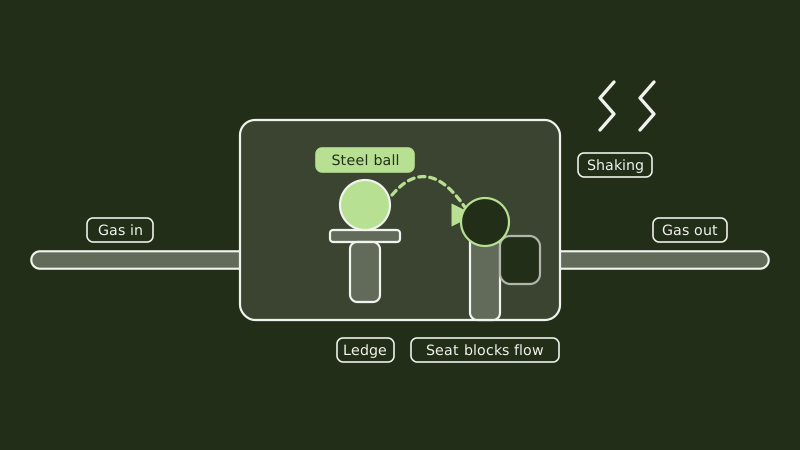
Orange County sits among active faults, and a hard shake can rupture an appliance connector or a rigid gas pipe. The answer many owners choose is a seismic gas valve: a mechanical device bolted onto the house gas line just past the meter. It senses strong motion and snaps shut without any human help, starving a potential fire. Gas piping is regulated, so a contractor does the work under a city permit, and a local plumber comes out through an arrangement we make. Our wider gas coverage begins at gas line pipe work, and everything else we organize in Santa Ana is collected on the home page.
How does a quake-triggered gas valve behave?
Inside is a spring-loaded or ball-type mechanism that drops into place when ground motion passes a set level. After that, gas stays out of the house until a person resets it by hand. It needs no electricity and responds to shaking, not to smell, so it can act before anyone realizes a pipe let go.
Two different devices are often confused. The seismic valve discussed here lives downstream of the meter, on the house piping and reacts to shaking. An excess flow valve senses a sudden surge in flow, as from a broken pipe, and is typically placed on the utility's underground service line. The valve at the meter itself belongs to SoCalGas, and only it or its authorized contractors may operate it.
California runs a testing and listing program for these devices through the Division of the State Architect, so ask that the quote name the model and its listing.
Do I need one in Santa Ana?
Rules vary, and we could not confirm a single state-wide requirement, so ask the City of Santa Ana Building and Safety division what applies to your address. Some cities require a valve at a major remodel or when a home is sold, and lenders and insurers sometimes ask for one. SoCalGas does not require them but speaks well of them in high-risk areas.
A few practical notes for central Orange County homes:
- Older houses here, from the 1920s through the postwar tract era, often have rigid steel gas pipe and flexible appliance connectors that age. Both can fail in a strong quake.
- Gas water heaters and furnaces are the largest sources of risk, so strapping and connector condition matter as much as the valve. See repairing a gas water heater for what a plumber checks.
- If your city or buyer asks for a valve, get the requirement in writing before paying for an install.
Whether a valve is mandatory or optional for you, it is a measure that reduces the chance of a gas fire after a big shake. It is not a replacement for knowing where your meter shutoff is, and it does not catch a slow leak.
What should I do after an earthquake?
Check for gas before anything else. A gas smell, a hiss or any other sign of escaping gas means everyone walks outside, and you call SoCalGas on 1-800-427-2200 the moment you are well clear of the building. Dial 911 as well when someone is hurt or at risk. The utility advises leaving the meter alone unless a leak is suspected and the valve is safe to reach.
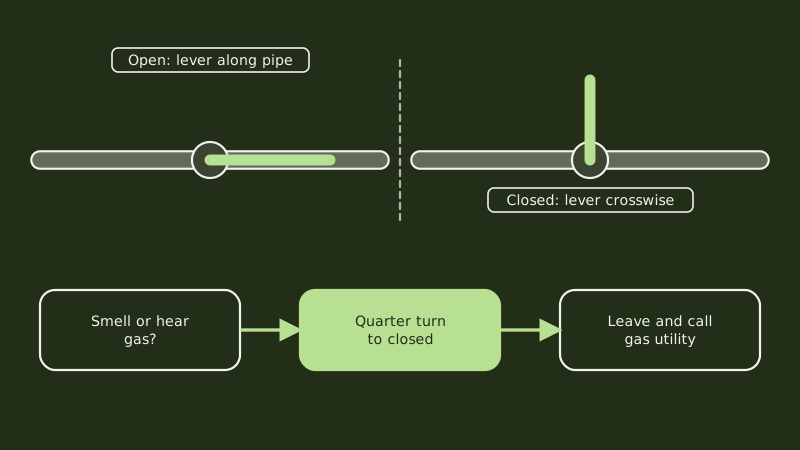
Avoid anything that sparks while you leave: no lighters, no flipping light switches or appliances. And do not trust your nose alone, since the odor can fade over time.
If the meter valve must be closed, a 12-inch adjustable wrench or larger gives enough leverage. Give it a quarter turn until the valve sits crosswise to the pipe. Then leave it. Reopening it yourself is not safe: SoCalGas restores service once the house piping and appliances have been inspected.
SoCalGas takes emergency calls day and night. Our enquiries are answered weekdays from 9am to 5pm, so we are not an emergency service, and smelling gas means calling the utility first.
How is a seismic valve installed, and who can do it?
A plumbing contractor cuts into the gas line downstream of the meter, fits the valve level and plumb, secures it, tests for leaks, and arranges the city inspection. Regulated gas piping and California's contractor license rule for jobs of $1,000 and up leave this to a contractor rather than a weekend handyman. The valve must be mounted correctly or it will not trip properly.
What to expect on the day:
- The plumber confirms your pipe size and picks a valve rated for that size and flow.
- The permit is pulled from the city. In Santa Ana that office is Building and Safety.
- Gas is shut off, the valve is installed and sealed, and pilots and appliances are relit.
- A leak test follows, and the city inspector signs off.
- The plumber shows you how to reset the valve.
Because gas work is closely controlled, the process for permits is described in how to pull a plumbing permit. Pipe materials and code points are collected in residential gas piping codes and the pipe used for natural gas lines.
What should I budget for a quake valve?
Published California contractor pages put installation at roughly $200 to $800 for most homes, with the permit often included, and some higher outliers for awkward access. That is a guide drawn from contractor marketing, so expect your actual written quote to differ. Valve size, pipe access and city permit fees move the number.
| Item | Rough guide |
|---|---|
| Valve part alone | about $100 to $200 |
| Standard home install with permit | about $300 to $800 |
| Combination valve | towards the upper end |
| Hard-to-reach pipe or larger line | higher |
Installation commonly takes one to four hours, according to those same contractor pages. Wider gas pricing sits in the gas line cost guide. A written price gets agreed first.
How do I reset a valve that has tripped?
Follow the maker's instructions, and only if you are certain nothing is leaking. SoCalGas recommends that it, or a qualified professional, handle the reset, the appliance leak check and the pilot relighting. If gas odor appears at any point, the valve stays closed while you step outside and phone.
The general pattern for resetting a mechanical seismic valve is to make sure appliances are off, then lift a lever or press a plunger as the instructions say. That step is why the valve needs a person and does not reset alone. If the valve restarted gas on its own into a damaged pipe, a fire or explosion could follow. A fuller walkthrough is in resetting a quake gas shut-off valve.
Common questions
Does a seismic valve stop every gas leak?
No. It answers strong shaking, nothing more. A slow seep from a tired fitting will not trip it, and a leak beyond the valve is still possible. Any gas odor counts as an emergency whatever hardware you own: get outside and phone SoCalGas.
Who can restart the gas at the meter?
Only SoCalGas or its authorized contractors. If you closed the meter after a quake, leave it that way and report it, and service resumes after the house piping and appliances pass a check. The seismic valve downstream of the meter is a separate device with its own reset steps.
Can I install the valve myself?
Not safely. Gas piping is regulated, and a poorly mounted valve can trip at the wrong moment or fail to trip when it should. Hire a plumbing contractor, and confirm that both the city permit and the final inspection appear in the written quote.
Is the valve required when I sell my house?
It depends on the city and the buyer's lender or insurer, and I could not confirm one rule for every address. Ask Santa Ana Building and Safety, or the building department of whichever central Orange County city your property sits in, because each city runs its own office.
What else should I check for earthquake safety?
Look at water heater straps, flexible gas connectors and where the meter and shutoff sit. Know how to shut off water at the street valve or the main. Keep an adjustable wrench near the meter, and post the SoCalGas emergency line where every family member can see it.
Sources
- SoCalGas, natural gas leaks and emergency information
- SoCalGas, emergency information
- Published installation prices from several California contractors, checked November 2026
- California Division of the State Architect, gas shutoff devices
Last updated