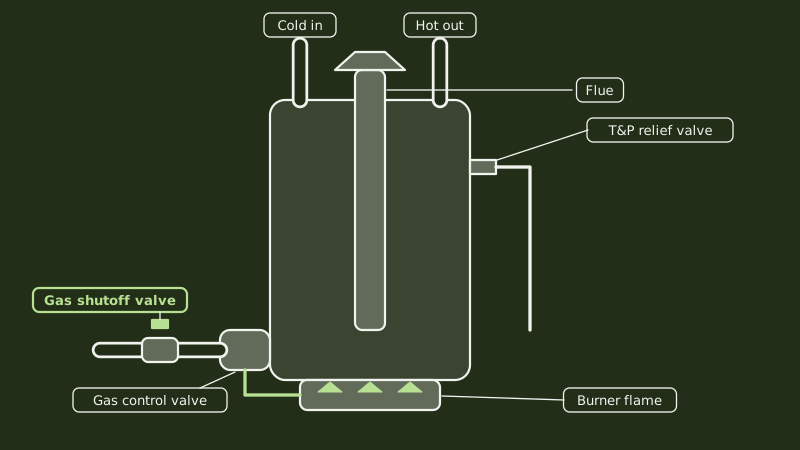
Two safety points come before any repair, and the water heater overview covers the rest. On a gas smell, step outside; SoCalGas answers its emergency line at 1-800-427-2200, and 911 is there for real danger. Headache, dizziness or nausea in the house means fresh air at once and a 911 call, since a faulty gas appliance can give off carbon monoxide. Neither one is a to-do item for later.
Once those are clear, a gas heater that gives little or no hot water tends to come down to a short list of suspects: the pilot, the part that senses it, the gas control, the thermostat setting, sediment or a vent problem. A few you can check in minutes. The rest involve gas piping and belong to a plumber, whom the quote page can arrange. An aging unit may also be a candidate for tankless water heater installation.
What stops a gas water heater from making hot water?
Typical causes: a flame that blew out, a tired thermocouple or flame sensor cutting the gas, a gas control or thermostat that has died, a closed supply valve, or a tank packed with scale. A blocked vent can shut the burner down too. How the heater behaves tells you which one applies.
Read the symptom, find the likely part:
| What you see | Likely cause |
|---|---|
| Pilot relights, then dies once you release the button | Worn thermocouple or sensor |
| Pilot lit, burner never comes on | Gas control valve or thermostat |
| Burner runs but water stays lukewarm | Sediment in the tank, a failed dip tube, or a setting that is too low |
| No flame, no pilot, dead display on a newer unit | Igniter, control board or power supply fault |
| Burner starts, then shuts off, soot on the draft hood | Venting or combustion air problem |
| Rumbling or popping noises | Sediment cooking on the tank bottom |
Pilots get their own page: pilot light repair. If the tank seems fine but taps stay cold, a heater that runs without giving hot water covers the crossover cases.
Which checks are safe for a homeowner?
You can confirm the gas valve on the supply line is open, read the thermostat setting, look over the vent and draft hood for blockage or scorching, and relight the pilot by working through the label on the tank. Opening the gas control, bending or disconnecting gas pipe, and re-sealing gas fittings are all for a plumber.
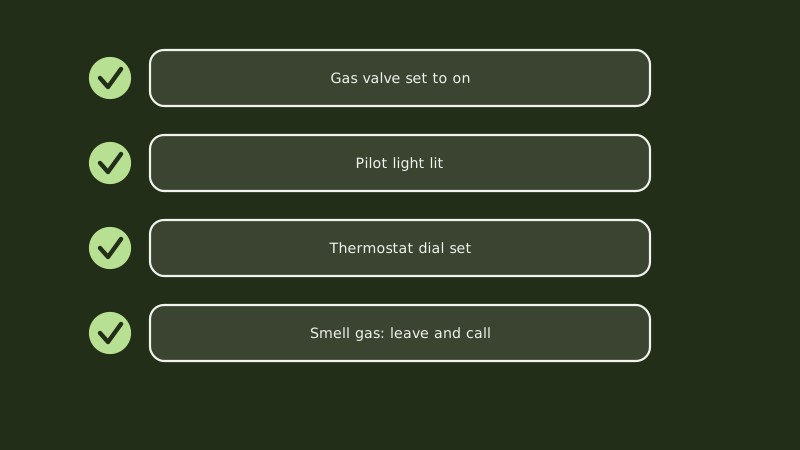
A sensible order:
- Gas supply. The shutoff on the pipe feeding the heater should sit in line with the pipe, not across it. If it was closed, open it slowly.
- Thermostat. The dial on the gas control sets the water temperature. About 120 degrees F is a commonly used setting. A knob turned to vacation or pilot gives lukewarm or cold water.
- Relight the pilot. Use the instructions printed on the tank. When the flame keeps dying after two or three attempts, stop, because more tries will not cure a worn sensor.
- Look at the flame. A steady blue flame is normal. A yellow, floppy or sooty flame is a sign to stop and call.
- Look at the vent. Check that the pipe above the tank is attached and that the draft hood is not scorched or blocked. Never block combustion air around the heater.
- Test for carbon monoxide. Make sure a working battery-operated alarm sits on each level and near bedrooms, as the Consumer Product Safety Commission advises.
If any step shows a gas smell, a hissing sound, scorching or soot, shut the heater off at the control and call.
Which gas heater repairs are a plumber's job?
Gas piping, the gas control, the burner assembly, venting and a heater that keeps shutting off all go to a plumber. California's contractor license rule begins at permitted work or once the bill for parts and labor reaches $1,000, and gas piping is regulated work. After the repair the plumber also checks for gas leaks and carbon monoxide.
Typical plumber jobs:
- Replacing a thermocouple, flame sensor or igniter.
- Swapping the gas control or the thermostat.
- Flushing sediment from the tank, or replacing the dip tube.
- Changing the T&P relief valve.
- Repairing or replacing vent pipe and checking draft.
- Inspecting the tank, anode rod and connectors for leaks and wear.
Santa Ana asks for a permit when a regulated plumbing system is replaced or altered, which covers a water heater replacement. A minor part swap is usually a repair rather than a permitted replacement, but the plumber will know which applies and will pull a permit when needed.
What does a gas heater repair run?
Water heater repairs show up in guides mostly at about $150 to $600, with a gas control valve at the top of that range. A relief valve swap commonly costs $150 to $300. Which part fails, how easy it is to reach and what time the visit happens all push the figure, and a call-out fee may be billed apart.
National cost figures are a guide only, so the plumber's written price after a look at your unit is the number that counts. Ask what the price covers: parts, labor, call-out and any permit. A garage or closet with tight clearance adds time.
When a repair quote approaches half the cost of a new heater, replacement deserves a hard look. A new 40 to 50 gallon tank, installed, appears in Angi's 2026 data at about $880 to $1,830, and the Santa Ana breakdown is in replacement cost for a water heater.
Should I repair it or replace the heater?
Repair a young heater with a single failed part. Replace one that leaks from the tank, is past about ten to fifteen years old or keeps needing repairs. The Department of Energy puts typical storage tank life at 10 to 15 years, and a tank that has rusted through cannot be fixed.
A few guidelines:
- Age. Check the serial number or date label. Over a decade, expect more failures.
- Rust and leaks. Rusty water, a wet base or a corroded tank bottom means replacement.
- Repeat repairs. Two repairs in two years usually mean more are coming.
- Anode rod. A tank that is otherwise sound can last longer if its anode rod is replaced. See anode rod replacement.
- Efficiency. A gas tankless unit is pricier at the start and can outlast a tank; the tank versus tankless comparison weighs the trade.
Santa Ana's very hard water, around 250 parts per million according to the city, leaves scale in tanks and on burners, which is a reason to flush a gas heater on a regular schedule. SoCalGas publishes rebate lists for qualifying high-efficiency models, and I would check the current list before buying, since amounts and eligibility change.
Can I keep running a gas heater that is misbehaving?
Not when there are signs of gas, soot, a yellow flame, an exhaust smell or carbon monoxide symptoms. A heater that is merely cold can sit off safely until repaired. Set the control to off and have it examined, and resist the urge to keep relighting a flame that will not hold.
Keep in mind the heater is typically in a garage or closet in a Santa Ana home. Do not store paint, solvents or anything flammable near it. If it is in a closet, keep combustion air openings clear.
Common questions
Why will the pilot not stay lit?
Most often a worn thermocouple fails to sense the flame and cuts the gas. Drafts, a dirty pilot orifice or a failing gas control can do the same. When a relight lasts only minutes, stop and let a plumber check it, because the cause involves gas parts.
The heater area smells like gas. Now what?
Treat it as a leak. Walk out without touching any switch, and from the yard phone SoCalGas, 1-800-427-2200. Anyone in danger makes it a 911 call. Searching for the source is not your job. Gas piping repair is professional work, and the utility will say when it is safe to go back in.
How long does the visit last?
Changing a thermocouple, relief valve or thermostat generally means one to two hours. Flushing a scaled tank adds time. If the visit exposes a failed tank, it turns into a replacement quote that takes a few hours of its own. Ask for the time and price up front.
Is turning the thermostat up a way to get more hot water?
Only within the label's limits. Hotter water scalds more easily, particularly children and older adults, and speeds scale. About 120 degrees F is a commonly used setting. If the hot water runs out quickly, the cure may be sediment removal, a bigger tank or a tankless unit instead of a hotter dial.
Does fixing a gas heater need a city permit?
A small part swap usually does not, but replacing the whole heater does, since Santa Ana asks for a permit before a regulated plumbing system is replaced or altered. When in doubt, ask the plumber or the city's Building and Safety Division, and read the water heater permit guide.
Our other services are laid out on the home page.
Sources
- SoCalGas, Natural Gas Leaks
- U.S. Consumer Product Safety Commission, Carbon Monoxide Information Center
- U.S. Department of Energy, Energy Saver Guide (water heater life, anode rod, expansion tank)
- California Contractors State License Board, AB 2622 minor work limit
- City of Santa Ana, When is a Permit Required?
- HomeTips, water heater repair cost (national figures, read November 2026)
- Angi, water heater replacement cost 2026 (tank-style $881 to $1,826)
Last updated