Two facts shape most plumbing calls in Garden Grove: the tap water is very hard, and the typical house is already past fifty. That combination wears out heaters, valves and old pipe in a recognizable way. A local plumber we arrange comes out, inspects, then gives you a figure in writing. Wider context lives on the areas page, and the quote form is where a request starts.
What does Garden Grove's water do to pipes and water heaters?
The city's 2025 water quality report, built on 2024 testing, gives groundwater hardness of 316 ppm on average (18 grains per gallon), swinging between 189 and 374 ppm. Imported treated water averages 270 ppm, or 16 grains. On the USGS scale, anything over 180 ppm counts as very hard, so both sources qualify.
Per the city, what comes out of your faucet is a blend: mostly groundwater from 11 wells in the Orange County basin that OCWD manages, plus treated surface water that MWDSC imports out of Northern California and the Colorado River. The blend varies by street, which is why next-door neighbors may report different scale.
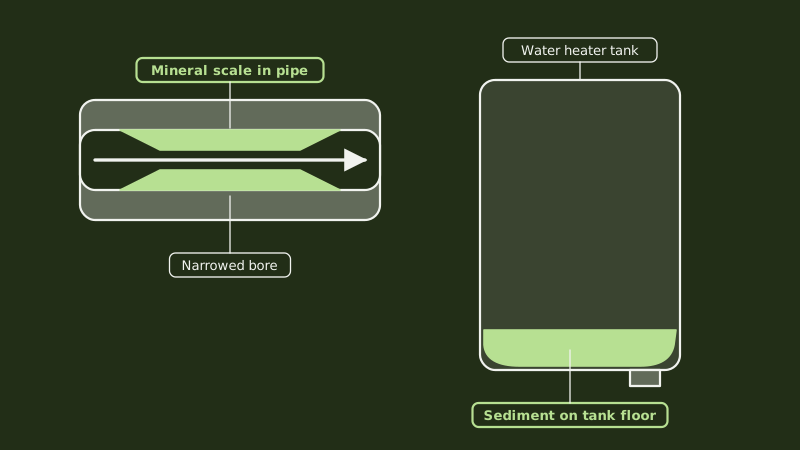
Hardness leaves mineral crust. Expect it on heating elements and tank floors, inside shower heads, aerators and cartridges, and as a lining in old pipe. A tank heater in water like this often slows down before it ever leaks: rumbling, long recovery, or a hot supply that fades are typical hints. Draining the tank and inspecting the anode rod are the routine fixes. For do-it-yourself descents on crust, try removing hard water scale; for a softener, softener plumbing explains the hookup.
One reassuring line from the same report: in the 2022 tap sampling, copper came in at 0.11 ppm at the 90th percentile against a 1.3 ppm action level, and lead stayed under its limit. That describes the city system, not the inside of a specific house, where an old fitting or solder joint can behave differently.
What fails first in a Garden Grove house from the mid-century tracts?
The median Garden Grove home dates to 1964. The city's housing element, drawing on 2010 census estimates, shows 42 percent of units from 1960 to 1979 and 38 percent from 1940 to 1959, with only about 8 percent built since 1990. Original lines, valves and drains in those houses have been in service for six decades or close to it.
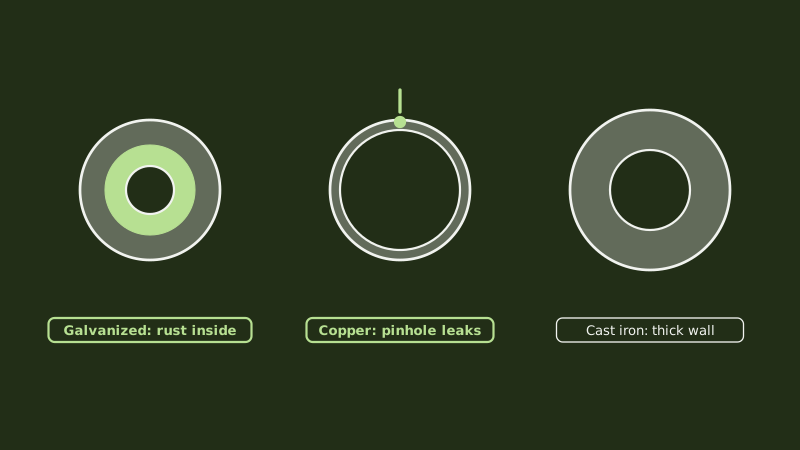
We cannot see behind your walls, so read the list below as common trouble spots for houses of that age, not as a diagnosis. In tracts like these, expect copper supply, drains of cast iron or clay, and the odd leftover galvanized run.
- Pinhole leaks in copper. Hard water plus decades of flow thins pipe walls. A damp patch, a ceiling stain or a water bill that creeps up gives it away. Details in pinhole leaks in copper pipe.
- Drains that keep slowing. Old cast iron roughens as it rusts, and clay laterals invite roots. A camera pass shows whether a spot repair will do or a longer run needs replacing.
- Stuck or weeping valves. Original angle stops and main valves often seize, then drip the first time anyone turns them.
- Slab leaks. Plenty of tract houses stand on concrete, with supply pipe buried in or beneath it. Floor tile that feels warm, or water audible with every fixture shut, points there. Fix-or-repipe tradeoffs are laid out in slab leak repair.
- Repeat leaks everywhere. At some point a repipe beats patching. Read about repiping with PEX and PEX against copper.
Roughly 31 percent of the city's housing is multi-family. In an apartment or condo, the shared main, your unit's shutoff and ownership of the pipe inside the wall may sit with the building, so ask the manager or association before booking.
How much should a plumbing job in Garden Grove run?
Garden Grove prices track the wider central Orange County market, so the cost guides on this site are the right starting point. They are guide ranges, not offers. The plumber looks at the actual job and then writes the figure down. Scale, a valve that snaps when touched or a cramped attic can each shift it.
The page on hourly plumber rates works with roughly $75 to $150 per hour. Water heater replacement runs about $900 to $3,900 depending on tank or tankless and the venting. Each lists where its numbers came from.
Three things lift a Garden Grove price. Scale comes first: a heater or valve that spent fifteen years in 18-grain water may fight back on removal. Access is second, since slab foundations, crawlspaces and apartment shutoffs add labor. Code catch-up is third, because a replacement often needs strapping, an expansion tank or vent corrections the old unit never had.
Which plumbing jobs in Garden Grove need a city permit?
Often a water heater swap, a repipe and any new or moved gas line do. Garden Grove's Building and Safety division issues permits, with an online application and a counter. Whoever does the work normally files it, and the written price ought to show if the fee is inside.
The city's Building and Safety page says the counter accepts applications until 4:00 pm Monday to Friday. For a specific job, phone (714) 741-5307 or email building@ggcity.org and ask what applies, since that page does not list plumbing permits by type. The permit walkthrough explains the steps and what an inspector checks.
Gas piping is where the law draws a hard line: state rules reserve it for people who hold the proper contractor classification, so do not extend, cap or relocate a gas line yourself. If you smell gas, get everyone outside first, then phone the SoCalGas emergency line, 1-800-427-2200. Anyone hurt or at risk means 911. The seismic valve has its own page: emergency gas shutoff in an earthquake.
Anyone you hire can be checked by license number on the California state contractor board website, cslb.ca.gov.
What helps a Garden Grove visit go smoothly?
Weekdays work best, since the phone line runs 9 to 5 Monday through Friday. Streets in the city are flat and mostly gridded, with driveways, curb parking and apartment lots all common, so mention where a van can stop and whether a gate needs a code.
Pull together this short list ahead of time:
- The location of the main shutoff, and whether it still turns.
- The heater's fuel type and age, printed on its label.
- Slab or raised floor, if you know.
- One or two phone photos of the leak, stain or fixture.
When water keeps flowing and the main valve will not turn off, phone immediately. Stay clear of outlets, cords and appliances near standing water.
Common questions
What do plumbers charge in Garden Grove?
A fair guide is $75 to $150 an hour, with set prices on standard jobs such as a heater swap. Final figures depend on access, scale and parts. The plumber writes the price down after seeing the job, and the price request form starts that process.
Is the tap water in Garden Grove hard?
Yes. The city's 2025 water quality report lists groundwater at 316 ppm average, about 18 grains per gallon, and imported water at 270 ppm. Both count as very hard by the USGS scale. The report shows it meeting drinking standards, but it does leave scale on heaters and fixtures.
Does a water heater replacement in Garden Grove need a permit?
Usually yes. Water heater replacement, repiping and gas line work typically need a permit from the city's Building and Safety division, and the plumber normally pulls it. To confirm what a particular job needs, call the permit counter at (714) 741-5307 before work is scheduled.
Do older Garden Grove houses have more plumbing trouble?
Age matters more than the exact neighborhood. The city's housing data puts the median home at 1964, and about 82 percent of units were built before 1979. Original copper, cast iron drains and aging shutoff valves are the parts to watch, and a camera inspection can show the drain side.
Prefer to start from the front page? Go to Santa Ana Plumbing Co.
Sources
Last updated