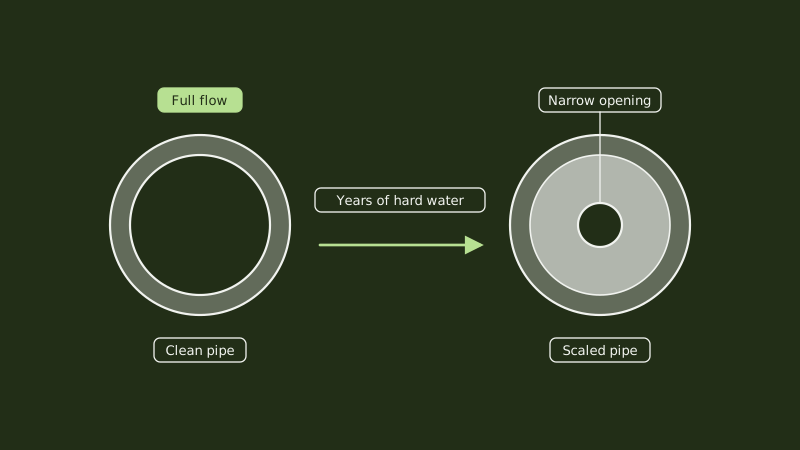
White crust on a showerhead, chalky film on shower glass and a water heater that grumbles at night tell one story: calcium and magnesium left behind when hard water dries or heats up. You can wipe off the surface mess with household acid, flush the tank, and slow the build-up with a softener. Installing one involves cutting into your supply lines, and our water softener installation page covers that side.
Why does Santa Ana water leave so much scale?
Because it is hard. The City of Santa Ana lists its water at roughly 250 parts per million, about 15 grains per gallon, and the USGS scale calls anything above 180 milligrams per liter very hard. Heat and evaporation drop those minerals out of the water as a stone-like crust on whatever it touches.
Santa Ana's supply is mostly local groundwater with some imported water mixed in, and hardness shifts a little through the year and between neighborhoods. Your own faucet will give the best clue. If the aerator clogs with grit every few months, you are seeing it first-hand. Scale matters beyond looks: it insulates heating surfaces, so a coated element or tank bottom wastes energy, and it narrows pipes and valves over the years.
How do I remove scale from faucets and showerheads?
Unscrew the part and let it sit in white vinegar for roughly an hour, then scrub with an old toothbrush, rinse and refit. A showerhead can stay in place: slip a vinegar-filled bag over it and fasten it with a rubber band. Use a cloth, not a metal brush, on shiny or colored finishes.
Practical notes:
- Check the finish. Brass and chrome tolerate vinegar for an hour. Brushed, matte-black or "living finish" fixtures can dull, so read the maker's care sheet first.
- Never mix vinegar with bleach or a cleaner containing it. The mixture gives off chlorine gas.
- Faucet aerators unscrew by hand or with a cloth and pliers. Soak the screen and the little washer separately.
- Citric acid powder stirred into warm water works too, minus the smell.
- For glass, a vinegar-soaked cloth held against the stain for several minutes works better than scrubbing.
For stubborn buildup that surrounds a cartridge or a valve stem, stop. Forcing a seized part can crack a fixture or twist a supply line, and then you are paying for a repair on top of the scale.
Does flushing the water heater help with scale?
It helps. Scale and grit collect on the floor of a tank water heater, where they cushion the burner or element and make the tank rumble. A flush, done once a year or as the manufacturer advises, carries some of it out. A tank that is badly encrusted may never fully clear, and a very old one can leak once disturbed.
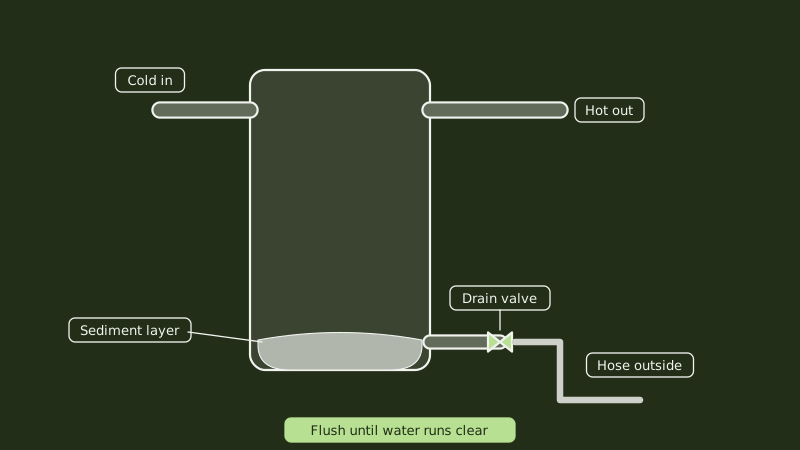
Water above 140 degrees Fahrenheit builds scale faster, so a setting near 120 helps. On a gas heater, you will need to shut off the gas control first, and on electric, switch off the breaker so the elements are never energized while the tank is empty. If the drain valve is crusted shut or keeps dripping afterward, leave it for a plumber. Why age matters for tanks is explained in the page on replacing a water heater by age, and the anode rod replacement guide covers a related tank-life job.
What stops scale coming back?
A water softener is the standard answer. Through ion exchange it exchanges hardness minerals for sodium or potassium, so less scale forms on fixtures, elements and glass. Cheaper add-ons, such as filters and descaler devices, vary a lot in results. Softening does add sodium or potassium to the water and uses salt or potassium pellets.
Before you choose, weigh up a few Santa Ana facts. Some California communities limit salt-regenerating softeners because of wastewater rules, so check with your water provider and your HOA if you have one. Softeners need a drain connection, power and a bypass, and they sit best near the main line. Our guides to preventing hard water scale and to what removes scale compare options, and the softener installation cost page gives a price range. If you are wondering about bills, see whether a softener can raise your water bill.
Is a DIY water softener install realistic?
Some people do, since a basic unit comes with a bypass valve, fittings and instructions. But it means cutting into the supply line, soldering or using push-fit fittings, routing a drain hose to an approved discharge point, and plugging in power. A mistake floods a garage or house. Permits may apply, and a plumber can handle the whole job.
If you go the do-it-yourself route, work in this order:
- Turn off the main, then open the lowest tap to depressurize the pipes.
- Pick a spot after the main shutoff, before the water heater, and keep the outdoor hose bibs on unsoftened water if you wish.
- Install the bypass valve first, then the unit inlet and outlet in the right direction. Arrows on the head show flow.
- Leave an air gap on the drain hose. It must not be sealed directly into the sewer line.
- Flush, restore power and program the regeneration schedule to match your hardness.
Where the water is part of a rental or a condo, the owner or association may need to approve the work. If you are unsure about soldering, a drain connection or a permit, hire it out. Most installs pass the $1,000 mark once the equipment is counted, and in California a job of that size needs a contractor license, and cslb.ca.gov is where you verify one.
What are the signs that scale has clogged my pipes?
Look for falling pressure at one faucet, then several, discolored water, a water heater that takes longer to heat and white crust at joints. These can indicate scale or corrosion narrowing the lines. A plumber can inspect, and if older galvanized pipe is involved a repair may mean a repipe instead.
Want a number for a softener or any job above? Send a price request and a local plumber visits the house. Browse everything else from the Santa Ana Plumbing Co home page.
Common questions
How often should hard water scale be cleaned?
In Santa Ana's hard water, showerheads and aerators tend to need a soak every few months, and glass a wipe weekly. Water heaters get a flush yearly or as the maker advises. If the crust returns within weeks of cleaning, treating the water at the source will save you effort.
Does vinegar damage pipes?
A short soak on a fixture is fine. Rinse it afterward. Hours of contact can pit some finishes and perish rubber seals, so keep it out of tanks and supply lines, and away from natural stone. Rinse thoroughly, and keep it away from natural stone.
Is scale in my water heater dangerous?
Usually it is a cost and noise problem, as the heater works harder and runs less efficiently. Heavy buildup can overheat tank parts and shorten the life of the heater. On the tank, the relief valve is the safety device and must never be capped or blocked. A rumbling, leaking or very old tank deserves a plumber's look.
Will a softener remove all scale from existing pipes?
No. A softener prevents most new scale but does not dissolve what is already there in any quick or dependable way. Existing crust at fixtures can be soaked off, and badly narrowed pipe may need replacing. Expect cleaner fixtures and less crust over the following months.
Do softeners change how water tastes or the safety of drinking it?
Softened water carries a little more sodium or potassium, which matters if you follow a low-sodium diet, so ask your doctor if unsure. Many households keep a separate unsoftened cold tap at the kitchen sink for drinking, which a plumber can arrange when the unit goes in.
Sources
Last updated