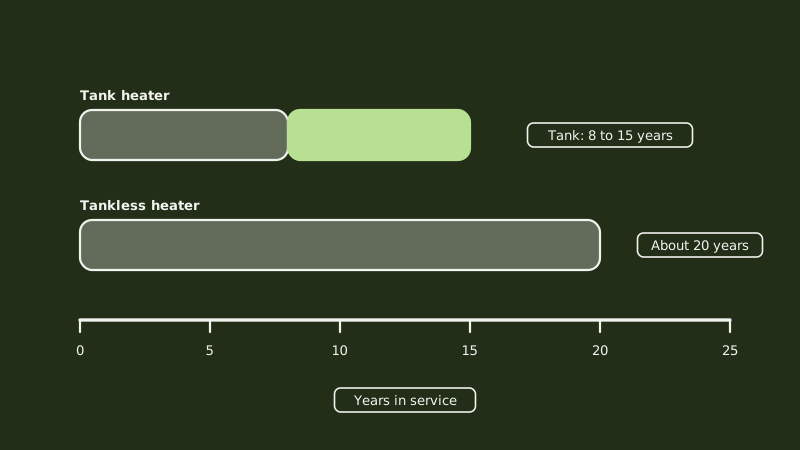
A storage tank water heater is usually replaced somewhere between year 8 and year 15, with 10 to 12 the figure most plumbers quote. A tankless water heater can run for around two decades, provided someone descales it. In Santa Ana, where the city's water runs near 15 grains per gallon, expect the lower half of those ranges unless the heater gets maintenance. If yours is already failing, see water heater installation and replacement.
Ahead: how to read the warning signs, how to date your own tank, and and the point where repairing stops making sense.
How long does a tank water heater really last?
Most storage tank water heaters last 8 to 15 years. Gas-fired tanks cluster toward the short end, roughly 8 to 12 years, while a maintained unit with a fresh anode rod can outlast that. Sediment, hard water and a rusted-through liner finish most of them. After a tank starts leaking, only replacement helps.
The numbers come from manufacturers, home inspector charts and the Energy Department's general guidance, and they differ a bit by source. Read them as a guide only. Your own heater tells you more: the date on its data plate, the state of its base, and how the hot water has been behaving lately.
A magnesium or aluminum anode rod hangs inside the tank and corrodes on purpose so the steel does not. When that rod is spent, the steel itself begins to rust. That is why a rod swap is the cheapest way to extend life, and why anode rod replacement is worth knowing about.
And a tankless unit, how many years does it get?
A tankless water heater typically lasts about 20 years, roughly double a tank, and many of its parts can be replaced individually. The catch is scale. In very hard water the heat exchanger clogs with mineral buildup, so a yearly descaling flush is what turns a 10-year unit into a 20-year one.
Their price tag is higher at the start. The tradeoffs are laid out in tank vs tankless water heaters. They also need the right gas line size and venting, which is part of why installs differ so much in price.
Where do I find the manufacture date on my heater?
Check the data plate stuck to the tank's side. The serial number encodes the month and year it was made, usually in the first digits or letters, and each brand uses its own code. Search the brand name with "serial number date" or ask a plumber. The plate also shows capacity, fuel and warranty length.
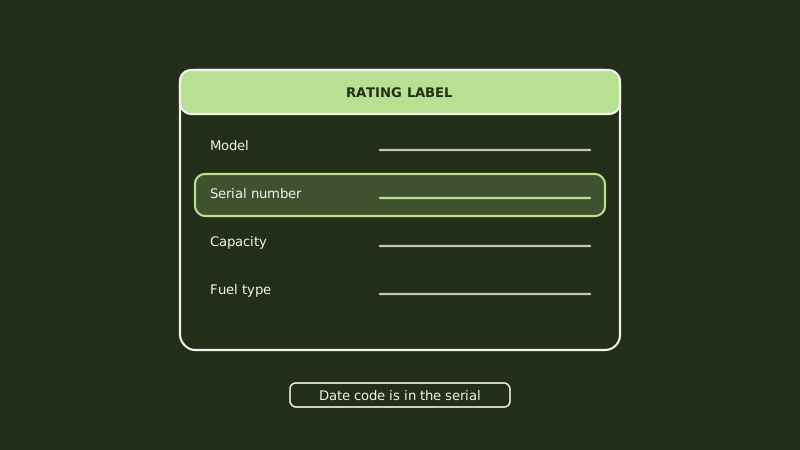
Never date the heater by the house. A Santa Ana home built in 1948 has had several, and the sticker on the tank beats any guess. A heater in a garage is easy to inspect. One in a closet or attic takes more care, because a leak there damages drywall.
What are the signs a water heater is near the end?
Warning signs: rust-tinted or cloudy hot water, rumbles and pops from the tank, a puddle at the base, crusty fittings, a tank older than ten years, and a hot supply that gives out sooner than before. A puddle is the one sign that cannot wait.
Those noises are sediment talking. Scale from hard water settles on the tank floor, the burner or element must heat through it, and the tank wears out sooner for it. Rusty hot water beside clear cold water points at the tank instead of the pipes.
When the heater stops making hot water altogether, the cause can be small, a pilot light or a tripped breaker for instance. Check the no hot water causes before deciding anything.
When is a repair not worth it?
Fix it while the heater is under about 8 years old and a single component failed, such as a thermostat, element, igniter or valve. Swap it when it is past 10 to 12 years, if the tank leaks, or if a single repair would swallow half of what a new heater costs. A leaking tank cannot be patched.
Guide prices run about $150 to $350 for an anode rod job, $300 to $550 for a gas control valve, and $1,100 to $2,500 for a standard tank swap. Size and fuel move those figures, so a written quote matters. Detailed numbers are on what replacement costs, and a leaking heater has the stopgap steps.
Does Santa Ana's hard water shorten a water heater's life?
Yes, it can. According to the city, hardness here sits near 15 grains per gallon, and that counts as very hard. Minerals settle out when water is heated, so scale builds on the tank floor or on tankless heat exchangers. Two habits offset the damage: an annual flush, and a periodic look at the anode rod.
A flush is a drain-and-rinse of the tank through the drain valve, and it is a reasonable job for a handy owner if the valve is not seized. Old valves often clog or break, so if yours is stuck, stop and call a plumber rather than force it.
What does replacement involve, and what rules apply?
The City of Santa Ana lists water heater replacement as work that needs a permit, issued by its Building Safety Division. State law also requires bracing for new and replacement water heaters, with one strap high on the tank and another low, in the upper and lower thirds. The installer normally deals with both the permit and the straps.
Gas water heaters also need correct venting, a shutoff, and a sediment trap, and if you ever smell gas, get outside first and dial the gas company's emergency number, 1-800-427-2200,. Permit specifics are on the permit rules for a heater swap, and a quote starts on the price request page.
Home page: Santa Ana Plumbing Co.
Common questions
Are there habits that stretch a tank's life?
Somewhat. Drain a few gallons each year, get the anode rod looked at now and then, test the relief valve, and keep the thermostat moderate. Each step slows the corrosion and scale that kill tanks, though none of them can save a tank that has already begun to seep.
Does fixing a ten-year-old tank make sense?
Usually only for a cheap part. At 10 years you are near the end of the typical range, so spending a large share of a new heater's price on a repair rarely pays. If the tank is dry and the repair is small, it can buy a year or two.
Is it smarter to swap it ahead of a failure?
If it is past 12 years, many plumbers advise yes, because a planned swap costs less than an emergency one and avoids water damage. Failures tend to happen at night and on weekends. Planning lets you choose between tank and tankless and pick a time for the permit.
Which lasts longer, gas or electric?
Published figures usually show electric tanks lasting a little longer than gas, with gas around 8 to 12 years and electric closer to 10 to 15, but the gap is small and water quality matters more than fuel. Maintenance is the bigger factor.
Sources
- US Department of Energy, Energy Saver guidance on water heater types and lifespans (typical figures; the original page has moved, so figures are treated as a guide)
- City of Santa Ana, Water quality FAQs (hardness about 15 grains per gallon)
- City of Santa Ana, Permits Counter (water heater replacement needs a permit)
- California Health and Safety Code section 19211, water heater bracing, as summarized by city building departments
- Published water heater repair and replacement price guides, checked November 2026
Last updated