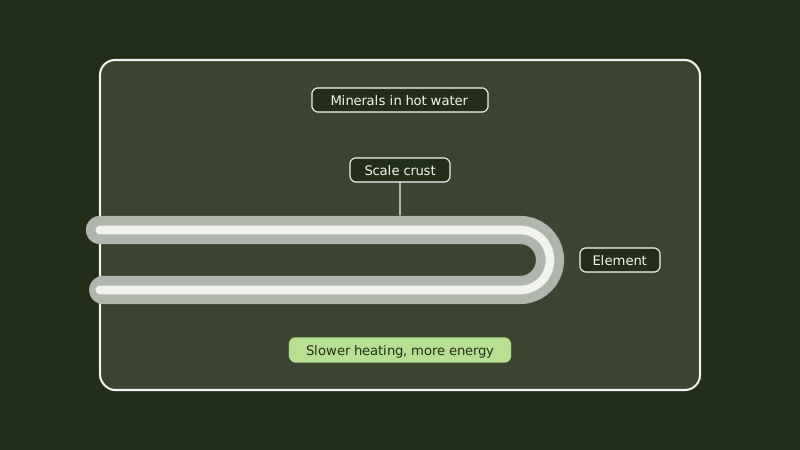
Scale is what hard water leaves behind when it is heated or evaporates: a pale crust of calcium carbonate on heating elements, tank floors, shower heads and faucet tips. You prevent it by removing the hardness before the water is heated, with a softener, or by limiting the heat and flushing what builds up. The water softener installation page covers the equipment route.
Santa Ana sits at the hard end of the scale. The City's water quality FAQ gives its hardness as about 250 parts per million, roughly 15 grains per gallon, and that is a long way past the point where scale shows up on glass in a week. The rest of this page decodes that number and lists the countermeasures.
How hard is Santa Ana water, and what do the numbers mean?
Santa Ana water measures around 250 ppm, about 15 grains per gallon, which the USGS classes as very hard (above 180 mg/L). Water from the City's wells ranges more widely, from roughly 8 to 24 grains per gallon, according to its 2022 water quality report, so the figure at your tap can move with the source.
Three scales appear in reports. Milligrams per liter and parts per million are the same thing for hardness. Grains per gallon is the American softener-industry unit, and the City's report gives the conversion: one grain per gallon equals 17.1 mg/L. In USGS terms, soft water is under 61, moderately hard runs 61 to 120, hard is 121 to 180, and anything above that is very hard.
A common mix-up is pH. The pH scale measures acidity, not hardness, so the two numbers on a report are separate. When someone quotes a "hard water rating," ask whether they mean ppm, mg/L or grains per gallon.
About three quarters of the City's supply comes from local groundwater, and the remainder is imported water, per the City's report and FAQ. Both carry hardness. The City's own page is the place to check the current figure for your address.
What causes hard water scale to form?
Dissolved calcium and magnesium come out of solution as water heats, and they settle as solid calcium carbonate on whatever surface is hottest or wettest. The hotter the water and the more of it you heat, the faster the crust grows, so water heaters, kettles and dishwashers collect it first.
The mechanism is chemical. Bicarbonate in the water breaks down under heat and leaves carbonate, which combines with calcium into rock-like deposits. Wikipedia describes the same pattern in heat exchangers and boilers. Scale is a poor conductor of heat, so it acts like insulation on an element or the floor of a gas tank, making the heater work harder.
The USGS lists the household effects: more soap needed, spotted dishes, scale in water heaters and pipes that shortens equipment life, raises heating costs and narrows pipe. It adds that hardness is not a health concern. Scale is a plumbing problem, not a drinking-water problem. Removing scale that has already formed is the subject of two other pages, one on clearing hard water scale and one on what dissolves it.
Which steps prevent scale buildup in a Santa Ana home?
The most effective step is softening the water before it reaches the heater. Beyond that, a lower heater temperature, a yearly tank flush, and cleaning aerators and shower heads all slow the damage. None of them removes hardness from water already in your pipes, but together they stretch the life of fixtures and heating equipment.
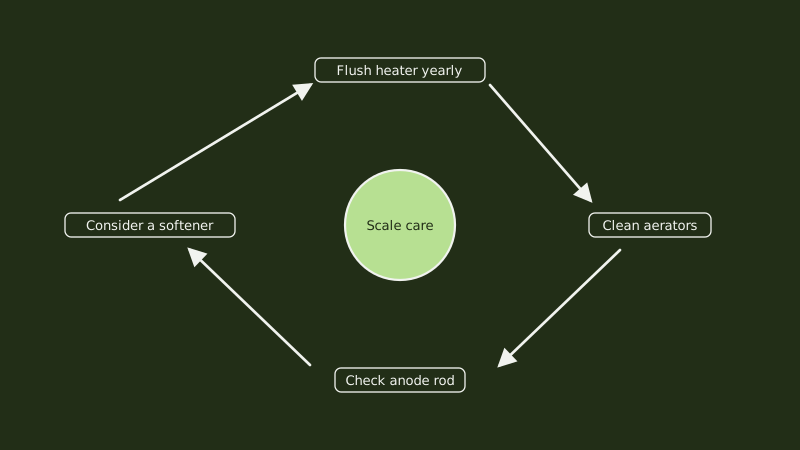
- Soften the water. A salt-based ion exchange softener trades calcium and magnesium for sodium or potassium, the method Wikipedia describes first among softening options. It protects the whole house when sized and set correctly. Cost and sizing are discussed in water softener system installation cost.
- Turn the heater temperature down. Heat drives scale. A commonly cited setting is about 120 degrees Fahrenheit, which slows scale and lowers scald risk. Check the heater label and what your household needs.
- Flush the tank. Letting a few gallons out of the drain valve at the tank base each year carries off loose sediment. On a very old tank, a drain valve that has sat untouched for a decade may not close again afterward, so let a plumber try it.
- Descale the small parts. Aerators and shower heads clear up after an hour in white vinegar, a rinse and a soft brush.
- Wipe as you go. A squeegee on glass and tile stops spots before they harden into film.
Do anti-scale conditioners work?
Salt-free conditioners and anti-scale devices claim to change how scale crystals form so they do not stick. Results reported by manufacturers and independent testers differ, and they do not remove hardness the way a softener does. Ask for independent test data, a clear return policy, and a plain statement of what the device does and does not do.
If you want soft water for laundry, skin or glassware, a conditioner will not give it, because the calcium and magnesium stay in the water. If your aim is only to protect pipes and a heater from scale, some households try one. Local plumbers can describe what they have seen in nearby houses, though nobody should promise results for a specific product.
A water test gives you a precise hardness figure at your own tap before you buy anything, and the City's published numbers give a good starting point for sizing.
What does scale do to a water heater, and when should it be replaced?
Scale insulates the tank floor and coats elements, so a gas burner runs longer and an electric element can fail early. A noisy popping from the tank and slow recovery are common signs. In a hard-water house the heater may wear out ahead of the manual's typical lifespan, and the steel tank is the one part that cannot be repaired.
To judge when repair stops paying off, read our notes on water heater lifespan. If your heater has an anode rod, a plumber can inspect it and swap it when it is eaten away, as set out in anode rod replacement.
If a softener is added to a house, ask whether the household bills change. Some owners worry about this, and we explain the facts in can a water softener raise a water bill.
Common questions
What is hard water scale usually caused by?
Calcium and magnesium dissolved in the supply, plus heat. As water warms or evaporates, those minerals form calcium carbonate crystals that cling to surfaces. Santa Ana's water is already very hard by USGS standards, so scale builds quickly on heating elements, fixtures and the inside of tanks and pipes.
How do I measure hard water at home?
Test strips from a hardware store give a rough hardness reading in grains per gallon or ppm. For a more precise figure, a lab test or the City's published water quality report is better. Remember that the strips measure hardness, not pH, so a separate test is needed for acidity.
Is hard water bad for my health?
The USGS says hardness is not a health concern, and drinking water may add some dietary calcium and magnesium. The real costs are practical: soap that does not lather well, spotted glassware, scale in heaters and pipes, and shorter equipment life.
Will a softener stop scale on my fixtures completely?
A properly sized softener removes most of the hardness that creates scale, and fixtures stay cleaner as a result. Spots can still dry onto glass and tile, and softened water does not suit every tap in the yard. A plumber can set up an outdoor hose connection that bypasses it.
For the wider picture, start with the plumber guide for Santa Ana.
Sources
- City of Santa Ana, water quality FAQ (hardness about 250 ppm, roughly 15 grains per gallon)
- City of Santa Ana, 2022 Consumer Confidence Report (groundwater hardness 7.7 to 24 grains per gallon, average 15)
- US Geological Survey, Hardness of water
- Wikipedia, Hard water (scale formation, softening methods)
Last updated