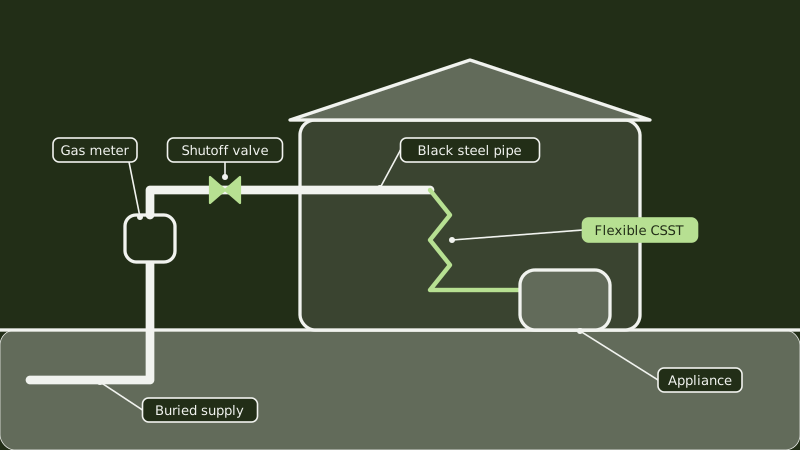
Most gas inside a California house runs through steel pipe, either black or galvanized, or through corrugated stainless steel tubing, known as CSST. Buried lines outside use steel, brass or approved polyethylene. Cast iron and copper are not the answer for gas. The exact rules are written into the California Plumbing Code and enforced by each city, so a Santa Ana job answers to the City of Santa Ana, not to a neighboring town. It supports our broader guide to gas line pipe in Santa Ana and spells out the choices and the legal limits.
Which pipe materials carry natural gas inside a house?
Residential gas piping is normally standard-weight steel pipe (black or galvanized) or CSST, with approved fittings. Local building department handouts that summarize the California Plumbing Code list steel, wrought iron and CSST for above-ground use, and steel, brass or approved polyethylene for underground runs. Cast iron is excluded for fuel gas.
How the materials differ:
- Black steel pipe. The traditional choice indoors. Threaded joints, rigid, sized from tables in the code.
- Galvanized steel pipe. Zinc-coated; allowed in some above-ground uses, and common in older Santa Ana houses.
- CSST. A flexible, ribbed stainless steel tube with a plastic jacket, quicker to run through framing than rigid pipe. The wiki article on corrugated stainless steel tubing notes the lightning-related fire debate, and the code answers it with bonding.
- Polyethylene. Buried yard lines only, never inside a building.
- Copper and brass. Brass fittings and yellow brass in specific buried uses show up in the code, but plain copper water tube is not a gas pipe.
Because rules vary by city and code edition, I am summarizing local handouts from other California building departments, not the City of Santa Ana's own pages, which I could not read. Ask the City before you buy any materials.
Is a half-inch flexible gas line a connector or a pipe?
It can mean two different things. A half-inch flexible appliance connector is the short corrugated hose joining a rigid gas stub to a range, dryer or water heater. A half-inch CSST run is a branch line inside the walls. They are different parts with different rules, and a connector is not meant to be run through walls or floors.
Connectors are sold by appliance rating, with a maximum length set by the maker, and sit exposed between the shutoff and the appliance. They are typically replaced along with the appliance, not reused. CSST, by contrast, is a piping system installed by a contractor, sized for the load, supported to the maker's instructions and bonded.
Sizing matters. A half-inch line carries only so much gas, and adding a range, a fire pit or a pool heater to an existing half-inch branch can starve everything on it. A plumber sizes the pipe from the code tables for total appliance demand and run length, which is why the answer to "will half-inch do" is never simply yes. Pricing effects are laid out in the Santa Ana gas line cost guide.
What rules apply to gas lines outside the house?
Outdoors, pipe must be a material approved for exterior use and protected from corrosion and damage. Handouts that summarize the code say black steel is not for unprotected outdoor use above ground, while galvanized steel, CSST (installed per the maker's rules) and coated or wrapped steel are. Buried lines have their own material and depth rules, and bonding and shutoff valves are checked at inspection.
Typical outdoor jobs include a barbecue line, a gas fire pit, a pool or spa heater, a dryer or a generator. Each needs its own shutoff valve and a pressure test before use. Not every outdoor line is flexible: a flexible hose for a grill is a manufacturer's accessory, not a house gas line.
Underground pipe under or near buildings has extra rules such as sleeving and venting, and I would not guess at them. The plumber and the city inspector decide that.
How deep must a buried residential gas line be?
City handouts built on the California Plumbing Code commonly cite roughly 12 inches of cover over buried steel and 18 inches over polyethylene, though one city's sheet gives 18 for both, so the figure depends on the jurisdiction. Cover is measured from the top of the pipe to the finished surface. Ask the City of Santa Ana's building staff for its current figure before digging.
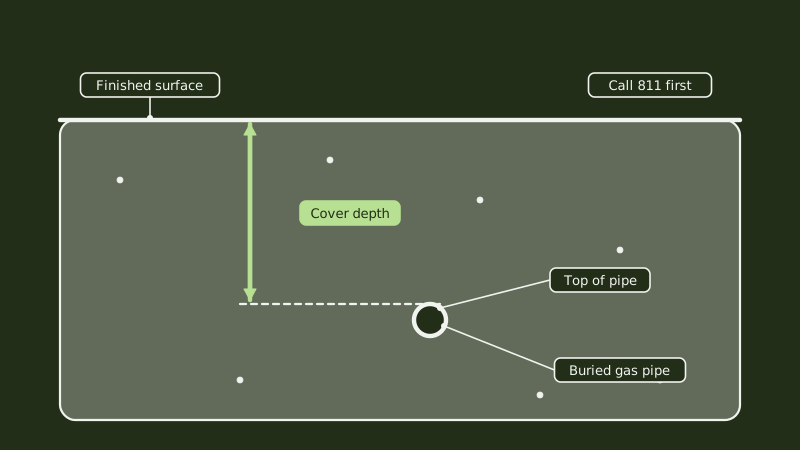
Do not dig for a gas line on your own. State law has you contact 811 before any excavation so utilities mark buried lines, and striking a gas line costs far more than any saving. Buried gas piping is contractor work, and the trench gets inspected before it is backfilled.
Can an owner install a gas line, and what changes for a mobile home?
Gas piping in California is contractor work. Adding, extending or replacing it takes a permit, and the state contractor license applies at $1,000 or more and wherever a permit is involved. An owner's role stops at hooking up an appliance with a listed connector to an existing valve, and even that deserves a professional the first time.
Some city handouts say only a contractor with the proper license may pull the permit. Installation is followed by an inspection and pressure test, and the gas company may have to switch service on. See how to pull a plumbing permit and residential gas piping codes for how the process runs in a Santa Ana job.
Mobile and manufactured homes sit under different construction rules than site-built houses, and the permit agency for gas work may be the city or a state office depending on the case. I could not confirm which applies to a given park, so ask the City's Building and Safety staff and the park management before you plan the work. Our page on a mobile home plumbing inspection covers related ground.
Earthquake shutoff valves are a separate topic; see emergency gas shutoff valves for earthquakes.
What if there is a gas odor near these pipes?
Go out at once with everyone in the house, and from a safe spot report it to SoCalGas, 1-800-427-2200, which answers around the clock. Dial 911 as well when someone is in danger or SoCalGas cannot be reached. Avoid switches, flames and indoor phones, and never trust your nose alone, since odor can fade.
This applies whatever pipe your system uses. A new installation, an old galvanized line and a flexible connector can all leak at a joint. After a leak is stopped, the gas line needs repair by a contractor, and the gas company may need to restore service. A repaired water heater line is covered in gas water heater repair.
Confirm any contractor's number with the state license board before gas work. Phone on weekdays between 9 and 5, or write through the price request page, and someone local is lined up to quote. Other services are on the Santa Ana Plumbing Co home page.
Common questions
Is CSST allowed in California homes?
Yes, where installed per the maker's instructions and the code. Handouts list CSST as acceptable for indoor and above-ground outdoor use, and some cities require the installer to hold the manufacturer's training. The system must be bonded to the home's electrical grounding. A contractor sizes and installs it, and the city inspects it.
Can I use copper pipe for natural gas?
Plain copper water tube is not the standard answer for fuel gas in California homes. The code's gas pipe list centers on steel, CSST and approved buried plastic, with brass in specific places. Cast iron is excluded. If you find copper on a gas run in an old house, have a plumber assess it.
What is the typical duration of a gas line job?
A short extension for a range or dryer may take a few hours, and a new branch for a fire pit or pool heater might need a day. The permit, inspection and gas company steps add calendar time. Planning, trenching and a pressure test lengthen larger jobs. The contractor gives an estimate.
Should someone be home throughout the installation?
Usually, at least to approve the route, give access to the meter and appliances, and be present for the inspection and when service is turned on. For an outdoor line, the contractor may need a gate unlocked and the area cleared. Plan for a short period without gas to the affected appliances.
Sources
Last updated