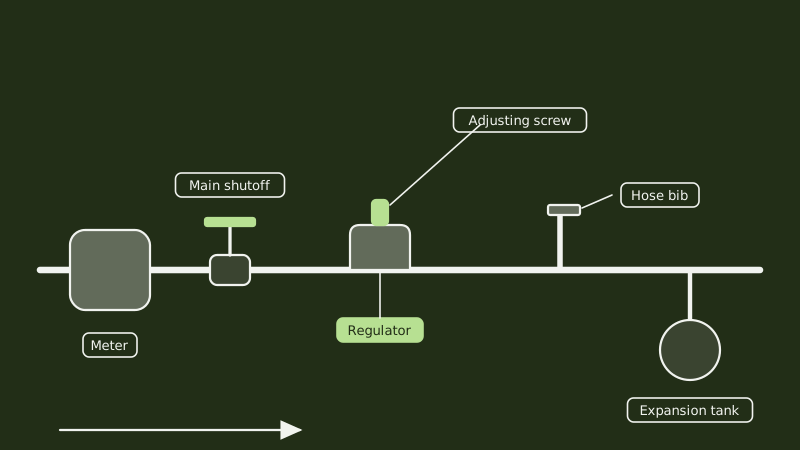
Look on the main supply line close to the spot where it enters the house, normally just downstream of the main shutoff valve. The regulator is a brass, bell-shaped fitting roughly fist-sized, usually topped by a bolt and locknut. Around Santa Ana it tends to turn up near the front hose bib, inside a garage wall or next to the water heater. If you came here chasing a symptom, the page on low water pressure in the house is the better place to begin.
Plenty of houses have none, and where one exists it can hide somewhere surprising.
Where is the water pressure regulator usually located?
Find the pipe where the main line emerges from the wall or the ground and look just past the main shutoff valve. Installers put the regulator there so the water can be closed off before servicing it. Frequent hiding places: the front exterior wall, the garage, a utility closet and the space beside the water heater.
Trace the pipe away from the main shutoff. The first fitting that bulges wider than the pipe, brass colored and bell shaped, with a flow arrow stamped on its body, is the regulator. Some sit in a below-grade box with a lid, similar to a meter box, and some are tucked behind an access panel in the wall.
Another California city, Santa Barbara, describes the same usual pattern: past the main shutoff, near where the service line comes in.
What does a pressure regulator look like?
It looks like a brass or bronze bell, roughly the size of a large coffee mug, set in the water line. The top has a bolt or screw with a locknut for adjusting pressure. The body usually carries an arrow for flow direction and a model name. Some have a small strainer cap on the inlet side.
Do not confuse it with other fittings nearby. A gate valve has a round wheel handle, and a ball valve has a short lever. The meter, if it is inside the house, is a round dial. A thermal expansion tank is a small round steel tank usually hanging off the cold line near the water heater, and the code can call for one where a regulator closes the system.
How can I find the regulator if I cannot see one?
Follow the supply from the meter toward the house, then try the front hose bib wall, the garage, the crawl space entrance and the water heater closet, plus any ground box near the foundation. If you find no bell-shaped fitting anywhere, the house may not have one, or the unit may be in the wall.
Santa Ana houses dating 1920 to 1950 were often plumbed before regulators were widespread, and some never got one, though a repipe may have added it. On a slab house the line can rise through the floor of a utility closet. A plumber locates it fast and can say if you need one.
Why does it matter where the regulator is?
It governs the water pressure in the whole house. A regulator becomes mandatory when pressure at the house passes 80 psi, and excess pressure strains pipes, fixtures, the water heater and appliance hoses. Knowing its spot lets you test it, shut water off ahead of it and point a plumber to the starting place.
Too much pressure shows as knocking pipes, hissing faucets, toilets that keep refilling and a drip from the water heater's relief valve. A failing regulator can produce low pressure as well, so find it before replacing anything else. Other suspects are in what causes low pressure.
How do I check what the pressure is?
Attach a pressure gauge to an outdoor spigot or the washer supply, make sure nothing else is running, and read the dial. Many homes sit around 40 to 70 psi. Above 80 psi suggests a failing or missing regulator, while below about 40 suggests a restriction or a setting that is too low.
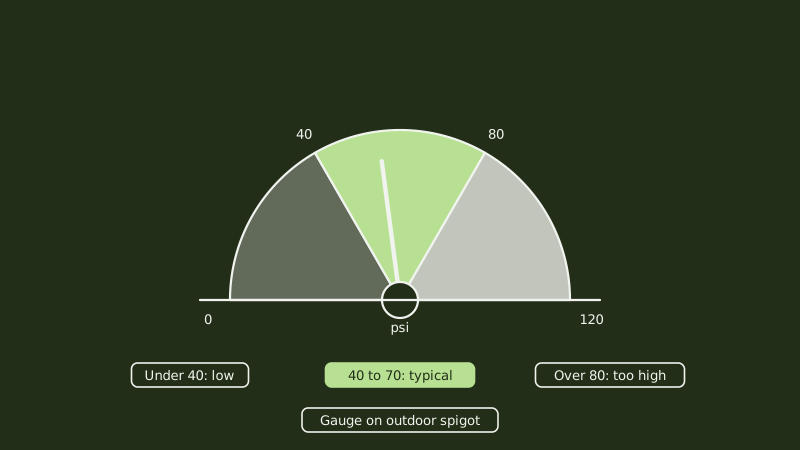
A basic gauge is a few dollars. For a fuller picture, use one with a drag needle and leave it on overnight, since street pressure tends to peak when demand is low. Keep a note of the readings for the plumber.
Is the adjustment screw something I can turn?
Many units have an adjustment screw. Back off the locknut, then turn the screw in small steps while watching a gauge, with clockwise raising pressure and counterclockwise lowering it. That is a fair homeowner task when the unit works. A regulator that will not hold its setting, drifts up overnight or leaks needs replacing.
Never set it above 80 psi, and give the reading a few minutes to settle between turns. Many plumbers regard a regulator beyond 10 to 15 years as nearly worn out, though water quality matters. Replacement usually goes to a plumber, and the process is described in changing a water pressure regulator.
How much does a regulator swap run, and does it need a permit?
A published guide suggests roughly $250 to $600 installed for a swap, with the valve, access and any expansion tank moving the figure. Permit rules vary, so ask, and expect the plumber to deal with the City of Santa Ana Building Safety Division if one is needed.
For the full numbers see what a regulator replacement costs, and for the job itself regulator replacement in Santa Ana. A relief valve dripping at the water heater can come from a regulator or missing expansion tank, as relief valve replacement explains.
Common questions
Does every house have a pressure regulator?
No. Many older houses lack one, and in some newer ones it is buried or tucked behind a panel. The code asks for one when static pressure goes over 80 psi, so if you cannot find it, a gauge reading answers whether you need one. A short plumber visit can confirm.
Is the pressure regulator before or after the main shutoff valve?
After it. Installers normally place the regulator downstream of the main shutoff so closing the main isolates it for service. A regulator found ahead of any valve is unusual, and a plumber should take a look at how it was installed.
What is the pressure regulator's lifespan?
Often ten to fifteen years, longer in gentle water. Hard water like Santa Ana's can foul the internals sooner. Wear shows up as pressure that rises or swings, noise, leaks at the body and a water heater relief valve that drips. A gauge test reveals which.
Who do I call if my regulator is stuck or leaking?
A plumber, because replacing one means closing the main, cutting pipe and sizing a new unit. Report what you see, plus the gauge reading, through the price request page and someone local is sent. Other services are on the Santa Ana Plumbing Co home page.
Sources
- California Plumbing Code (2025) section 608.2, excessive water pressure: regulator required above 80 psi static pressure
- City of Santa Barbara, Water pressure regulators (typical location after the main shutoff, near where the service line enters)
- Plumbinguide, water pressure regulator replacement cost (2026)
Last updated