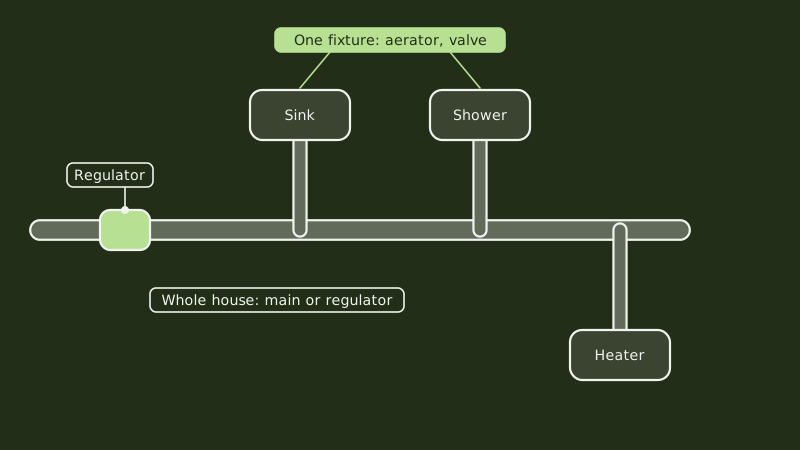
Start by asking where the pressure is low. One faucet or one shower points at a clogged aerator or showerhead. Hot water only points at the water heater. Every tap in the house points at the main shutoff, the pressure regulator, corroded supply pipe, a leak, or occasionally the street supply. The repair side lives under fixing low pressure throughout a house. This page is about finding the cause.
Why is the pressure low at only one faucet or shower?
Scale and grit in the aerator or showerhead is the usual reason. Santa Ana water is hard, around 250 parts per million by the city's own figure, and the minerals harden into crust that blocks the small holes. Unscrew the aerator, soak it in vinegar, rinse and refit. If it still dribbles, check the faucet's shutoff valve under the sink.
Pressure that is low at a single fixture and normal everywhere else is almost always local to that fixture:
- A partly closed angle stop under the sink, left that way after a repair.
- A clogged cartridge in a single-handle faucet or shower valve.
- A kinked or old braided supply hose.
- A flow restrictor in a showerhead that was added for water savings.
Separate guides go deeper on a weak shower and a weak kitchen faucet.
What makes the pressure drop in the whole house?
A main shutoff left partly shut, a failing pressure regulator, corroded galvanized supply lines, a leak, or a street-side problem. Because it hits every tap, the cause lies upstream of the branches. Check the main valve first, then the regulator, then ask neighbors whether theirs has changed.
Work upstream, from easy to hard:
- Main shutoff and meter valve. A gate valve that was nudged or never opened all the way chokes the entire house. On a quarter-turn ball valve the lever sits along the pipe when open.
- Pressure regulator. Many Santa Ana houses have one on the main line, a bell-shaped brass fitting. When the internals wear out, pressure can sag or spike. Our page on where the regulator is located helps you find it.
- Supply pipe. Galvanized steel corrodes inward until the opening is a fraction of its original size.
- Leaks. Water going out through a hole is water not reaching the tap. The meter test in signs a pipe has burst checks for one.
- The street. A main repair or heavy local demand can lower pressure for a while. If neighbors see the same, call the water provider.
How can I test the pressure myself?
Buy a gauge with a hose-thread fitting, fit it to an outdoor spigot with everything inside switched off, and read the dial. Many sources treat roughly 40 to 60 psi as comfortable for a home. Under about 30 psi will feel weak. Once static pressure exceeds 80 psi, the state plumbing code wants a regulator in the line.
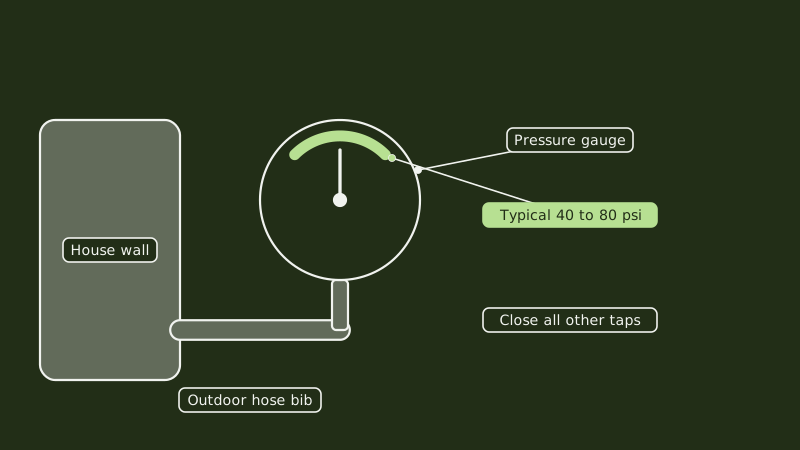
Such gauges are cheap at any hardware store. Test in the morning or evening when the neighborhood is using water, and again at a quiet hour, since the two readings can differ a lot. A reading that is normal while no water is running but collapses when a tap opens suggests a restriction in the pipe, not a supply shortage. A reading that sits high, above 80, suggests a faulty regulator or none at all. If the regulator needs work, see how to change a water pressure regulator and the regulator replacement cost.
Why is the pressure low on hot water only?
When cold runs strong and hot runs weak, suspect the heater and its fittings, not the main line. Sediment can plug the tank outlet, a half-shut valve at the heater can throttle flow, and a corroded hot-side pipe can be narrower than the cold. Our guide to low hot water pressure goes through these.
A tank water heater in Santa Ana's hard water collects scale at the bottom, which is one reason a yearly flush is a good idea if the maker recommends it. For what scale does elsewhere in the house, read about removing hard water scale. Gas heaters need care, so leave controls and venting alone. If gas is in the air, get out and use your phone from outside: SoCalGas, 1-800-427-2200.
Do older Santa Ana homes have pressure problems from their pipes?
Often, yes. Houses of the 1920s through 1950s can still carry galvanized supply lines that have narrowed with rust, and old copper can clog with deposits. When several fixtures weaken together and the water runs brown or rusty at first, the pipes themselves are the likely cause.
If a plumber confirms the lines are failing, replacing them is the lasting fix. A repipe in PEX or copper restores flow, and PEX repiping explains how that job runs. Because a repipe is a major project, get the cause confirmed first. A pressure test and a flow check at several fixtures show whether the problem is the pipe or something simpler like a valve. In Santa Ana, work on this scale goes through a permit from the Building and Safety division.
Is low water pressure dangerous?
Mostly an annoyance rather than a hazard, though it has real downsides. Weak flow can make a tankless heater shut off or fail to fire, leave appliances short of water, and when supply pressure collapses it can allow back siphonage, which pulls water backward through plumbing. A sagging main can also hide a leak.
Backflow happens when pressure in the system exceeds supply pressure or supply pressure drops, which is why hose bibs and some fixtures have backflow protection. That protection is one reason not to remove vacuum breakers from outdoor faucets. If low pressure arrives suddenly along with discolored water or a rising bill, check for a leak. When you want a local plumber to diagnose it, request a price. Browse the rest of our services from the Santa Ana Plumbing Co home page.
Common questions
Can a clogged water heater cause low pressure in the whole house?
Not usually, because the heater only feeds the hot side. A clogged or half-shut heater valve lowers hot water flow while the cold stays normal. If both are weak, look at the main valve, the regulator and the supply pipe instead of the heater.
How long does tracking down the cause take?
Gauge, main valve, regulator and a few fixtures can often be checked in one visit. A hidden leak or a failing pipe can take longer to confirm, and repairs depend on what turns up, so ask for the diagnosis and the proposed plan in writing.
What do I raise with the plumber before a diagnosis?
Ask whether pressure will be measured with a gauge, how a regulator fault gets told apart from a pipe fault, and how the price changes if something bigger turns up. Also request the contractor's license number, which the state board lets you verify online.
Is it normal for pressure to drop at certain times of day?
Some drop is normal. Demand across a neighborhood rises in the morning and evening, and pressure can dip a little when many people use water at once. A steady, large drop at the same time each day is worth raising with the water provider, particularly if neighbors notice it.
Does an adult have to be present?
Yes, ideally, so the plumber gets to the main, the heater closet and the troublesome tap without delay. Water goes off briefly while a valve or regulator is swapped out. Mention any recent plumbing work or renovation on arrival, since a changed valve or new fixture can explain a sudden drop.
Sources
Last updated