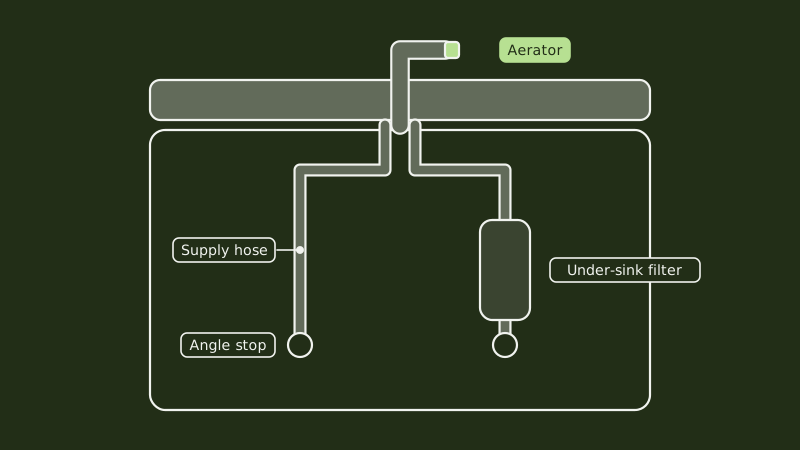
Unscrew the aerator at the tip of the faucet and run the water without it. If the flow jumps back to normal, the aerator was clogged with mineral grit, and a vinegar soak or a new one fixes it. If it stays weak, move down the line: the two valves under the sink, the braided hoses, then the faucet cartridge. This belongs with the other work on faucets, sinks and disposals that we arrange.
Before you start, check one thing. Run the bathroom sink and a shower. If they are weak too, you are not looking at a kitchen problem, and the whole-house section further down matters more.
Is the weakness confined to the kitchen, or is it house-wide?
Compare it with another tap. If the bathroom faucet and the shower run strongly, the cause sits in the kitchen fixture or its supply lines. When every tap is weak, suspect the main valve, the regulator, a leak or aging pipe. Hot only or cold only is a third pattern, and it points to one supply line.
Test in this order:
- Run the kitchen faucet cold only, then hot only. Note which one is weak.
- Compare with the outdoor hose faucet, which has no aerator and shows raw house flow.
- If you own a pressure gauge, screw it onto that outdoor faucet and read the pressure with other taps shut.
A gauge reading well below 40 psi, or a pattern of weakness everywhere, means the house supply is the issue. Readings in the normal range with a weak kitchen faucet mean the kitchen fixture is the problem. House-wide causes get full treatment in reasons for low water pressure.
How do you clear a clogged faucet aerator?
Twist the aerator off by hand, or with a rag and pliers, and disassemble it over a bowl so tiny parts cannot reach the drain. Rinse the grit away, steep the pieces in white vinegar for about an hour to loosen scale, scrub, rinse, and thread it back on. A torn screen or crumbling plastic means a replacement.
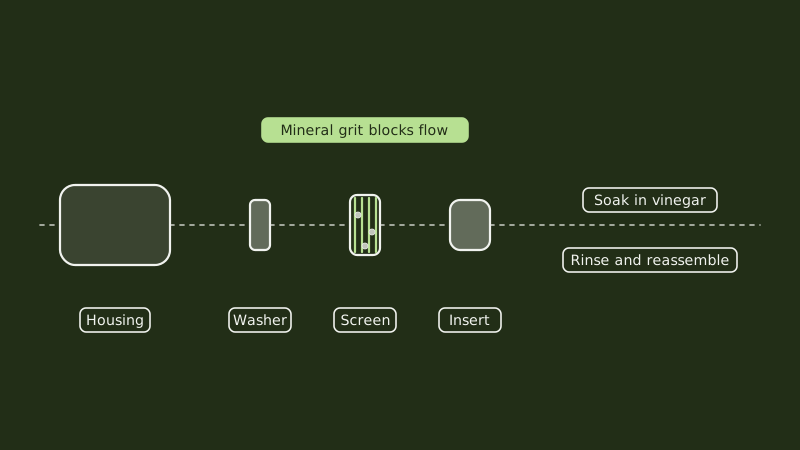
With a pull-down or pull-out spray head, the aerator may be hidden inside the spray head, behind a small plastic insert. A pick or a small flat screwdriver pops the screen out.
Santa Ana's water is hard, about 250 parts per million by the city's figure, so scale forms on small openings quickly. An aerator that was clean last year can be crusted now. A habit that helps: soak and clean it twice a year, and flush the faucet for a minute after any plumbing work in the house, because loose debris from repairs lodges in the screen first.
If vinegar does not dissolve the buildup, the screen is likely past saving. Aerators cost very little, and you should match the thread size when you buy one.
Could a supply valve or a hose be restricting the flow?
Yes, and it is common. The two angle valves under the sink may have been left partly closed after a repair, and a stiff old valve may not open fully. The braided supply hoses can also kink behind a cabinet, or crumble inside as they age. Check each valve is fully open, and look at the hoses for bends.
Turn each valve all the way counterclockwise, slowly. A valve that resists should be left alone. A seized stop can snap, which leaves you with a leak and no shut-off. Fixing the valve itself is covered in a toilet guide, though the same ideas apply to kitchen stops.
Stainless braided hoses have a rubber or plastic liner. With age, the liner can swell or collapse, which chokes the flow though the outside looks fine. Replacing both hoses costs little, and plumbers do it as routine whenever they replace a faucet.
If the sink has a pull-out spray, check the hose for kinks where it loops below, and see that the weight on the hose is positioned so that it does not pinch.
Why is the hot water weak but the cold water strong?
Hot-only weakness points to the hot supply path: a partly closed hot valve, sediment from the water heater clogging the line or the faucet's hot inlet screen, or a partially closed valve at the heater. A faucet cartridge with debris on the hot side can do it too. The fix starts at the hot valve under the sink.
For hot water pressure at several fixtures, see our page on low hot water pressure. Sediment inside a water heater can break loose and travel into the lines, particularly after plumbing work or a change in water supply. Flushing the heater and cleaning the faucet's inlet screens usually solves it.
Check that the heater's cold inlet and hot outlet valves are fully open. A gate valve left half open after service is a classic cause of weak hot flow in the whole house.
Could the faucet cartridge or an under-sink filter be the culprit?
Yes. Faucet cartridges and inlet screens collect grit, and a damaged one can restrict flow. Under-sink filters and reverse osmosis systems also cut pressure when a cartridge is clogged or overdue. If a filter faucet is separate from the main spout, check whether the weak flow is only at the main spout or at the filter tap.
Disconnect the filter, if it has a bypass, and see if full pressure returns. Many filters need a cartridge change every six to twelve months, per the maker.
For a single-handle faucet, a worn cartridge can leak and give uneven flow, and replacing it restores pressure and stops the drip. If the faucet also drips, our guides on fixing a leaky sink faucet and how to fix a leaky faucet go through the repair.
A final note: modern kitchen faucets are designed to limit flow. California's standard for residential kitchen faucets sold since 2021 is 1.8 gallons per minute, with an optional temporary 2.2 for filling pots, per the industry summary of plumbing rules. A new faucet can feel weaker than the old one without anything being wrong, because it uses a smaller restrictor.
What would point to something larger behind the sink?
If every fixture is weak, if the gauge reads low or very high, if there is a wet spot or rising water bill, or if the problem started after plumbing work, look past the sink. Candidates include a worn regulator, a main valve not fully open, a concealed leak, or corroded supply pipe, galvanized steel above all in older houses.
Excess pressure is a problem too. State plumbing code expects a regulator once static pressure passes 80 psi, and a regulator that has failed in either direction can produce symptoms. For a walk-through, see how to adjust or change a regulator.
Older Santa Ana homes with galvanized pipe sometimes get weak flow because the inside has narrowed with rust and scale. That is a repiping question, not a faucet fix, and our wider pages on the subject explain the options.
To have a local plumber look at your kitchen sink, send the details with the price request form. Other work is listed on the Santa Ana Plumbing Co home page.
Common questions
Why did my kitchen faucet pressure drop suddenly?
A sudden drop often comes from debris. Plumbing work, a water main repair or a water heater event can send grit into aerators and cartridges. Check the aerator first, then the valves under the sink. If other taps also dropped, the cause is upstream, such as a main valve, regulator or leak.
What does a repair run for a weak kitchen faucet?
An aerator costs a few dollars, and a cartridge or new supply hoses are modest parts. A plumber then adds labor and a service charge. The total grows if the cause is a regulator, corroded pipe or a leak. Have the figure written down before the work begins.
Is it normal for a new kitchen faucet to have lower pressure?
Often, yes. New faucets have flow restrictors set to limits in California's rules, so they run at 1.8 gallons a minute, with a temporary override on some models for filling pots. If the flow is far below that, remove the aerator and check the supply valves and hoses before assuming the faucet is faulty.
When is a plumber worth calling for one weak faucet?
The aerator, valves and hoses take minutes, so try them first. After that, call if a valve is stuck, the cartridge needs replacing and you are unsure, or other fixtures are weak as well. The plumber can measure pressure and hunt for a hidden cause.
Sources
Last updated