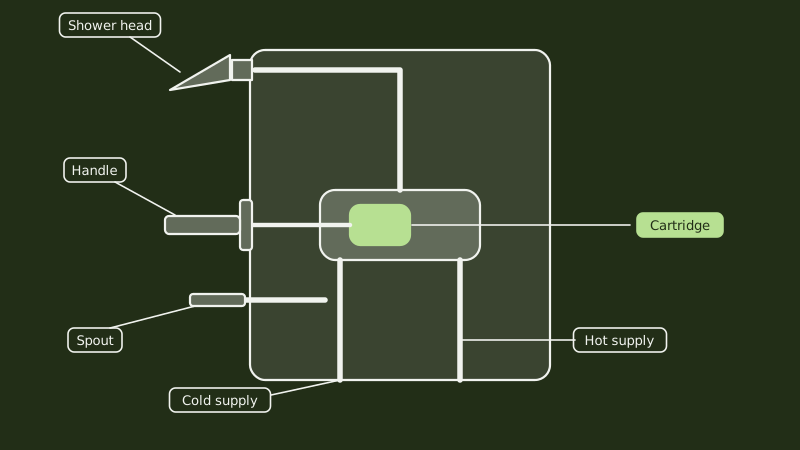
A drip from the shower spout or head wastes water every minute and stains the tub. Most of the time the cause sits inside the valve behind the handle: a worn rubber washer on an older two-handle model, or a tired cartridge on a single-handle one. The job needs a few hand tools and the right replacement part. It sits inside our group of faucets, sinks, showers and garbage disposals, and the full routine follows.
Which type of shower valve is behind the wall?
Start with the handles. A hot one and a cold one mean a compression valve, which seals with a rubber washer against a seat. One handle that turns and pulls or pushes usually hides a cartridge. A single lever that rocks in all directions often means a ball valve, while a one-handle valve with a smooth quarter-turn feel often hides a ceramic disc cartridge.
Why it matters: each type fails in its own way, and the replacement part is not interchangeable.
| Valve type | Handle | Usual fault |
|---|---|---|
| Compression | Two handles, you turn several times | Worn washer or damaged seat |
| Cartridge | One handle, push and pull or turn | Worn O-rings or cartridge |
| Ball | One lever, rocks side to side | Worn seals or springs |
| Ceramic disc | One handle, smooth short turn | Worn disc seals or cartridge |
Santa Ana's oldest housing, built between the wars and just after, sometimes still has the original two-handle compression showers, while recent remodels tend toward single-handle cartridges. Carry the worn part to a plumbing supply counter to match it, or read the brand stamped on the trim.
Is the drip from the head, the spout or somewhere else?
A drip from the shower head after shutoff usually points to the valve passing a little water or to trapped water draining out, while a dripping tub spout points to the valve or the diverter. A wet wall or ceiling beyond the shower is a different, hidden leak. Work out where the drip is before you open anything.
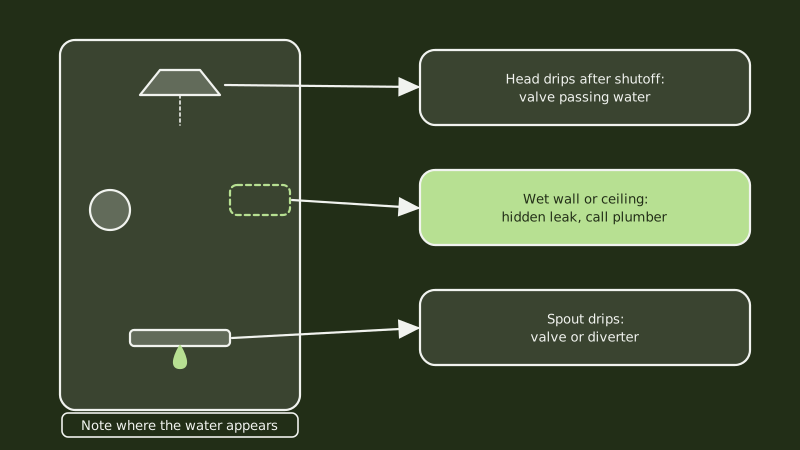
A small amount of water draining from the head for a minute after shutoff is normal. A steady drip that continues is the valve. If the drip appears only when you pull the diverter for the shower, the diverter is worn.
If you see stains on a wall or ceiling next to the shower, stop and do not just replace a cartridge: a leak inside the wall behind the valve needs a plumber, and a hidden leak costs well beyond a cartridge swap. See what a plumber costs to fix a leak.
How do I replace a worn shower cartridge or washer?
Cut the supply and empty the line, then pop the cap off the handle, take out the screw and the handle itself, then lift away the trim plate. For a cartridge valve, remove the retaining clip or nut and pull the cartridge straight out, then fit an identical new one. For a compression valve, unscrew the stem, fit a new washer and inspect the seat.
Steps in order:
- Close the shower's own stop, or the main valve if it has none, then run the shower briefly to confirm nothing flows.
- Plug the drain with a rag so screws cannot fall in.
- Pry off the decorative cap on the handle with a small flathead and remove the screw beneath it. Pull off the handle.
- Unscrew the escutcheon, the round trim plate, to reach the valve.
- Note the cartridge position, a photo helps, then remove the retaining clip or bonnet nut and extract the cartridge. Some stick and need a puller.
- Lay the old and new parts side by side, coat the new O-rings in a thin film of plumber's silicone grease, and push the cartridge in facing the same way.
- Put everything back, reopen the water gradually with the shower running, and look for seepage behind the trim.
Do not force a stuck cartridge with pliers if it is crumbling; that can wreck the valve body. A seized stem or a heavily scaled valve is a sign to call a plumber. Hard water scale is a common reason that parts seize, and the low water pressure from the shower guide covers scale on the head.
What if my shower has a compression valve and the seat is worn?
A new washer will not stop a drip if the seat that it presses against is pitted or corroded. Use a seat wrench to unscrew the seat and replace it, or a seat-dressing tool to resurface it. Seats are brass, and in old bathrooms they can be fused in place. If it will not move, stop and call someone.
Many old compression valves also have packing nuts that weep around the stem. Tightening the packing nut a little, or replacing the packing, fixes a drip at the handle and not at the spout.
For a leaking tub faucet rather than the shower, see fixing a leaky tub faucet, and for a bathroom or kitchen sink the sink faucet repair guide goes through the same logic. The general guide, how do you fix a leaky faucet, covers the basics.
When does a shower repair become a plumber's job?
When the valve lies behind finished tile with no access panel, when the cartridge or seat will not come out, when the new part does not stop the drip, when you see water stains nearby, or when the pipes look corroded. Also call if you are unsure about working near the main shutoff.
Tile walls often have no access panel, and opening one is a repair of its own. A plumber can decide whether to cut from the back side, usually from a closet or the next room, which is easier to patch than tile. Matching an old discontinued valve is another reason: some need a whole valve swap, which is bigger work.
For price context, national guides put a plumber's faucet or valve repair somewhere in the low hundreds of dollars, and replacing a whole shower valve higher. I did not find a dependable local price, so only the quote on paper counts. Look up the contractor at the state license board; the state license is mandatory from $1,000 or where a permit applies, which a simple cartridge swap usually avoids.
Tell us what is dripping on the price request page, or call during weekday hours, and a nearby plumber is lined up. Browse more of our work from the Santa Ana Plumbing Co home page.
Common questions
What does a shower faucet repair cost?
Parts run from a few dollars to a few tens, so a home repair is cheap. National guides place a plumber's simple valve repair in the low hundreds of dollars, with full valve replacement above that. Water inside the wall is a separate and larger job.
Must the whole house water supply be off?
Only when the shower has no stop valve of its own. Many newer showers have stop valves on the supply lines behind the access panel, and some older ones have none. Close the nearest valve, then open the shower to confirm the water has stopped before you take the handle off.
What if the shower still drips after a new cartridge?
Common reasons: the new cartridge is not the exact match, an O-ring is pinched, the cartridge is not fully seated or rotated correctly, or the valve body is scored or scaled. On a compression valve, a worn seat causes the same symptom. If it still drips after a careful second attempt, call a plumber.
How long should I plan for this?
An experienced hand swaps a cartridge in about an hour. A first attempt deserves longer, to track down the part and wrestle a stuck handle off. Seat replacement or a seized valve adds more. Plumbers usually wrap up a straightforward valve repair within a couple of hours.
Sources
- California Contractors State License Board
- Published plumbing repair prices from several national cost guides, checked November 2026
Last updated