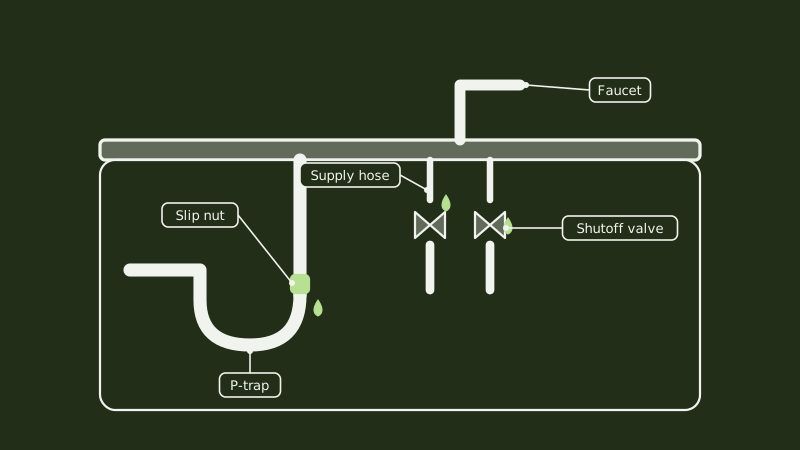
Dry the cabinet, run the water and watch. That one habit finds most under-sink leaks within minutes, because the drip shows up at the same joint every time. Fixes are usually a quarter turn of a nut, a new washer or a new trap, all within reach of a basic tool kit. Doing this work with the disposal out of the way? The garbage disposal installation page covers that part of the cabinet.
Where is the water actually coming from?
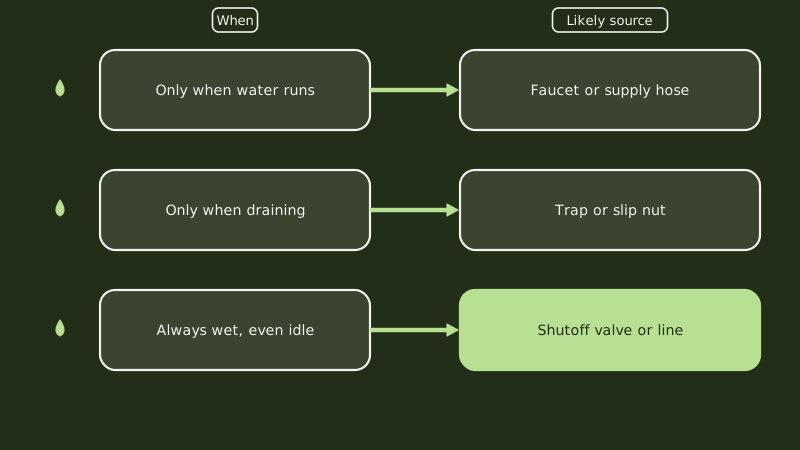
Empty the cabinet, wipe every pipe and fitting dry with a paper towel, put a dry sheet of paper on the cabinet floor, then run the tap and watch. Drips that appear only while water drains point to the drain side. Drips that appear with the faucet on but not draining point to the supply side. Constant drips even with the water off point to a valve.
Work from top to bottom. Begin at the faucet base and under the basin, then the two supply hoses and their shutoff valves, then the drain basket, tailpiece, trap and the wall connection. Run your fingertip along the underside of each pipe, because water travels along a pipe before it drips. A flashlight and a mirror help. If water drips from the cabinet ceiling, the source is above you, at the sink rim or faucet.
Do the test twice: once with the faucet running, then once with the sink filled and released, because a full sink pushes more water through a weak joint.
What if the drain trap or a slip nut is the culprit?
On the curved drain section, undo the slip nuts by hand and lower the trap into a bucket. Inspect the washers inside each nut, and swap any that are flat or cracked. Put it back with each washer's tapered edge toward the joint. Hand-tighten, then give a gentle quarter turn. Overtightening cracks plastic nuts and creates a new leak.
A trap that is cracked, pinholed or corroded should be replaced whole. Kits for plastic and chrome traps are inexpensive and standard sizes cover most kitchen and bathroom sinks. Bear in mind the pipe's direction: the trap has to hold a little water, which is what stops sewer gas, and the line must slope toward the wall. If a joint leaks only when a lot of water runs, the trap may be misaligned and the nut is working against a pipe that does not sit square. Fix alignment first.
In a Santa Ana bungalow from the 1920s to 1950s, the pipe leaving the cabinet may be old galvanized or cast iron, and rust at that wall connection is a plumber's job, not a washer swap.
What if a supply hose or shutoff valve is leaking?
Turn the shutoff under the sink to closed, open the faucet to bleed off pressure, then unscrew the hose from both ends. Fit a replacement braided hose of the same length and connection size and snug it with a wrench, about a quarter turn beyond hand-tight. A valve that drips at its stem may only need its packing nut tightened a little.
A shutoff that refuses to close or seeps from its body needs replacing, and the main water valve is your stopgap until then. Old chrome and brass valves often seize after years of not being turned. Forcing them can snap the stem, so replace them proactively when you are working there. Our page on toilet shut-off valve repair shows the same steps for a valve behind the toilet.
Hard water leaves scale in old valves and hose connections. Santa Ana's tap water is about 250 parts per million, according to the city, and crust on a fitting can stop a washer from seating. Cleaning the thread and fitting a fresh washer often cures a weeping connection.
What if the leak is the faucet itself?
Water that runs down the faucet shank and into the cabinet comes from a failing O-ring, cartridge or washer, and not from a pipe. The cure is a faucet repair. Close the water, take off the handle and replace the worn part. Our step-by-step for that is in the page about leaky faucet repair.
Worn washers and gaskets are listed by the EPA as frequent faucet-leak causes, and one drip per second loses upwards of 3,000 gallons over a year. With an old faucet whose parts are scarce, buying a new one often makes more sense. The sink faucet repair guide goes through that decision.
When is a temporary fix acceptable?
Plumber's epoxy putty, a clamp or self-fusing tape can stop a small leak on a drain pipe or a pinhole in copper long enough to arrange a proper repair. They are a bridge, not a repair. Use them for a day or two, and put a bucket under the leak while you wait for the plumber.
Do not rely on putty for a leak on a pressurized supply line, a joint that is actively spraying, or a pipe that is corroded along its length. Those need a new section of pipe. For a pinhole in copper, options are laid out in pinhole leak repair for copper pipe, and joint types from solder to push-fit are covered in leaking pipe joints.
Which leaks should you leave to a plumber?
Hand it to a plumber when the water comes from inside the wall or from the wall connection, when a shutoff valve will not close, when pipe is corroded, when you cannot tell the source, or when the cabinet floor is already soft. Anything involving the main water line, gas or a hidden pipe is plumbing work. Water damage that keeps spreading calls for a visit the same day.
Sometimes the smart move is renewing the whole under-sink set: new shutoffs, new braided lines and a new trap often cost little more than a repair and end repeat leaks. When the water shows up in the ceiling below instead, read the page on a leak through the ceiling. To get a price, the quote page starts a visit.
Common questions
Water in the cabinet but nothing running: what gives?
Water with nothing running comes from a pressurized part: a supply hose, a shutoff valve or the faucet. Drain pipes only leak when water flows through them. Wipe everything dry and check again after an hour, working from the faucet downward. A valve that weeps slowly is easy to miss, but a flashlight and a dry paper towel give it away.
Will tape stop a leak at a drain joint?
Plumber's tape, also called PTFE tape, is meant for threaded water and gas connections. It does not seal slip joint drain nuts, which rely on tapered washers. Use the right washers and tighten by hand plus a quarter turn. For threaded supply connections, tape or the fitting's own washer, depending on the connection, can help.
Does this count as an emergency?
Usually not, but do not leave it. A steady leak rots the cabinet floor and can feed mold. Close the sink's shutoff, or the main valve if that will not budge, set a bucket underneath, and fix it or arrange a plumber soon. A spraying line or water reaching the ceiling below needs prompt action.
What does the repair cost?
Parts such as washers, a trap kit or a braided hose are low-cost and sold at hardware stores. A plumber's price covers the visit and labor, and varies with the problem. The real figure arrives only with a written quote. Typical rates are explained under plumber cost per hour.
Everything else we cover is on the Santa Ana Plumbing Co home page.
Sources
- Under-sink leak repair guides from plumbing publishers and parts makers, checked November 2026
- U.S. EPA WaterSense, Fix a Leak Week
- City of Santa Ana, water quality FAQ (hardness about 250 ppm)
Last updated