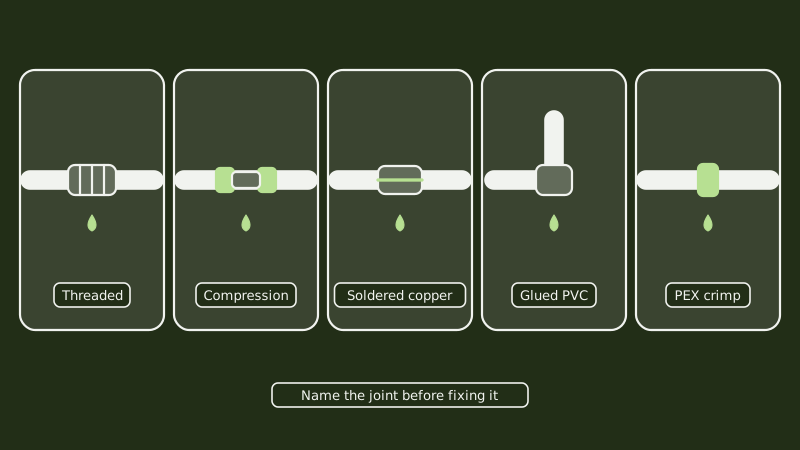
A joint that weeps is cheaper to fix than a pipe that bursts, so deal with it early. Stop the water to that line, dry the joint, and study what it is made of: threaded metal, a compression fitting, a soldered copper joint, a glued plastic one or a PEX connection. Each has its own repair, and using the wrong one is the usual reason a fix fails. If the water is already pouring, treat it as a burst; start with burst pipes in Santa Ana, then return here.
What kind of pipe joint is leaking?
Look at the fitting and the material. A threaded joint shows screw threads and tends to sit on galvanized or brass lines. Compression joints have a nut and a small ring. Soldered copper joints show a silvery bead around a smooth fitting. PVC and CPVC joints are glued, with a visible seam. PEX uses a crimp ring, a clamp or a push-in fitting.
Match the joint to its likely failure:
| Joint type | How it looks | Why it leaks |
|---|---|---|
| Threaded (galvanized, brass, black iron) | Visible threads, nut-like fittings | Worn thread sealant, corrosion, a loose joint |
| Compression | Brass nut with a ring beneath | Loose nut, damaged ring, scored pipe |
| Soldered copper | Silver bead at a smooth fitting | Cracked solder, corrosion, movement |
| Glued PVC or CPVC | Smooth plastic, glue seam | Poor glue bond, stress, age |
| PEX | Crimp ring, clamp or push fitting | Loose ring, damaged fitting, pipe not cut square |
Plenty of Santa Ana homes from the interwar and postwar decades still carry galvanized supply lines, and corrosion at threaded joints is one of the commonest places they weep. Newer homes and remodels tend to have copper or PEX. If you are unsure what you have, the pages on PEX versus copper and repairing a leaking pipe under a sink help you tell.
How do I stop the water before starting the repair?
Close the nearest isolation valve, or the main when no local one exists, then open one faucet near the floor level to empty the line and another upstairs to let air in. Dry the joint thoroughly with a rag. A leak you cannot stop right away can be managed with a bucket and towel, and a repair clamp holds it for the time being.
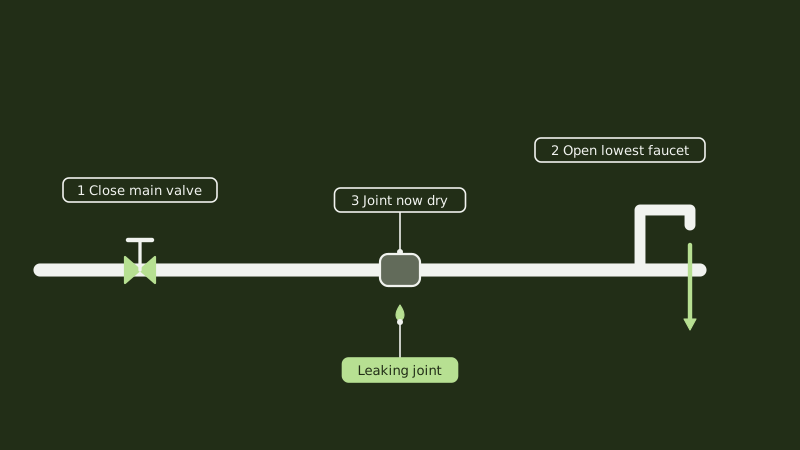
Never repair a joint while water is still running through it. Solder, glue and tape will not bond to a wet surface, and sweating a copper joint with water inside only boils it.
If the joint sits near outlets, the panel or a light fixture, switch that circuit off before working. Water and power do not mix; the page on water leaking from a ceiling light explains the risk.
Could it be a gas pipe? Gas lines look much alike, and a gas smell is an emergency. Get out, from a safe distance, report it to SoCalGas (the number is 1-800-427-2200), and involve 911 if anyone could be hurt. In California gas piping is reserved for contractors.
What is the fix for a weeping threaded or compression joint?
For a threaded joint, drain and dry it, unscrew the fitting if it moves freely, scrub the threads, wrap them in PTFE tape (two or three turns, following the thread direction) or brush on pipe joint compound, and snug it up. For a compression joint, snug the nut a quarter turn first, and replace the ring if it still weeps.
Do not over-tighten. Cranking a brass nut can crack it or deform the ring, and a galvanized fitting that is badly corroded may break instead of turn. If a threaded joint will not budge or crumbles, the section probably needs replacing, and that is plumber work.
Steps for a compression joint:
- Shut the supply and drain the pipe.
- Give the nut a quarter turn, holding the valve body steady with a second wrench.
- Reopen the water gradually and watch for beads of moisture.
- Still wet? Close the supply again, back the nut off, fit a fresh ring and inspect the pipe end for scoring.
- Reassemble and test once more.
Can a soldered copper joint be repaired?
Drain the line completely, clean the joint to bare metal, apply flux, heat the fitting and feed lead-free solder into the seam until it flows around. A small weep sometimes responds to re-heating and adding solder. A badly made or corroded joint should come out entirely, with a fresh coupling in its place.
Soldering with a torch is a skill. The pipe must be dry and clean, the flame kept off the pipe walls, and flammable material shielded. Drinking-water lines need lead-free solder. If you have never done it, there are mechanical alternatives: push-fit couplings that slide onto clean copper, or repair clamps. They cost more per fitting but need no flame.
A pinhole that is not at a joint is a different problem, covered in pinhole leak copper pipe repair. If several joints leak in an older copper system, the pipes may be wearing out, and a plumber can advise on repair versus replacement.
What about leaking PVC, CPVC or PEX connections?
A glued PVC joint cannot simply be reglued. The bad stretch comes out and new pipe and couplings go in, with primer and solvent cement, and the cure time must pass before the water returns. For PEX, cut out the leaking fitting and install a new one, or tighten or replace the crimp ring using the right tool for that system.
Slip couplings help when there is no room to slide pipe, and sleeve-style repair fittings let you fix a section in place. Push-fit connectors are easy for beginners, though they cost more. Use fittings rated for your pipe type and for potable water. The page on stopping a leak in plastic pipe goes into this.
Gray plastic polybutylene pipe, found in some houses from the 1970s through the 1990s, has a record of failing at its fittings. If that is what you have, an occasional leak may be a warning that the whole system is aging, and a plumber's opinion is worth paying for.
At what point is a plumber the better choice?
When the joint hides inside a wall or slab, the pipe is flaking, you cannot identify the material, several joints weep, or your repair did not hold. A plumber also belongs on anything needing a permit, or involving gas, the main line or the water heater.
Temporary fixes such as epoxy putty, self-fusing silicone tape and clamps stop drips for a while but are not a permanent repair on a joint under pressure. Treat them as time-buyers. For prices, national guides run about $150 to $550 for an accessible leak and $500 to $2,000 for one inside a wall; see what a plumber costs to fix a leak.
State law lets people without a contractor license take only small jobs, under $1,000 and with no permit or employees, so whoever you hire should hold a contractor license that you can confirm at the state license board.
Outline the leak on our price request page or phone on a weekday between 9 and 5, and we organize a plumber from the area to inspect it. The wider service list lives on the Santa Ana Plumbing Co home page.
Common questions
Are epoxy and tape acceptable for a weeping joint?
For a short time, yes. Epoxy putty and self-fusing tape can stop a drip on a dry, clean joint while you arrange a proper repair. They are not meant to hold a pressurized joint for years. Shut off and dry the pipe first, follow the product's cure time, and plan to replace the fitting.
Why does the joint still drip after I tightened it?
Tightening cannot repair a damaged ring, worn threads, a cracked fitting or a bad solder bond, and going too far can worsen things. Stop the water, open the joint, inspect each part and swap whatever is damaged. Repeated leaks on corroded pipe usually mean the whole section should be replaced.
How long should a joint repair last as a job?
A compression or threaded joint can be finished within the hour if you have the parts. Soldering takes longer because of draining, drying and cleaning, and glued plastic must cure before the water returns. A plumber's visit to an easy-to-reach joint often runs one to two hours.
Is a leaking joint an emergency?
A slow weep is not, as long as the line is closed off and the drip is caught. A spraying joint is, since water spreads fast; close the main valve first. Joints near electrics or over a ceiling are more urgent still. Gas always counts as an emergency: get out and call SoCalGas.
Sources
Last updated