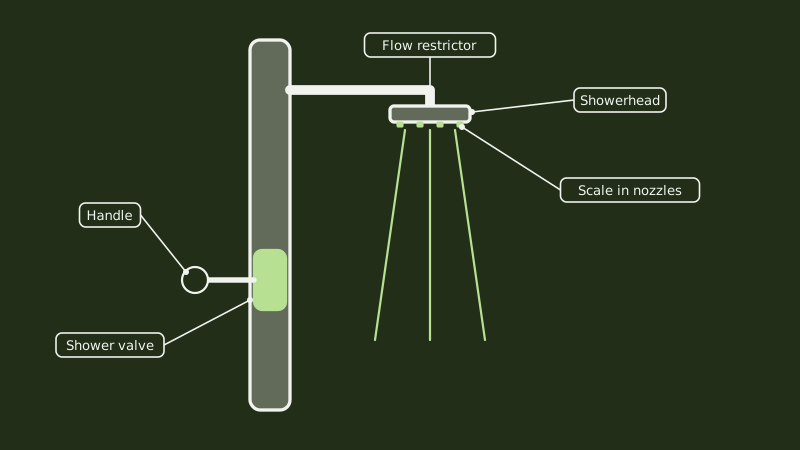
Start with the showerhead. In hard water areas like Santa Ana, mineral scale blocks the spray holes and the filter screen, and a vinegar soak or a new head often fixes it for a few dollars. Weak flow at other taps as well means the cause sits further upstream, in the supply line. Anything at the fixture itself, a tired valve choking the flow included, falls under faucet and fixture plumbing.
Below, the checks run from quickest to most involved.
Is it the showerhead, the shower valve or the whole house?
Open the bathroom sink, the kitchen faucet and the shower in turn and compare. When only the shower lags, suspect the head or the shower valve. When everything lags, suspect the main valve, regulator or supply pipes. A weak hot side alone points to the water heater.
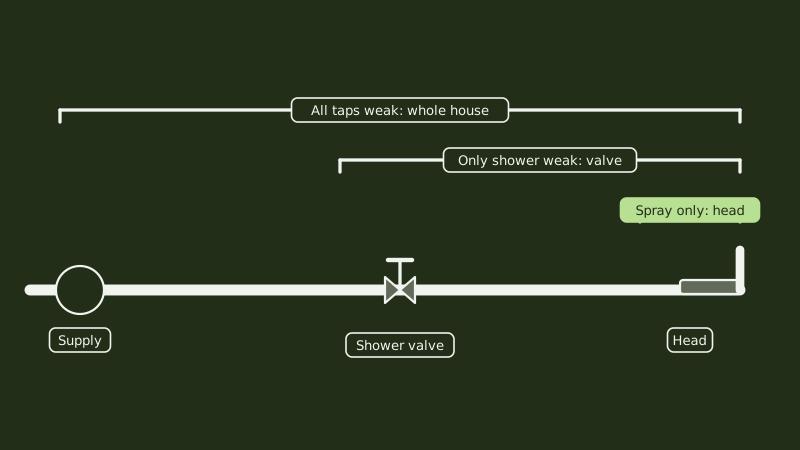
That comparison saves hours. Try the tub spout in the same bathroom too: a tub that fills quickly beside a feeble shower implicates the head or the diverter. A second bathroom that is also weak suggests a house-wide cause, which low water pressure throughout the house follows up.
How do I descale a showerhead?
Unscrew the head, lift out the rubber washer and filter screen, and let the head sit in white vinegar for thirty to sixty minutes. Brush the nozzles with an old toothbrush, rinse, and refit with fresh plumber's tape on the threads. Read the care instructions first, since vinegar can dull some brass and oil-rubbed finishes.
A head that will not come off can be treated in place: a bag of vinegar held over it with a rubber band, nozzles submerged, for about an hour. Scale builds up quickly where the water runs hot. Santa Ana's water is around 15 grains per gallon by the City's own report, which is very hard, so expect to clean the head every few months. A nozzle poked with a pin can widen the hole and spoil the spray, so use a brush.
Could the flow restrictor or a low-flow head be the problem?
Yes. State rules cap new showerheads at 1.8 gpm, measured with 80 psi behind the water, which feels thinner than the older 2.5 gpm heads. Many heads also contain a small flow restrictor disc. Removing the disc can raise flow, but it may make the head noncompliant, so a better answer is a head designed to feel strong at 1.8 gpm.
Spray design matters more than the flow number. Heads that mix air into the stream or use fine pulsing jets feel stronger at the same flow. If you replace the head, look for one rated at or below 1.8 gpm. A head that says 2.5 gpm on the box was made before the state limit, and it may not be legal to sell new.
Can a worn shower valve cause weak flow?
Yes. A worn cartridge, or a mixing valve crusted with minerals, can strangle the flow while the supply is fine. The handle may feel stiff and the temperature may swing. A new cartridge often brings flow back. That is a modest job, though an old valve or a tiled wall around it goes more smoothly with a plumber.
Cut the water to the bathroom before opening the valve. Different brands use different cartridges, so note the make or take the old one with you. A walkthrough of a cartridge swap sits in repairing a dripping shower faucet, and the same steps apply when the problem is flow instead of a drip.
What if the pressure is low everywhere in the house?
Make sure the main shutoff is fully open, look for a closed or half-open valve at the water heater, read the pressure using a gauge screwed to an outdoor hose bib, and inspect the pressure regulator, which can fail in either direction. A weak flow at every fixture often points at the regulator, a partly closed main or corroded pipes.
Normal home pressure is usually somewhere in the 40 to 70 psi range, and the state plumbing code wants a regulator once street pressure climbs above 80 psi. The gauge is a few dollars and threads onto a hose bib. If the reading is below about 40, something is restricting flow. Two pages follow that thread: low pressure causes and swapping the pressure regulator.
Does old pipe cause weak shower pressure?
It can. Galvanized steel pipe, a staple of homes built between the 1920s and 1950s, rusts and scales on the inside, narrowing the passage until little water gets through. The signs are brown water, falling pressure over years and thin flow at the house's far end. The cure is replacing the pipe, which is plumber work.
Copper pipes can also scale in hard water, though they rarely clog completely. If the shower is the farthest fixture from the main, it feels the loss first. Repiping is a bigger job, and a plumber can read pressure at several points to locate the loss. If you are considering it, see how a house is repiped.
What if only the hot water is weak?
Fine cold and feeble hot points at the water heater: tank sediment, a half-shut valve, a blocked outlet or scale inside the hot pipes. The hot supply passes through the heater, so a restriction there shows up only on hot. A plumber can flush the tank and check the valves.
Hard water leaves scale in tank heaters, which can narrow outlets and cut flow. More is in low hot water pressure. A tank that has not been flushed for years and a heater past 10 or 12 years old are worth a look.
When does a weak shower justify a plumber?
Phone one when the fault is inside the wall valve, when every fixture is weak and a gauge confirms it, when brown water appears, or when the simple tests leave you stumped. A plumber can read pressure at several points, replace a regulator, flush the heater or replace failing pipes.
Put the symptom into the price request page to start a visit. Pass along your test results too: which fixtures are weak, whether hot is worse than cold, and the gauge reading. That shortens diagnosis.
Common questions
Why is my shower pressure suddenly low?
A sudden drop usually means a clog or a closed valve: scale breaking loose in the showerhead, a partly closed shutoff after recent work, or a failed cartridge. If the whole house lost pressure at once, check the main valve and ask neighbors whether the water utility had work or a leak nearby.
Will a pressure-boosting showerhead work?
Some designs feel stronger without raising flow, by narrowing the spray. A few add a small pump, though those need power. A head that stays under the state's 1.8 gpm limit will not add water, only change how the water feels, so results vary from head to head.
Can hard water ruin shower pressure?
Yes. Minerals leave scale on the showerhead, in the cartridge and inside pipes, which cuts flow over time. Cleaning the head regularly helps. Whole-house treatment such as a softener reduces scale, and our softener cost page shows what that involves.
Is low shower pressure dangerous?
Not by itself, but a house-wide pressure drop with brown water points to failing pipe, and a pressure that swings can mean a failing regulator that may later let high pressure through. Treat a sudden loss with leaking or damp walls as a possible leak and check the water meter.
The rest of our guides start from plumber santa ana.
Sources
- California Code of Regulations Title 20 section 1605.3, showerhead flow rate limit of 1.8 gallons per minute at 80 psi for units made since July 2018
- California Plumbing Code section 608.2, pressure regulator where static pressure exceeds 80 psi
- City of Santa Ana, Water quality FAQs (hardness about 15 grains per gallon)
- Showerhead manufacturer care instructions (check the finish before using vinegar)
Last updated