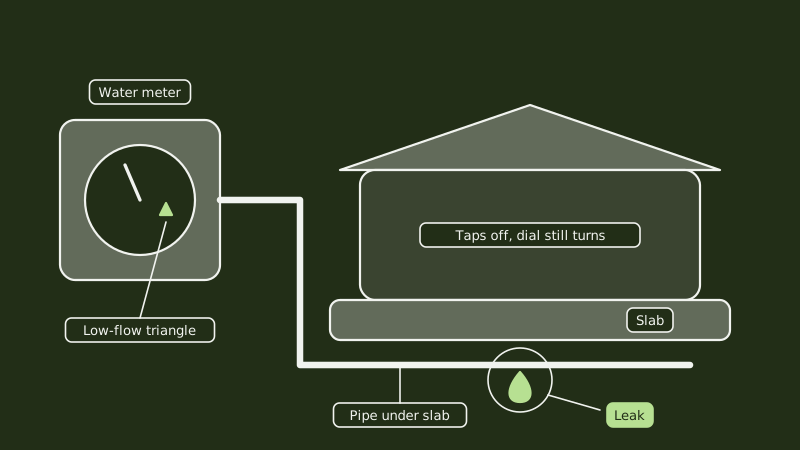
Picture a supply line running through the gravel and concrete under your floor, with a pinhole in it. Nothing drips onto the carpet, yet water is leaving the system around the clock. That is a slab leak, a quieter relative of a burst pipe. Fixing one means proving where it is, then picking among three repairs, and the price depends mostly on that pick.
Is the water meter telling you something is wrong?
It is the best first test. Shut every tap and appliance, the ice maker and sprinklers included, then watch the dial or low-flow triangle on the meter. If it keeps turning, water is escaping somewhere between the meter and your fixtures. A leak under the slab is one candidate, and a running toilet or a garden line are two others to rule out.
Other clues point the same way. Other signs include a bill that grows while your habits stay put, a faint trickling sound at night, a patch of floor that feels warm underfoot, damp baseboards, and pressure that fades. A warm spot suggests a hot line, but radiant heat, ducting or a water heater beside the wall can warm concrete too, so treat it as a lead and not a verdict.
Not every Santa Ana house is built over a slab. Many postwar tract homes are, while the 1920s and 1930s bungalows in neighborhoods such as Floral Park more often stand on raised floors with a crawl space beneath. Your foundation type tells a plumber where the pipes probably run.
How is the leak pinpointed without tearing up the floor?
A plumber listens before cutting. Acoustic gear hears escaping water through concrete, electronic locators follow the metal pipe's route, and a thermal camera shows warmth from a hot line. Combined, they can narrow the leak to a patch the size of a dinner plate, so the hole that follows, if there is one, stays small.
Published prices for this detection step in Southern California are about $150 to $400, and some guides report more. It earns its fee. You learn whether the fault is really in the slab rather than in a wall or a fixture, and whether one line or several are failing. That second answer drives the repair choice, and it is why a quote for demolition without a detection report deserves a question.
What are the three ways to fix it?
You can open the slab and patch the pipe, abandon the leaking line and run a new one overhead or through walls, or replace the whole supply system. A fourth method, lining pipe with epoxy, suits some conditions only. The right choice follows from how many leaks exist, the pipe's age and material, and whether the floor can be reached.
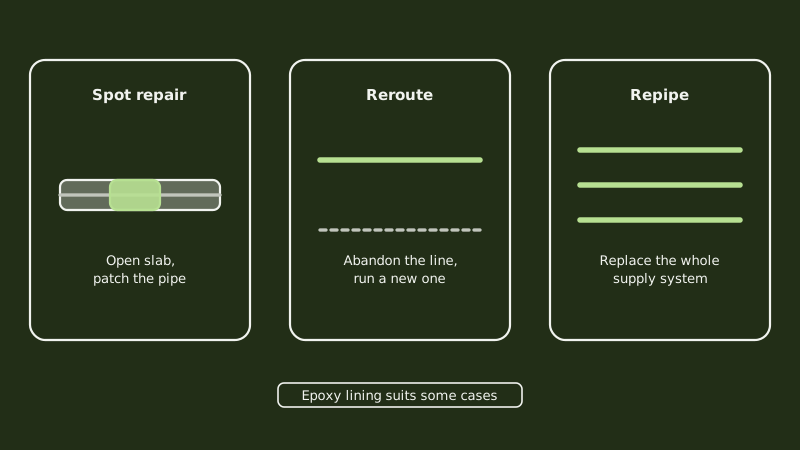
A spot repair is quickest and cheapest on paper, but a line that has failed once under concrete can give way again a short distance along. Rerouting skips the concrete, which helps with repeat leaks and hard-to-reach slabs. When the metal is worn throughout, as aging copper can be, a repipe is the sensible answer. Alongside this page, slab leak repair or repipe sets out when each wins, and PEX versus copper compares the pipe you would use for new lines.
What do the published prices look like?
National and Southern California guides do not agree exactly, so read these as a spread. Detection tends to run $150 to $400. Patching through the slab runs roughly $500 up to $4,000. Rerouting starts near $1,500 and reaches about $7,500 on long runs. Epoxy lining ranges from $500 to $8,000. A whole-house repipe starts at $4,000 and may pass $15,000.
| Method | Published spread | What pushes it up |
|---|---|---|
| Locating the leak | $150 to $400, some higher | More lines to test |
| Patch through the slab | $500 to $4,000 | Depth, finished flooring |
| New line overhead or in walls | about $1,500 to $7,500 | Length, wall and ceiling repair |
| Epoxy lining | $500 to $8,000 | Pipe condition, how much is lined |
| Whole-house repipe | $4,000 and up, past $15,000 | Bathrooms, house size |
Restoration is the hidden line item. Putting back tile, wood or carpet over a broken slab can rival the plumbing bill, so ask whether floor and concrete repair are in the figure. The mechanics of the largest option are described in the price to repipe a house.
Does insurance help?
Possibly with the damage, rarely with the pipe. California homeowner policies commonly respond to a sudden, accidental failure and exclude slow corrosion and wear. They tend to cover wrecked flooring more readily than the cost of reaching or fixing the leaking line. Policy wording differs, so call the insurer before work begins.
Keep records: photographs, the plumber's report on cause and location, and the failed length of pipe if one is removed. How claims usually go is described under insurance and burst pipes. Only your insurer can say what your own policy covers.
Why do pipes under a slab leak at all?
Common causes are corrosion, abrasion from concrete or gravel as pipes flex with temperature, a defective original joint, and ground movement. In Santa Ana the tap water carries roughly 250 parts per million of hardness, according to the city, and a plumber may weigh water chemistry as one factor among several.
Old copper can pinhole. Some houses built between the late 1970s and mid 1990s were plumbed with polybutylene, a plastic with a record of failure, and those owners should read about polybutylene pipe replacement. Pressure matters as well: persistently high pressure wears every pipe, so a plumber on site will often test it, and may suggest checking the regulator.
What do you do right away?
Close the main water valve if water is visible or the meter is racing, and call a plumber. Keep the main closed until someone has looked. Lift rugs and furniture off wet floors and mop up. Gas is a separate matter: any smell means everyone leaves, and you call from outside rather than waiting for a plumber to arrive.
The gas number is 1-800-427-2200 (SoCalGas), with 911 for immediate danger. Gas pipe is never a homeowner repair. Where water has reached outlets or the panel, stay away and cut power only if the switch is dry and reachable.
Which contractor may do it, and does the city have a say?
Slab leak repair is plumbing contractor work, classified C-36. A contractor license is compulsory for any job totaling $1,000 or more in labor plus materials, or needing a permit, and slab work nearly always qualifies. Check the license number in the state's online lookup before anything starts, and get the scope written down.
Rerouting and repiping normally need a permit from the city building office where the home stands. For Santa Ana that is the City of Santa Ana Building Division, and other Orange County cities run their own. Ask who applies for it, and whether the price covers drywall, concrete patching, flooring and cleanup.
Common questions
Is there a way to fix it without cutting the concrete?
Sometimes. A line run overhead or inside walls bypasses the slab entirely, and lining works from access points on the pipe. Whether either fits depends on the pipe and how many leaks it has. A single leak at a known point is often easier to reach by cutting a small opening.
How many days will the repair take?
Locating the leak can be finished in a morning. A patch commonly needs a day, plus drying time for concrete and flooring work. Rerouting and repiping stretch from a couple of days to most of a week depending on house size. A realistic schedule comes once the method is chosen.
How much water does a hidden leak waste?
That varies with the size of the break. Small ones can run for months, and the first hint is often an odd bill. Meter checks with all taps off show whether the loss is continuous. Even a slow loss accumulates across a billing period, so do not sit on it.
Does every slab leak count as an emergency?
Urgent, yes, but not always an emergency. Close the main when water is spreading and arrange a plumber promptly. A slow loss spotted by the meter can wait a short while without going ignored. A gas smell, electrical risk or flooding means act immediately.
To get a leak located and priced, use the quote page. More plumbing topics sit behind the Santa Ana Plumbing Co home page.
Sources
- Published slab leak detection and repair prices from national and Southern California cost guides, checked November 2026
- Southern California plumbing publishers, slab leak warning signs and detection methods, checked November 2026
- City of Santa Ana Permits Counter
- City of Santa Ana, water quality FAQ (hardness about 250 ppm)
- California Contractors State License Board
Last updated