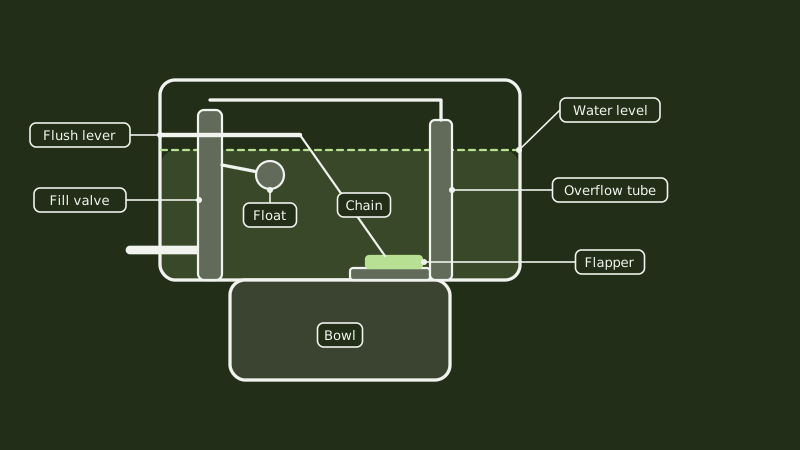
Three small parts account for almost every toilet that never shuts up: the rubber flapper that plugs the tank floor, the float that tells the tank when to stop filling, and the fill valve that does the filling. Each swaps out in under an hour for a few dollars. A repair that goes beyond parts is described on our page about toilet repair in Santa Ana.
How can you tell which part is failing?
Lift the lid and look and listen. A stream pouring down the central pipe says the level is set too high. If the tank keeps topping itself up between flushes, the flapper is letting water slip into the bowl. A steady hiss with the level low says the fill valve is worn. Most cases show themselves within a minute.
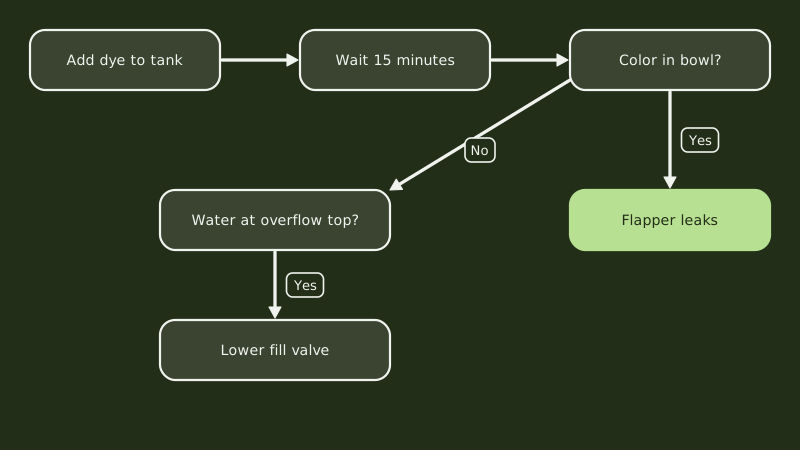
For proof, follow the EPA's dye test: add a little food coloring to the tank water and leave the toilet unflushed for ten minutes. Tinted water in the bowl exposes a flapper leak. Then drain the tank and run a finger around the flapper seat. Grit, slime or a pitted edge shows why the seal fails, and it can ruin the next flapper too.
| What you notice | Likely culprit |
|---|---|
| Water flowing into the central pipe | Float or fill valve set too high |
| Tank refills now and then, no flush | Leaking flapper or dirty seat |
| Steady hiss, tank slow to fill | Worn fill valve |
| Handle sticks down, water roars | Chain too short or handle binding |
| Puddle around the base of the bowl | Wax seal or tank bolt, not the flapper |
How do you swap out a leaking flapper?
Shut the little valve on the wall, flush until the tank empties, then unclip the old flapper from the pegs on either side of the overflow pipe and unhook its chain. Match the replacement to the old one, clip it in, and attach the chain with a small amount of slack. The EPA says flappers should be replaced at least every five years.
Chain length is the usual mistake. Too short, and it holds the flapper up. Too long, and a loop slips under the flapper and blocks it. Allow two or three links of slack. In Santa Ana the water carries about 250 parts per million of hardness, which is roughly 15 grains per gallon according to the city, so crust tends to coat the seat. A nonabrasive scrub pad restores a smooth surface. Photos and a part-by-part view are in our flapper repair guide.
How do you lower the water level and fix the fill valve?
Find how your float works. A cup rides up and down the fill valve's shaft, so slide it lower. A ball float hangs from an arm, which you gently bend or turn at a screw. The target is a water line about an inch under the top of the overflow pipe. If lowering the level changes nothing, the fill valve itself has failed.
For a fill valve, close the wall valve, empty the tank and undo the supply nut beneath it, then lift the old unit out. Seat the new one at the height marked on its stem, snug the nuts by hand with a quarter turn more, and test it. Older houses in Santa Ana, especially bungalows from the 1920s to 1950s, can still have a brass ballcock with a metal arm. A modern fill valve fits those tanks and improves on them.
Could a cracked overflow pipe be the reason?
Yes. If the central pipe has a crack or the flapper seat is chipped, water slips into the bowl faster than the tank can fill, and the valve never reaches its shutoff point. A pipe cut too short does the opposite. Both belong to the flush valve assembly, and the cure is replacing the whole assembly.
That job is bigger than a flapper swap because the tank lifts off the bowl. A kit is cheaper than a visit if you are comfortable with that. Rusted tank bolts or brittle old porcelain are good reasons to pass this one to a plumber. The details are in the overflow tube repair guide.
What does a running toilet waste in water and money?
Older EPA consumer material credits a leaking toilet with about 200 gallons of waste a day, and the current Fix a Leak page says a worn flapper can lose thousands of gallons a year without a sound. Water and sewer charges both ride on that volume. A bill that has crept up for no clear reason is a cue to test your toilets before anything else.
For a whole-house check, write down the meter reading, keep every fixture off for two hours, then compare. A moving meter means a leak. Toilets are the commonest source, but irrigation lines and buried pipes can mimic them. Other suspects are listed in high water bill causes. Houses on a slab can hide leaks under the floor, where a plumber's leak detection comes in.
At what point should a plumber take over?
A plumber is the next step if fresh parts have not cured it, if the wall shutoff will not close, if water seeps from the base of the bowl, or if the tank is cracked. None of these is a part you can buy and drop in. They point to a failed flush valve, a seized shutoff or a bad seal.
A shutoff that turns stiffly deserves replacing during the visit. If you force it, the stem can snap and leave you unable to isolate the toilet. A rocking bowl or sewer smell suggests the wax ring or flange has failed, which calls for lifting the toilet and resetting it. Age matters too, and with a very old toilet the plumber can say whether repair is still worth it. The numbers for a replacement are on the toilet installation cost page.
Describe the toilet through the quote page, and a local plumber will price the repair in writing.
Common questions
Why does the toilet kick on for a few seconds when nobody has flushed?
A slow leak from tank to bowl is the usual reason. The tank level sinks a little, the fill valve wakes up and tops it off. People call it a ghost flush. The dye test confirms it. The remedy is a new flapper and a cleaned seat. A hairline crack in the overflow pipe can produce the same pattern.
Is it all right to jiggle the handle until it stops?
It works because jiggling frees a flapper that has stuck open, but think of it as a warning light. The chain may be snagged, the flapper may have warped, or the handle linkage may be rubbing. Between jiggles, water is probably leaking. Fix the root cause with a chain adjustment and a fresh flapper.
What do the parts cost?
A flapper, a fill valve or a flush valve kit typically costs a few dollars up to around $20 at a hardware store. Bringing in a plumber adds labor plus a call-out fee, which is why parts-only repairs are the cheap route for anyone handy. Replacing the whole toilet is a larger spend, covered on our install cost page.
Does a running toilet count as an emergency?
Usually not: it wastes water and raises the bill but does not flood the room. Close the valve on the wall to silence it until repair day. If water spills over the rim or across the floor, close that valve straight away and phone a plumber.
More plumbing help sits behind the Santa Ana Plumbing Co home page.
Sources
- U.S. EPA WaterSense, Fix a Leak Week (worn flappers, food coloring test, replace flappers at least every five years)
- U.S. EPA WaterSense, Fix That Leak (a leaking toilet can waste about 200 gallons a day)
- City of Santa Ana, water quality FAQ (hardness about 250 ppm)
- Toilet repair guides from plumbing publishers and parts makers, checked November 2026
Last updated