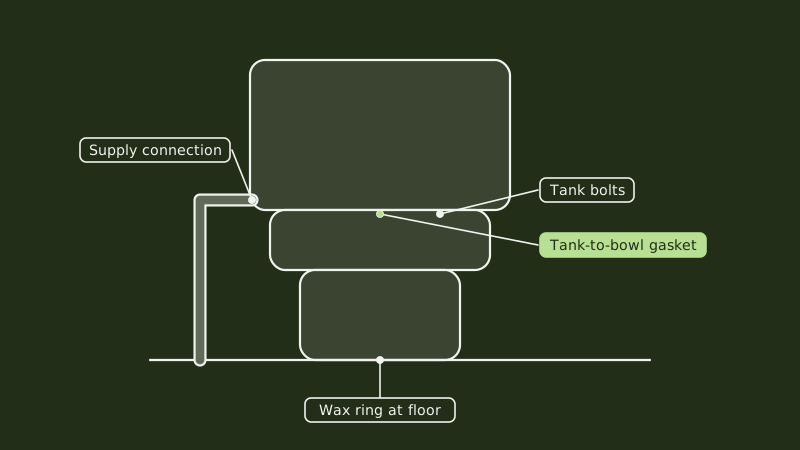
A leaking toilet gets repaired by finding where the water first appears and fixing that joint: a loose or worn supply line, a tank bolt or gasket, or the wax ring seal under the bowl. Dry everything, put dry paper around each connection, and see which turns wet first. Plenty of these repairs suit a careful owner. Our wider page on toilet repair covers the visit side when it does not.
A tank that keeps refilling is a different fault, covered on its own page. Here the concern is water outside the fixture, on the floor.
How do I trace which joint is wet?
Dry the bowl, tank, supply hose and floor with a towel. Then tuck strips of tissue by the supply fitting, beneath the tank bolts and around the foot of the bowl. Give it an hour, flushing a few times, and note which strip darkens first. Wetness only at the foot normally means the seal under the bowl has failed.
Where water shows up points to its source:
- Wet at the wall valve or on the hose: a supply connection or the stop valve packing.
- Drips below the tank or at the bolt heads: a worn gasket or washers.
- Wet around the base, mostly after flushing: the wax ring or flange.
- Beaded wet over the whole outside of the tank: condensation, which is not a leak.
- Wet along a visible crack: a split in the porcelain, which cannot be mended.
Do not forget tank sweating. On a warm, humid day a cold tank gathers droplets that run to the floor. If the tank feels cold and the puddle appears evenly along its base on muggy days, you may be looking at condensation, and an anti-sweat liner or a mixing valve is the fix.
What if the water comes from the supply hose or the wall valve?
Shut the stop valve, flush the tank down, and give the compression nut or tank-side coupling a quarter turn. A hose that still weeps is cheap to swap for a new braided one. A valve weeping at its stem may respond to a gentle nudge on the packing nut, and otherwise needs replacing.
Take care when tightening. Plastic fittings on the tank strip easily, and a nut cranked too far can crack the tank. Use a rag under the connection to catch the drip while you work. Reconnect, open the valve slowly, and let the paper test run for another hour before declaring it fixed.
An old, stiff shutoff valve is a common reason people postpone this job. A valve that refuses to close all the way means shutting the main for the whole house, then bringing in a plumber. The valve itself is dealt with in our note on replacing the toilet stop valve.
How is a leaking tank gasket or bolt sorted out?
Empty the tank. Work the bolts that hold it to the bowl in small, even turns, switching sides each time. If seepage continues, new rubber washers or the large gasket between the tank and bowl come next. Porcelain cracks if you overdo it, so stop once the tank sits snug, level and still.
A new gasket kit is cheap. For that swap the tank comes off the bowl, and ceramic is heavy and awkward, so line up a helper. Place the old tank on a towel, clean the seats on the bowl and tank, fit the new gasket and bolts, and tighten gradually.
If the leak stays after new parts, look for a hairline crack in the tank or bowl. A cracked ceramic piece cannot be mended with sealant for long. Replacement is the answer, and the cost side is covered under toilet installation cost.
How can I tell the wax ring has given out, and how is it changed?
Water pooling at the foot after a flush, a bowl that wobbles, or a whiff of sewer near the floor all point to the wax ring. The job goes like this: water off, tank and bowl emptied, toilet unbolted and lifted aside, old wax scraped off, new ring and closet bolts fitted, toilet lowered back into place. Two people make it safer.
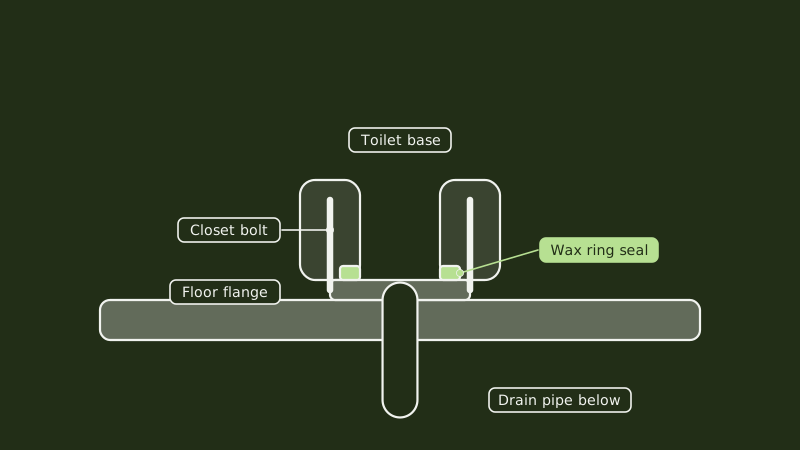
The wax ring seals the toilet outlet to the drain flange on the floor. If the flange is broken, rusted or sits below the floor surface, a fresh ring will not hold. Check the flange when the toilet is off. A damaged flange needs a repair kit or replacement, which is a plumber's job when it touches the drain.
Warning signs that call for a pause. Spongy flooring near the base, or dark staining on the subfloor, shows the water has been getting out for a while. A bathroom in an older Santa Ana house can lose a floor section to months of seepage, turning a plumbing fix into carpentry too.
While the toilet is off, stuff a rag into the open drain so sewer gas stays down, and never leave the opening bare. If lifting the toilet is more than you can manage safely, leave it to a plumber.
At what point does a plumber need to take over?
Bring one in for a cracked fixture, a damaged flange, a seized valve, a bolt that will not turn, or a soft floor. Do the same if new parts have not stopped the water. The plumber resets the toilet, examines the flange, repairs the supply, and tests before leaving.
A toilet reset sits well below the $1,000 line in labor and materials where CSLB guidance says a California contractor license is required, though rebuilding a floor can cross it. Whatever the size, ask for the price in writing, and ask whether wax rings and flange parts ride along so a single visit can finish the work.
If water escapes quickly, shut the stop valve and switch the water off at the main if needed, then use the quote page to request a visit. The matching page on running toilets covers faults inside the tank. If the leak is slow but constant, according to the EPA, leaks cost the average household upward of 9,300 gallons a year, so even a steady drip deserves prompt attention.
Common questions
How much of the day will a leaking toilet job take?
A hose or valve swap runs about thirty minutes, and a gasket and bolt kit around an hour. A wax ring costs more time because the whole toilet is lifted and reset, commonly one to two hours, and more if the flange or floor needs attention.
Which questions should come first when I call about a toilet leak?
Get the license number, then confirm it on the state licensing site. Check whether the price covers the wax ring, bolts and hose, whether the flange gets inspected, and how floor damage would be handled. Get the figure on paper, and see the toilet tested before the plumber leaves.
Should I be home when the plumber arrives for the toilet?
Yes, since the plumber needs the bathroom and the water shutoff, and it helps if you watch the closing flush test. Before the visit, lift rugs and bath mats away from the toilet so they do not get soaked, and clear a path.
Will caulk around the base stop the leak?
No. A bead of caulk can mask a bad seal and hold water under the toilet, where it rots the floor. Fix a leaking base with a fresh wax ring. Caulk belongs at the end, as a finish once the seal is known to be sound.
For the wider picture, start with plumber in Santa Ana.
Sources
Last updated