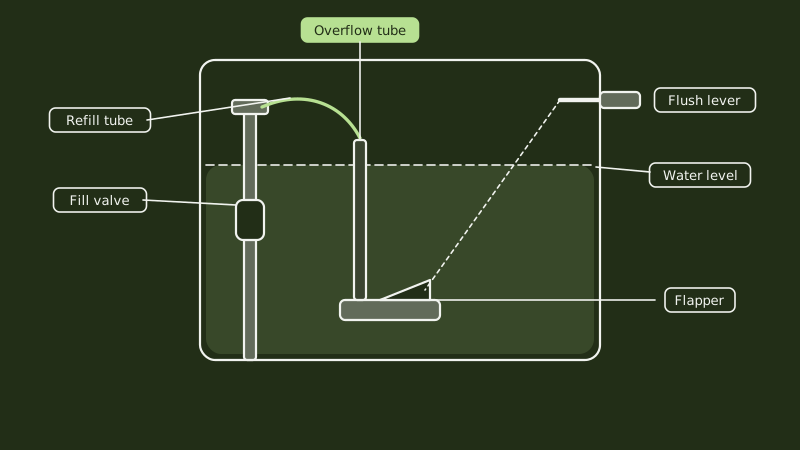
Look inside the tank and you will see a vertical pipe near the flapper. That is the overflow tube. It has two jobs: it sends runaway water to the bowl should the fill valve ever stick open, and it forms part of the flush valve that the flapper seals against. Faults here cause running toilets that a new flapper does not cure. For the wider list of toilet problems, start at toilet repair in Santa Ana.
What does the overflow tube do, and how does it fail?
The tube sets the maximum water level in the tank. Water that rises above its open top spills down it into the bowl, which keeps the tank from overflowing onto the floor. The tube is usually plastic, and it can crack, warp or break at its base. Mineral scale or a loose connection can make it leak where it meets the tank.
A cracked tube lets tank water slip into the bowl below the normal level, so the fill valve keeps refilling. A tube cut too low makes the tank fill only partly. A tube that has come loose from the flush valve base leaks where it joins. Often the symptom is a toilet that runs on its own every few minutes, which looks like a flapper fault until the flapper is replaced and nothing changes.
How do you check the overflow tube?
Close the wall valve, lift the lid and study the tube in good light. Look for hairline cracks, a chipped top edge and gaps at the base. Then try a dye test: tint the tank water with food coloring, give it about ten minutes unflushed, and see whether the bowl picks up any tint. If the flapper and its seat are fine, a crack may be the leak path.
Also check how far the water rises. A line marked inside the tank often shows the intended level. The fill should end roughly an inch under the tube's rim. Water that climbs to the rim and pours in means the float or fill valve is set too high, and the tube is only doing its safety job. Float and valve adjustments are covered on the page about a running toilet.
Do not rule out the refill tube yet. A slim hose runs from the fill valve into the top of the tube so the bowl gets topped up after each flush. If it has slipped out and sprays into the tank, or sits below the water line and siphons, it will cause strange running noises.
How do you fix the refill tube or the water level?
Reattach a loose refill hose with its small clip, keeping the hose end above the water line and not shoved deep into the tube, and trim the hose if it kinks. For the level, slide or bend the float until the fill stops a little under the tube's rim.
Both are tool-free jobs. A cup-type float slides down its rod, and a ball float adjusts by a screw or a bend in the arm. A fill valve that still overfills after adjusting is worn out. Replacing a fill valve involves disconnecting the supply, but the tank stays on the bowl. It costs little more than a flapper and takes around half an hour.
Can you repair a cracked overflow tube, or must you replace the flush valve?
A cracked overflow tube is normally fixed by replacing the whole flush valve, since the tube is built into it. Temporary patches with epoxy putty exist, but they are unreliable for a part that sits underwater and carries a flapper seat. On most toilets the kit is inexpensive and the work fills a morning, not a day.
A new flush valve also gives you a fresh flapper seat and a new tube at the right height, so it often ends running problems that several smaller repairs did not. Most kits include a fresh gasket between tank and bowl, and it should go in. The next section walks through the job.
How is a flush valve replaced?
Close the water, flush the tank empty, sponge out what is left and detach the supply line. Undo the tank bolts from below, lift the tank clear, and spin off the big plastic nut beneath it that holds the old valve. Drop in the new valve, tighten its nut by hand, fit the new gasket, set the tank back and tighten the bolts evenly.
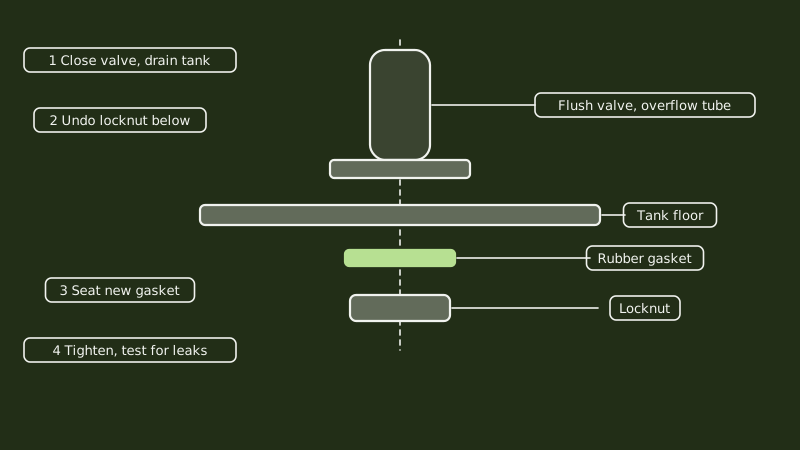
Take care at each stage. Porcelain cracks when it is overtightened, so tighten the tank bolts gradually, swapping sides, and stop once the tank sits level and firm. Use the washers that come with the kit, and check that the flapper chain has slack. Turn the water on slowly, let the tank fill, and flush several times. Check the tank-to-bowl joint and the supply nut for drips, wiping with a dry paper towel.
Set the overflow tube height to the maker's instructions. Many valves have a telescoping tube that you cut or twist to the right height. An overflow tube set too high can let water spill over the tank edge before the tube takes it. One set too low leaves you with a half-filled tank and a weak flush.
What do the parts cost and which toilets are worth repairing?
A flush valve kit usually costs a modest amount, and a fill valve, tank bolts and gasket together cost little more. The question is whether the toilet is worth it. If the porcelain is sound and the bowl is not cracked, a flush valve repair gives it years more life. Very old or leaking toilets may be better replaced.
Santa Ana's housing includes plenty built between the 1920s and the 1950s, and some still have toilets from decades ago, with tanks that are heavy and bolts that are corroded. Corroded bolts can snap or round off when you try to remove them, which makes the job harder. If that happens, stop and phone a plumber rather than forcing it. Hard water, at about 250 parts per million according to the city, also builds scale on bolts and fittings. For replacement prices, the page on having a plumber install a toilet lists published ranges.
When should a plumber do it?
The job moves to a plumber when tank bolts are seized, the tank itself has a crack, the shutoff valve will not turn, the floor feels soft or water seeps from the base. Each of those is larger than an overflow tube problem. A plumber can also confirm whether the fault is the tube, the flapper or the fill valve.
Handing it over starts on the quote page. For smaller faults, the flapper repair guide and the page on toilet flush repair may save the call.
Common questions
Why is water running down the overflow tube?
Two things cause it: an over-high float setting, or a fill valve that never closes. Water that reaches the top of the tube spills into it and flows to the bowl. Lower the float and, if that does not help, replace the fill valve. The tube is working as designed, and the fault lies elsewhere.
Can I fix a crack in the overflow tube with epoxy?
You can try it as a stopgap, but it is rarely reliable. The tube is submerged, flexes and carries a flapper seat. A better fix is a new flush valve, which costs little and takes up to a couple of hours. If you patch it, check it often and plan to replace it soon.
How high should the overflow tube be?
The tube should be about an inch above the water line when the tank is full, and it should be at the height the toilet maker specifies. If it is too short, tank water spills into the bowl. Many replacement valves adjust to fit, and the kit's instructions set the exact height.
What is the small tube attached to the overflow tube?
That is the refill tube. It carries a little water from the fill valve into the overflow tube to refill the bowl after each flush. Its clip sits on the tube's top edge and its end stays above the water line. If it slips off or sits too low, the toilet can hiss or run.
For more on what we cover, go to the Santa Ana Plumbing Co home page.
Sources
- U.S. EPA WaterSense, Fix a Leak Week (toilet leak checks, dye test)
- City of Santa Ana, water quality FAQ (hardness about 250 ppm)
- Flush valve and overflow tube installation instructions from toilet parts makers and plumbing publishers, checked November 2026
Last updated