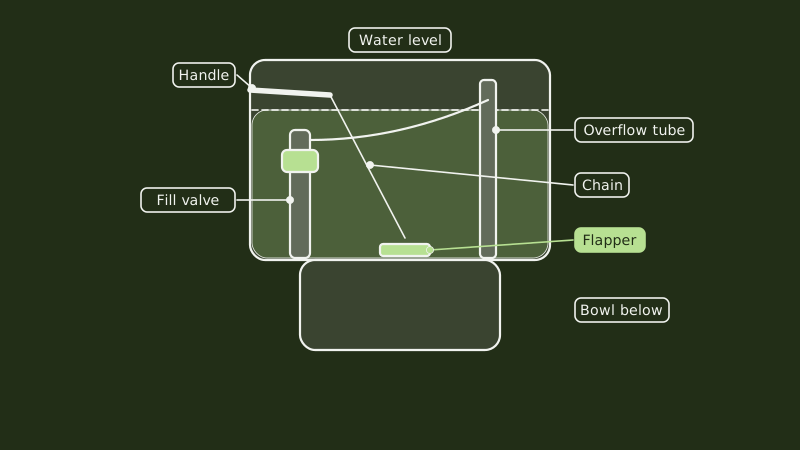
Lift the tank lid and flush once while you watch. What the rubber, the chain and the float do in those ten seconds explains nearly every flush complaint. A hiss that never ends belongs to the flapper or the fill valve. A feeble swirl belongs to the chain or the water level. A handle that flops belongs to the lever. Most fixes are small parts, and the toilet repair page covers when a plumber should step in.
Four parts do the work in a standard tank: the handle with its lever, the chain, the flapper over the big outlet at the bottom, and the fill valve with its float. Wikipedia's description of the flush toilet uses the same vocabulary, so a part name you meet at the hardware store will match.
Why does the toilet hiss or refill again after every flush?
Water is escaping past the flapper, so the tank refills again and again. The flapper may be warped, may be held open by a taut chain, or may be sitting on a crusty seat. Clean the seat, give the chain a little slack, and replace the flapper when its rubber feels soft or distorted.
The EPA says most toilet leaks come from old or worn flappers, and it advises swapping them no less often than every five years. A leak of this kind can be silent. Squeeze a little dye into the tank and leave the lid off for ten minutes without flushing. Color that reaches the bowl proves the leak. Flush as soon as you have looked, so the dye does not tint the tank.
Two other culprits cause the same noise. The water level may be climbing to the lip of the overflow tube, which tells you the fill valve is failing to shut. Or the chain may have slipped under the flapper and propped it open. Companion reading: fixing a running toilet and why a toilet bowl keeps running.
What if the flush valve seat is the real culprit?
Should a brand-new flapper still leak, inspect the ring it presses against. That ring is the flush valve seat. Pitting, scale or a hairline crack there prevents any seal. Light crust comes off with a non-scratch pad. A damaged seat means replacing the whole flush valve, and that is a larger undertaking than a flapper swap.
Replacing the valve involves closing the wall supply, emptying the tank, and on many models unbolting the tank from the bowl. The new valve goes in with fresh gaskets, and the bolts are snugged down in turn, never cranked, because porcelain cracks under uneven force. When the bolts are seized or the tank is awkward to lift, hire the job out.
Hard water matters here. Santa Ana's own water quality FAQ puts hardness near 15 grains per gallon, and mineral scale accumulates on seats and rubber. That may shorten the life of a flapper compared with soft water. Wipe the seat each time you swap one, and the new rubber has clean ground to seal on.
Why is the flush weak, or why does the handle feel wrong?
Look at slack in the chain first. If the chain is long, the flapper closes before the tank has emptied, and the flush stops short. If it is too tight, the flapper never settles. Then check the handle: a loose nut inside the tank makes it spin freely, and a bent arm makes it stiff.
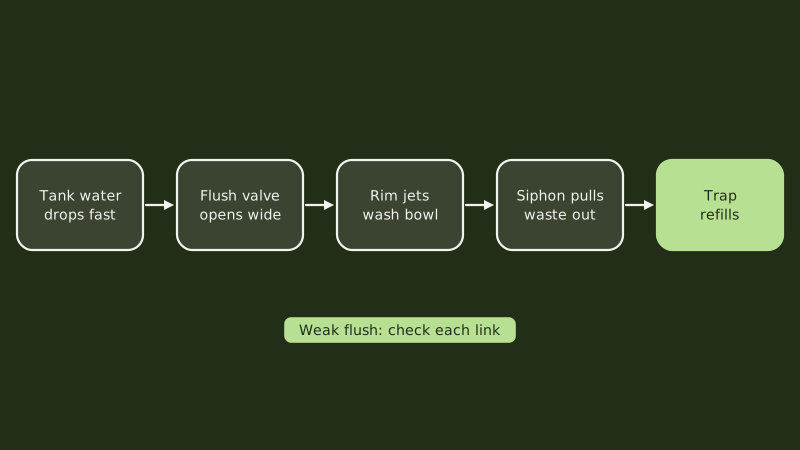
A cracked plastic handle simply unscrews, and the replacement costs little. Do not force a stuck nut. Porcelain around the handle hole is fragile.
A flush that begins strongly and then fades can point away from the tank. Partly blocked rim holes under the bowl lip, or a sluggish drain, steal flow from the siphon. Our guides on toilet flapper repair and on replacing the flapper gasket cover the swaps people attempt most.
How do I adjust or replace a toilet float and fill valve?
Set the float so water stops roughly an inch beneath the rim of the overflow pipe. Most modern fill valves have a screw, clip or sliding cup for this. If the valve keeps trickling at the right level, or sputters, or sings, its seal is worn and the whole valve is replaced, usually in under an hour with basic tools.
Older toilets carry a ball float on a metal arm. Newer ones use a cup that rides up and down the valve stem. Before reconnecting a new valve, run a little water from the supply line into a bucket, so grit that has collected there does not lodge in the fresh seal.
The shutoff valve on the wall deserves a glance as well. If it is stiff or weeps when turned, it is its own repair, described in toilet shut-off valve repair, and swapping it at the same visit saves a trip.
At what point should a plumber take over a toilet flush repair?
Call one when water seeps at the base, the tank leaks at its bolts, parts are seized, or the flapper and fill valve are new and the toilet still runs. Any wet floor deserves quick attention because moisture under flooring costs more than the toilet. Lifting a toilet is also a two-person job with a wax ring to replace.
A tired toilet that keeps eating parts may be better replaced. Under the EPA's WaterSense label a toilet may use no more than 1.28 gallons a flush, 20 percent under the 1.6 gallon federal standard. A leak-prone older model can waste more than that saving. Prices for a swap are covered under toilet installation cost.
Water on the floor from the base, rather than the tank, is a separate problem and a separate page: repairing a leaking toilet.
Common questions
What if the flush valve keeps leaking after I clean it?
The seat is probably pitted or cracked, or the valve is mismatched to the flapper. Dye in the tank will confirm the leak. If it persists with a fresh matching flapper, replace the whole flush valve, or hand it to a plumber, because the seat cannot be repaired once it is damaged.
Can I fix the toilet handle on my own?
Yes. A handle swap or chain adjustment needs a wrench at most, and the water can stay on if you do not remove the tank parts. Go slowly with the nut, because porcelain chips easily. If something will not budge, stop there and bring in a plumber.
How much time should a flush repair take?
Adjusting a chain or fitting a new flapper typically takes under half an hour. A fill valve is usually under an hour. Replacing the entire flush valve is longer, often an hour or two, and anything that means lifting the toilet adds more time. Expect a firmer figure once a plumber has seen the toilet.
What job does the toilet float do?
This part floats on the tank water and signals the fill valve to shut off. Set too high, water runs down the overflow tube and the toilet keeps filling. Set too low, the tank is short of water and the flush is weak. Small adjustments often fix both.
For the wider picture, start with plumber in Santa Ana.
Sources
Last updated