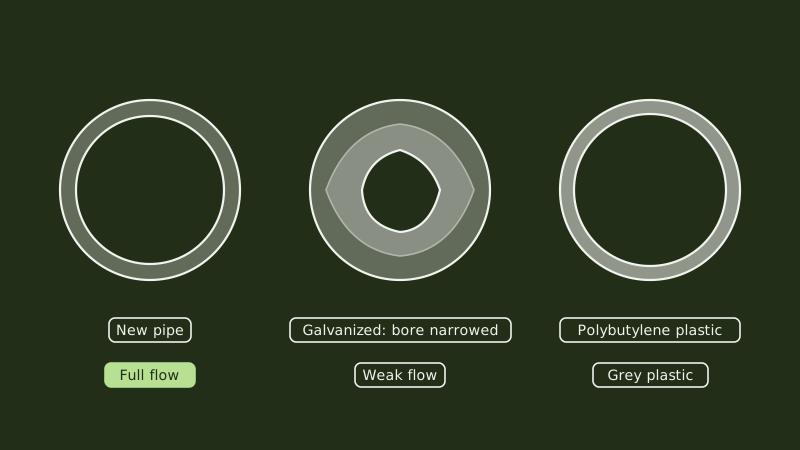
Replace galvanized pipe when it is rusting from the inside, narrowing, staining the water or leaking at joints, and replace polybutylene before it fails because it tends to fail without warning. A whole-house repipe, say the published cost guides, falls somewhere between four and fifteen thousand dollars, with a schedule of one day to a week depending on the material, and a city permit is part of the job. There is no active manufacturer program that pays for polybutylene replacement today.
Choosing the new pipe, PEX or copper, belongs to our house repiping with PEX page. Here the subject is the old pipe: spotting it, how a job unfolds and what Santa Ana houses tend to need. For a written price, go to the quote page.
What does galvanized pipe look like?
Galvanized supply pipe is dull gray steel with threaded joints, often with orange or brown rust staining at the fittings. A magnet sticks to it, unlike copper, and a scratch reveals silver-gray metal. It was standard in houses built before copper took over, so it turns up in plenty of Santa Ana homes from the twenties up to the fifties.
Check wherever pipe is exposed: beneath the floor, around the water heater, inside the garage or near the meter. Signs it is wearing out:
- Brown or rust-colored water at the tap, especially after the water has sat unused.
- Weak pressure at several fixtures together, since rust and mineral build-up narrows the bore.
- Leaks at threaded joints or small weeping spots, which tend to return after a patch.
- Reduced flow when two fixtures run together.
Galvanized pipe fails slowly from the inside, which is why the outside can look fine while the bore is half closed. Hard water adds to the scale, and the City of Santa Ana reports hardness near 250 parts per million. The wider picture for an old house is in what redoing an older home's plumbing costs.
What is polybutylene, and does a payout program still exist?
Polybutylene is a flexible plastic pipe that was fitted in several million houses across North America from about 1978 to the mid-1990s. Chlorinated water attacks the pipe and its fittings from the inside, causing leaks and sudden splits. The class action settlement that once helped fund replacement closed its claims in 2009, so no fund is open today.
The case was Cox v. Shell Oil, settled in the mid-1990s with commitments of roughly $950 million, according to published accounts. Claims windows ran until 2009 and then closed. Be wary of any company that says it can still file a polybutylene claim for you; I could not find an open program and would treat such an offer as a warning sign.
What remains is the practical choice: replace the pipe on your schedule, or wait for a leak and replace it on the leak's schedule. Wikipedia's summary notes that the only lasting fix is replacing the plumbing throughout, since the damage happens inside the pipe where you cannot see it. Look hardest at houses from that window. Our page on polybutylene replacement and the one on what polybutylene replacement costs go deeper.
When a seller disclosure, an inspector or an insurer has flagged polybutylene, have a plumber identify the pipe inside the walls before you commit to anything.
What will replacing galvanized pipe cost?
Across cost guides, a full repipe is listed anywhere between $4,000 and $15,000, and the national average is nearer $7,500. In a house of around 2,000 square feet, PEX frequently comes to $4,000 through $10,000, and copper to $8,000 through $18,000. Galvanized houses lean toward the top because pulling old pipe takes labor, and slab houses cost more again.
One guide quotes urgent galvanized or polybutylene jobs at $3,000 to $8,000 with permit and city inspection folded in, which suits a small house with easy access. Plan separately for wall repair: drywall, ceiling or floor patching can add $1,000 to $5,000, and a repipe contractor often leaves patching to a drywall trade.
What changes the price:
- Pipe material. PEX is generally cheaper than copper. Our PEX versus copper page compares them, and the PEX A or B guide covers the grades.
- House size and number of bathrooms.
- Access. Open crawl space is easier than plaster walls or a slab.
- What else is replaced: shutoffs, fixtures, a pressure regulator, a water heater connection.
- Permit and inspection.
Published figures are national. For local numbers, see what it costs to repipe a house, then get a written bid on your own house.
How many days does a repipe take?
PEX usually takes one to five days, depending on house size and access, and copper takes three to seven, because every joint is soldered. A lived-in house or plaster walls add a couple of days. The taps go dry for stretches of each day, and the drywall patching often follows a few days later.
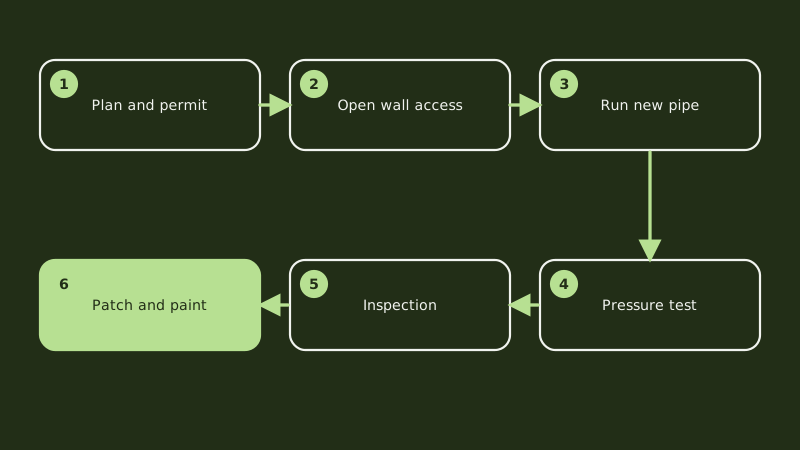
Realistic timeline for a typical Santa Ana home:
- Day 1: shutoffs, layout, cutting access holes, running new lines.
- Days 2 to 3: connecting fixtures, pressure testing, the city inspection.
- Afterward: patching and paint, usually by another trade.
Find out from the contractor for how many hours the water is shut each day and whether you should sleep elsewhere. Move breakables and clear the spots where holes will be cut. The full process is described in how a house gets repiped.
Does a repipe have to be permitted?
Yes. Santa Ana wants a permit before anyone installs, alters, repairs or replaces a regulated plumbing system, and a repipe replaces the entire supply system. The contractor normally takes out the permit, the city inspects, and the cost shows on the quote. California also ties permitted work to a contractor license.
The City of Santa Ana's Building and Safety Division handles permits inside the city. If your home is in a neighboring city, a different department applies. Unpermitted repipe work can cause trouble at sale or with insurance, since an inspector may ask for the permit number.
A repipe is far beyond the $1,000 labor-and-materials line below which the contractor board lets small jobs go without a contractor, and permitted work is never exempt. Run the license number through the board before signing. The steps appear in pulling a plumbing permit.
Should I patch a section or redo the whole house?
Patch when a single section failed and the rest tests sound. Repipe when pipe is failing in several places, pressure is poor everywhere, or the material itself is the problem, as with polybutylene. For a leak under the slab, a reroute through the attic or walls is sometimes an alternative to digging.
Weigh a few things before choosing:
- Two or more leaks in a few years usually mean more are coming.
- Galvanized with rusty water and low pressure rarely improves with patches.
- A leak beneath concrete raises its own question, handled in slab leaks, and when a repipe beats a repair.
- Plan the repipe before major remodeling, so walls are opened once.
A plumber can run a pressure test and look at the fittings to judge whether a repair holds or a repipe is the better value.
Common questions
Is old galvanized pipe a health risk?
Not in itself. The usual troubles are rust, low flow and leaks. Very old galvanized pipe can add lead from its coating or fittings, and lead in drinking water is a health concern, so arrange a water test if the house has old pipe and young children. New pipe settles the question.
Is a partial replacement possible?
Yes, though joining new pipe to old galvanized calls for dielectric fittings to limit corrosion at the connection, and the remaining old pipe keeps aging. A partial job works for one bad section, or as a bridge while you save for a full repipe. Ask the plumber which stretch will fail next.
Does home insurance pay to replace polybutylene?
Rarely. Policies tend to cover sudden water damage from a burst but not the cost of replacing the pipe, and some insurers ask about polybutylene when writing a policy. Put the question to your insurer, and see what insurance says about burst pipes.
What is normally in a repipe quote?
New supply lines to each fixture, new shutoffs, water heater connections and a pressure test, plus the permit and inspection in most quotes. Drywall repair, paint and fixture replacement are often separate, so get in writing what is included and who patches the walls.
Do I have to move out while the pipes are replaced?
Usually not, although the supply is interrupted for part of each day. Many contractors work in stages so you have water overnight. Expect noise, dust and access holes in the walls. With small children, a medical need for running water or pets, plan to stay elsewhere for the heaviest days.
Other pipe and repair work we arrange appears on the Santa Ana Plumbing Co home page.
Sources
- Wikipedia, Polybutylene (years installed, chlorine degradation, Cox v. Shell Oil)
- Wikipedia, Cross-linked polyethylene (PEX types)
- Published accounts of the Cox v. Shell Oil polybutylene settlement and its 2009 claims close, checked November 2026
- City of Santa Ana, When is a Permit Required?
- Published whole-house repipe cost guides (PEX and copper, 2026), checked November 2026
- California Contractors State License Board, AB 2622 minor work limit
Last updated