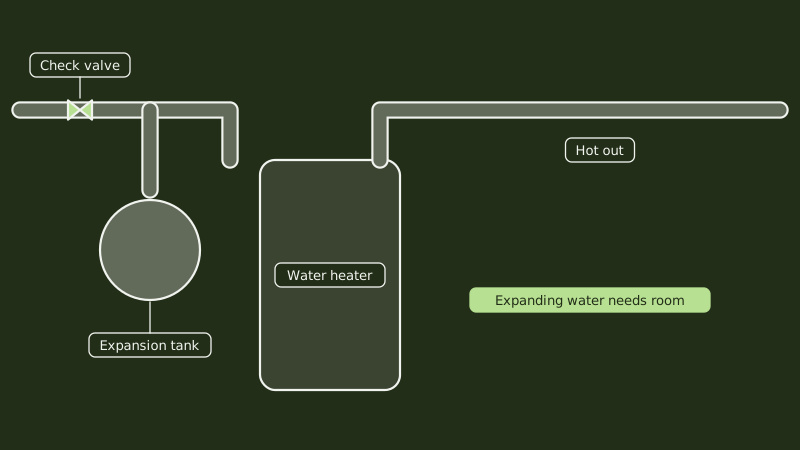
A thermal expansion tank is a small pressurized tank, usually mounted on the cold water pipe at the water heater, that gives expanding hot water somewhere to go. Replace it when it has failed: water comes out of the air valve when you press it, the tank feels full and heavy, or the relief valve keeps dripping. A swap generally takes less than an hour. The heater this tank serves is covered on our water heaters page.
Wikipedia's water heater article lists two safety parts: a relief valve that opens on excess temperature or pressure, and an expansion tank that absorbs pressure buildup. The tank protects the valve from constant work, so when it goes bad, the valve starts weeping.
What does an expansion tank actually do?
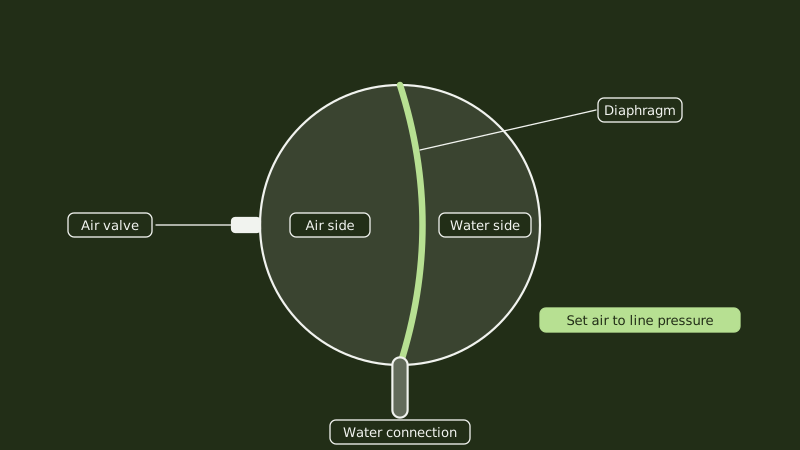
Water takes up more space when it is heated. In a plumbing system with a check valve, backflow preventer or pressure regulator, that extra volume cannot flow back into the street, so pressure climbs. The expansion tank holds it with a rubber diaphragm and a cushion of air, keeping pressure steady instead of letting it spike.
Without a tank, a closed system pushes pressure up each time the heater runs. The relief valve may open and weep, fixtures wear, and supply lines or the heater itself take strain. Plumbers describe the effect as pressure creep after every heating cycle.
Not every house needs one. An open system, with no check valve between the heater and the street main, can push the extra water back out into the city line. Many homes today are closed, because a pressure regulator or backflow device sits at or near the main. If yours has a regulator, our page on water pressure regulator replacement explains where that part lives.
How can I tell the expansion tank has failed?
Push the little valve on the tank, the same kind found on a tire. Water coming out means the rubber diaphragm inside has torn, and the tank is finished. Other clues: a relief valve that drips following each heating cycle, banging pipes, a gauge that jumps, or a tank that feels heavy.
Tapping helps too. Knock on the upper half of the tank, then the lower half. Air in the top gives a hollow note, and water below sounds dull. If the whole shell sounds dull, the air is gone or the tank is waterlogged. A gauge reading is the better test, because the tank's air pressure should equal the pressure in the house.
Industry guidance gives a normal range of 40 to 60 psi for homes, read from a gauge threaded onto an outdoor spigot or the laundry tap. Check the tank twice a year. For problems with the relief valve itself, see pressure relief valve replacement.
What size tank, and how is it set up?
Most single-family homes use a small tank sized to the heater volume and system pressure. The tank goes on the cold supply line to the heater, downstream of the shutoff valve and any check valve or regulator, on a tee fitting, and its air charge is set to match the home's static water pressure before it goes in.
That last point is where DIY goes wrong. A tank shipped with a factory charge may not suit your pressure. Measure the pressure, then set the tank's air with a pump while the system is relieved of pressure, because adjusting it under water pressure gives a false reading. Too high a charge keeps the tank from accepting water, and too low lets it fill instead of cushioning.
The tank should hang or be supported, with room for a fitting that stays reachable. A tank on an older unit with a short, rigid connection may need a support bracket to avoid straining the pipe.
The sizing question is the plumber's call, since it depends on the heater and the household. Ask for the tank model and size in the written quote.
How is an expansion tank replaced, and can I do it myself?
Shut the cold supply to the heater, relieve pressure by opening a hot tap, drain the short section, unscrew the old tank, and thread on the new one after setting its air charge. Then reopen the supply, bleed air at a hot tap and check the joints for leaks. The job is within reach for a handy owner, but gas or permit work is not.
Steps for a plumber, and what to watch if you try:
- Close the cold valve feeding the heater, and cut its power or gas.
- Open a hot tap, then open the tank's drain valve to drop pressure.
- Unthread the old tank where it screws into the tee.
- Bring the new tank's air up to the pressure you measured at home.
- Wrap the threads with sealing tape or compound and screw the tank on, supported.
- Reopen the supply slowly, bleed air at the hot tap, and check for weeping.
- Test with a gauge and watch the relief valve over the next heating cycle.
Hand the job to a plumber if the tank hangs from rigid copper, sits in a cramped spot, or needs soldering. The heater itself is also plumber territory. State law has residential heaters braced or strapped against earthquakes, and anyone working at the heater should look at the straps. If you replace the whole heater, a permit is needed in Santa Ana, as covered in water heater permits. Ask Building Safety whether a tank-only swap needs one.
What should an expansion tank replacement cost?
National 2026 cost guides put an expansion tank at about $150 to $300 installed, with some going as wide as $125 to $450. The tank itself often runs $30 to $200 in parts, and labor adds a modest amount. A tight space, a rigid connection or extra plumbing work pushes the price up.
Treat those as ballpark figures. A quote that bundles the tank with a heater replacement is common, because it takes little extra time. To see how the tank sits inside a bigger price, read about having a plumber replace the heater and heater replacement costs.
The written price should arrive before any work begins. CSLB tells homeowners to look the license number up online and to compare several bids. Ask whether the price includes setting the air charge and testing the relief valve afterward.
Common questions
What are the symptoms of a bad expansion tank?
Press the air valve. If water sprays or dribbles out, the internal diaphragm is torn and a new tank is due. A heavy tank that sounds dull when tapped, together with a relief valve that drips after heating, tells the same story, and a gauge that spikes while the heater runs confirms it.
What is the lifespan of an expansion tank?
No fixed figure applies. Many run for years, then fail when the diaphragm tears or the shell rusts. Test yours roughly twice a year by pressing the valve and tapping the shell, and renew it once water shows. A new heater is a sensible moment to renew the tank.
Why does my relief valve keep dripping?
Often because pressure is climbing with each heating cycle. A failed or missing expansion tank is a common cause, and so is high house pressure from a faulty regulator. A worn valve can also drip by itself. A plumber can test house pressure and the tank, then replace whichever part is at fault.
Is an expansion tank required?
It is needed wherever the plumbing is a closed system, meaning a check valve, backflow preventer or pressure regulator keeps expanding water from flowing back. Plumbing codes drive this, and the plumber can say whether your house needs one. With a new heater, ask if the quote covers the tank.
This guide is one of many on plumber across Santa Ana.
Sources
- Wikipedia, Water heater (temperature and pressure relief valve, expansion tank)
- Plumbing industry guidance on thermal expansion tanks and closed systems (Fresh Water Systems, ACDirect, others), checked November 2026
- Current Cost, water heater expansion tank cost and pricing guide (national figures, read November 2026)
- ProFindr, expansion tank cost guide 2026 (national figures, read November 2026)
- California Health and Safety Code section 19211, water heater bracing
- California Contractors State License Board, finding the right contractor
Last updated