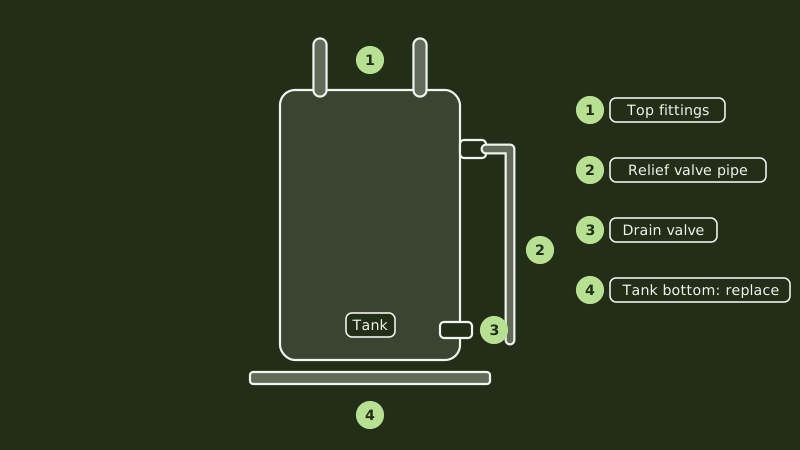
Start with three moves, and read the water heater overview after the water is under control: close the cold supply going into the heater, kill the power or turn the gas dial to off, and slide a bucket under the drip. After that, trace the water to its source. A weeping fitting or valve is usually a repair in the low hundreds of dollars. Water seeping through the steel shell means the tank has reached the end, so the heater gets swapped.
One visit from a local plumber settles which case you have, and the quote page starts that. In many Santa Ana houses the heater lives in the garage or a hall closet, so a slow leak can run for weeks unseen. If it points to replacement, our guide to tankless water heater installation covers the other type of unit.
What should I do right now when the water heater is leaking?
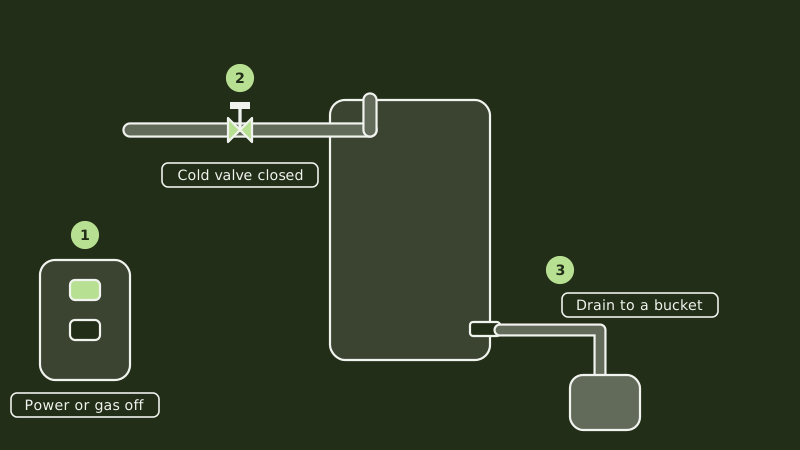
Close the cold inlet valve above the heater, trip the heater's breaker, or on gas turn the control knob to off, and let a hot tap run so the tank loses pressure. Catch the drip in a pan or on towels. Leave the drain valve alone unless you know where the hose will empty.
In more detail:
- Water. The cold supply pipe runs into the tank from above, and a lever or round handle on it shuts the heater off from the house. If that valve is missing or stuck, go to the main valve for the whole house.
- Power. An electric heater has its own breaker. Flip it before you touch anything damp around the unit.
- Gas. The control valve has a dial with an off setting, so turn it there. A gas smell changes everything: stop what you are doing, get outdoors, then call SoCalGas on 1-800-427-2200 from there. If people are in danger, 911 comes first. That is the utility's own advice.
- Pressure. An open hot tap lets the tank ease off, which usually slows the leak.
- Cleanup. Pull stored boxes back from the base and mop, so the floor and framing can dry out.
Water from a leak can be scalding. Keep children and pets away, and stay clear of the relief valve's discharge pipe while it is flowing.
How do I tell which part is leaking?
Match the wet spot to the part. Water at the top points to the inlet and outlet connections. Water at the side suggests the T&P valve or the pipe attached to it. Water at the base suggests the drain valve or, worse, the tank. Drips from the vent or burner area on a gas unit can be condensation.
Towel the heater dry, then note where the first bead of water returns.
| Where it drips | Likely cause | Typical outcome |
|---|---|---|
| Inlet or outlet pipe connection | Loose or corroded fitting, worn flex connector | Repair |
| Pressure-relief valve or pipe | Pressure above normal, thermal expansion, worn valve | Repair, plus a pressure check |
| Drain valve at the base | Valve seat worn, loose cap | Repair, as long as it is the valve |
| Pan fills from beneath the tank | Corrosion through the tank wall | Replace the heater |
| Water vapor or drips near the vent | Condensation from cold incoming water | Usually nothing |
| Puddle around the base of a gas unit | Tank leak or condensation | Needs a plumber to check |
From the outside, a leaky drain valve and a leaky tank look alike. One cost guide advises confirming the source before you accept a replacement quote, and I agree. Have the plumber point to the exact spot where water is escaping.
Is it worth repairing a heater that leaks?
Sometimes. Fittings, valves and connectors can be repaired. The steel body of the tank cannot, because corrosion works from the inside and leaves no sound metal to patch. After the tank wall fails, the whole heater has to be replaced.
The Department of Energy explains why tanks fail. A sacrificial anode rod inside the tank corrodes first so the steel does not, and when the rod is used up the tank itself starts to rust through. Poor water quality, high temperature settings and heavy use speed that up, and so do some softening methods. Thermal expansion on a closed system can also stress a tank, which is why the department recommends a correctly sized expansion tank in those cases. Our guide on anode rod replacement shows how that part works.
Energy Department material puts storage heater life at 10 to 15 years. When an older unit leaks from the tank itself, replacement is the answer. A young heater leaking at a joint is another story, and repair makes sense.
Hard water plays a role too. Santa Ana's tap water is very hard, with the city reporting around 250 parts per million. The USGS says heated hard water leaves calcium carbonate deposits that can shorten equipment life and cut efficiency. Flushing the tank, and treating the water, can extend the heater's life.
How much does a water heater leak cost to fix?
Cost guides give leak repairs a wide band of about $100 to $1,000 depending on the part, with a leak at a valve or fitting on top often at the low end. A relief valve swap commonly runs $150 to $300 installed. For an ordinary tank replaced after a leak, one guide shows about $875 to $1,800.
Treat those as national guides. Your quote depends on the part, the access and your code upgrades.
- Repair of a fitting, valve or connector: often $20 to $200 for a leak at the top, according to one guide.
- Relief valve replacement: about $150 to $300 installed. The part is a small share; the rest is labor.
- Full replacement: about $875 to $1,800 for a standard tank, higher for large or high-efficiency units and for jobs that need new venting.
- Add-ons: an expansion tank, drain pan and seismic straps can add to a replacement quote. Permits and haul-away add more, and one guide puts permit fees at $25 to $300.
For a full breakdown, see water heater replacement cost in Santa Ana. When the relief valve drips, the cause is often house pressure over 80 psi or thermal expansion, not a worn valve. That is why a plumber may test the pressure regulator and the expansion tank before replacing the valve.
Do I need a city permit for a new water heater?
In practice, yes. Santa Ana asks for a permit before anyone installs, replaces or alters a regulated plumbing system, and a water heater falls under that. The contractor usually obtains it and books the city inspection. A replacement also brings code items: seismic strapping, a pan or discharge pipe, and for gas units safe venting and connections.
California ties permitted work to a contractor license, so a handyman offering to swap the heater without one is outside the rules. Strapping matters in earthquake country: industry summaries of the California Plumbing Code describe two straps on a tank-type heater, the lower one above the controls. Look at the straps before the plumber leaves.
Gas piping and venting are regulated work. Do not try to reconnect a gas heater yourself. The paperwork is explained in the heater permit guide, and replacement timing for water heaters helps you judge your unit's age.
Common questions
Does a leaking heater need attention today?
Plan on it. A small seep at a fitting can sit for several hours with the supply closed, but a tank leak can release a great deal of hot water and ruin flooring and drywall. Shut off supply and power, then book a visit. A gas smell means leaving and ringing SoCalGas.
Can I keep the heater running while it drips?
I would not. A leaking tank can give out without warning, and water on a gas unit can disturb the pilot or burner. If you must run it briefly, check the pan every hour. The better choice is to close the supply, go a day without hot water and have it diagnosed.
Why does water collect on top of the tank?
Leaks up top typically come from the inlet or outlet connections, the flex connectors or a rusted nipple. Dry the area and spot the first drop. If a fitting is at fault, tightening or replacing it can end the leak. If water runs down from inside the jacket, suspect the tank.
How dangerous is a heater that leaks?
It can be risky in several ways. Hot water scalds, wet electrical parts shock, and a faulty gas unit adds fire and carbon monoxide worries. Shut off power or gas, and stay out of any puddle near wiring. A gas smell means exiting the building first and phoning SoCalGas outdoors.
Which tradesperson handles a leaking heater?
A plumber, since the job involves water piping, gas piping or both. Close the supply valve, then use the quote page or the phone number shown on this site during weekday business hours. We promise no response time, so the first job is stopping the water yourself.
Other repairs and installs we arrange around Santa Ana appear on the home page.
Sources
- U.S. Department of Energy, Energy Saver Guide (water heater life, anode rod, drain pan, expansion tank)
- SoCalGas, Natural Gas Leaks
- USGS Water Science School, Hardness of Water
- City of Santa Ana, When is a Permit Required?
- HomeGuide, water heater repair cost (leak repair $100 to $1,000)
- Phil Barnett Plumbing, relief valve replacement ($150 to $300)
- ConsumerAffairs, water heater repair cost (permit fees $25 to $300)
Last updated